You are currently browsing the category archive for the ‘theology’ category.

At my Unitarian Universalist church, we have a ritual every Sunday of lighting a candle of compassion, accompanied by a few words of meditation or prayer or our hopes for a better world–whatever you want to call it. Yesterday I served as the lay leader for the service and this is what I wrote when I lit the candle.
Each Sunday we light a candle of compassion for those in our community and around the world who are struggling or suffering. At this moment in history, the number of people who fall into those categories seems to be growing exponentially.
As UUs, we strive to cultivate equity, justice, and generosity, among other essential values. Meanwhile, a lot of people with a lot of power are working hard not only to remove these words from our shared vocabulary, but also to destroy their meaning and manifestation in our society. Which means we need to dig deep for compassion and hold tight to love. Our faith compels us to double down on kindness and refuse to abandon our commitment to our fellow humans.
It’s not always easy, though, as we bear witness day after day to selfishness, callousness, and utter disregard for humanity. So we must start by offering compassion to ourselves. We need to do what it takes to care for ourselves if we are to continue caring for others.
We share our compassion with all people who are isolated, persecuted, marginalized, or abused because of who they are or how they look or where they live or what they believe or their desire to be fully themselves. We hope for them mercy, relief, wholeness, and ease. We extend compassion to those who feel demoralized, devalued, and lost, and wish for them affirmation and encouragement and the understanding that something better is possible.
And, as we begin our celebration of pride month, may we offer our compassion to our LGBTQIA+ siblings and those who support them. We hope for them not just safety and belonging, but also love, and joy. We strive for a world where members of the queer community are not just accepted but authentically embraced.
May we extend compassion to all who need it, including ourselves.
Share this:

Inertia has me prisoner
Glued to the bed long after
I should have arisen
Captured by an invisible powerful pull
Sometimes I sleep.
My need is rarely satisfied.
Sometimes I glimpse the chaos and suffering of the world and
I have to disappear somewhere that it can’t reach me.
It may be cowardly but it’s true.
Most often I read novels.
For years and years all I read was realistic fiction but now reality is too painful
even if it’s fictional because I know at the heart of all fiction is truth.
Now my books are populated by wizards and witches.
Which makes me consider my own witchy tendencies and talents.
Witch has always been another word for a woman
Who stands on her own
Who knows things about people and the world
Who doesn’t care to conform
All of which is threatening to men
My books follow the paths of magical creatures who actually face human choices and consequences, or maybe they are universal choices and consequences
because we have no way of knowing
what goes on in the minds of vampires and demons
and there is plenty in the world
that we don’t have to see with our eyes
to believe in.
When I require a break from the plot,
I wade into an endless stream of crosswords,
a reliable source of immediate endorphins.
There I frequently encounter familiar characters such as Brian Eno and Uma Thurman and Che Guevara
and any of the King Olavs and Pope Leos and always a czar or tsar in the mix.
I spy many an imp, some tots on trikes, and French and Spanish ladies, both married and unmarried.
I often visit Erie (the lake, the city, and the county), I hear the echo of Caesar’s last words, many formulations of the Latin word for egg, and at least two ways to end a list.
I gaze at the bear in the sky and the guy with the belt. I am reminded of campaign slogans from before I was born and what to say when someone is sharing more than you want to hear and any number of Australian animals.
Occasionally, the two names of our current domestic terrorists come up,
even though I’m deep in the crossword archives when they were once
seemingly harmless rich idiots.
Harmless no more.
Eventually I am able to extract myself from the bed and go about my business
There are always more demands
on my attention
Than I can satisfy
Which is why the temptation
to hide under the covers
remains.
Share this:

You shared only your
smoothest prayers
sent them sailing
on the winter wind
through moonless night skies
from where you sit in the universe
to the small space
I occupy tonight
in an unfamiliar room
our momentary home
On their way
from you to me
they glided into the
open hearts of
all the gods and goddesses
who whispered them aloud
and with strong and
gentle hands
surrounded us
with love
Share this:

If we want to support each other’s inner lives, we must remember a simple truth: the human soul does not want to be fixed, it wants simply to be seen and heard. If we want to see and hear a person’s soul, there is another truth we must remember: the swoul is like a wild animal — tough, resilient, and yet shy. When we go crashing through the woods shouting for it to come out so we can help it, the soul will stay in hiding. But if we are willing to sit quietly and wait for a while, the soul may show itself.
~Parker Palmer
This is a talk I shared during a Sunday service at the Unitarian Universalist Church of Arlington as part of the church’s series on the six sources of Unitarian Universalism. My writing was inspired by this source: direct experience of that transcending mystery and wonder, affirmed in all cultures, which moves us to a renewal of the spirit and an openness to the forces which create and uphold life.
For two years I spent a good chunk of my waking hours talking and writing about this church. As a member of the ministerial search committee, I met with my fellow committee members weekly, and we worked doggedly to discern what the congregation needed in a new minister. Surprise–Unitarian Universalists have a lot of opinions! Our committee had to digest, synthesize, and transform what we learned into UUCA’s church profile, an incredibly elaborate version of a job announcement. Then we spent months reviewing applications and sermons of prospective ministers. This role and its attendant responsibilities were heady–and hard–and ultimately richly rewarding. It was a privilege to serve UUCA in this capacity, and if I’m being honest, it made me feel kind of important. It’s easy for me to make the mistake that what I do for a community is more valuable than who I am.
Now, raise your hand if you were part of UUCA in any way in the spring of 2020. You may recall that, just as our committee was preparing to recommend Rev. Amanda as the candidate for our senior minister, the pandemic shut everything down. All of our plans to introduce her to the congregation, celebrate a new beginning, and enjoy the fruits of our committee’s labor were funneled online or simply forgotten in the crush of a worldwide crisis.
I know every one of you here in the sanctuary or watching online has a story like this–or a very different one. There are likely a million variations on the theme of how things changed in 2020. Now, four years later, I am still feeling the effects of those changes, for better or worse. Maybe you are too. Who knows how long the ripples will expand throughout our lives?
Church has always meant community for me. Throughout my life, community often outweighed theology in my choice of a congregation. I feel lucky to have found in UUCA a place where I feel both a sense of belonging and alignment with the tenets of the faith. From the moment I arrived at UUCA, I felt seen. I felt valued. I understood that my being here mattered.
Unfortunately, for a good portion of the years since 2020, I lost that sense of belonging, not just here, but really anywhere. Does that sound at all familiar to you? The isolation of the pandemic was soul crushing. And I am a big believer in silver linings. I love my family so much, and I am so thankful for the hours we spent playing board games, watching movies, making art, and going on hikes. But the four of us did not a whole community make. I need different kinds of people and multiple communities to nurture various aspects of my personality and my identity. All of us do.
There’s a wonderful graphic novel series called Heartstopper, which is now an amazing Netflix show, that my kids adore and introduced me to and which I love now as well. First of all, Heartstopper creator Alice Oseman does a masterful job portraying the pain and beauty of making your way as a teenager, particularly as you come into your gender identity and sexual orientation. Secondly, in book four of the series, Charlie–one of the main characters–comes face to face with what feels like an insurmountable struggle. His boyfriend, Nick, wants so badly, as all of us do when we love someone, to be able to fix Charlie’s problem, but of course he can’t. And Nick realizes that, no matter how much he loves Charlie, he can’t and shouldn’t be everything to Charlie. Charlie needs a community to help him. As do we all.
I took baby steps to return to UUCA. I co-facilitated a covenant group for parents of gender-expansive kids. That was an easy one–a way to test the waters by creating a small community. Coming back to church on Sunday mornings, however, was a challenge. The first few times I tried, I felt confused and out of sorts. When we were all masked, I felt embarrassed because I didn’t recognize people who I had known for years. That kept me home for a while longer. When I came back again, I felt like I had somehow forgotten how to interact with other humans. Once after the service ended, I just sat in the back and cried. Holly saw me and sat with me. She didn’t ask me to explain myself. She just kept me company.
When I heard about the LEAD program that Greg and LeeAnn were running, I knew I had found a path back to community. I wasn’t sure what my role was supposed to be in the congregation, but this was an opportunity to meet new people and reconnect with old friends, so I took it.
The irony–or perhaps the true intention–of joining LEAD was being reminded that I didn’t need to have a leadership position or a particular responsibility in the congregation to belong. When I arrived for that first workshop, I was so warmly welcomed back. Wendy and Kristen, among other folks, let me know that they were genuinely delighted to see me again, without asking why I hadn’t come back sooner, or what I was going to be doing for the church now that I was back, or without any other expectations of me whatsoever. After the session, I gave Kristen a ride home and we sat in my car, parked outside her house, for an hour catching up. It was such a relief to renew that connection. I know I’m name dropping a lot this morning. I intentionally want to recognize the people who have shown me so much grace and love in building and rebuilding community here.
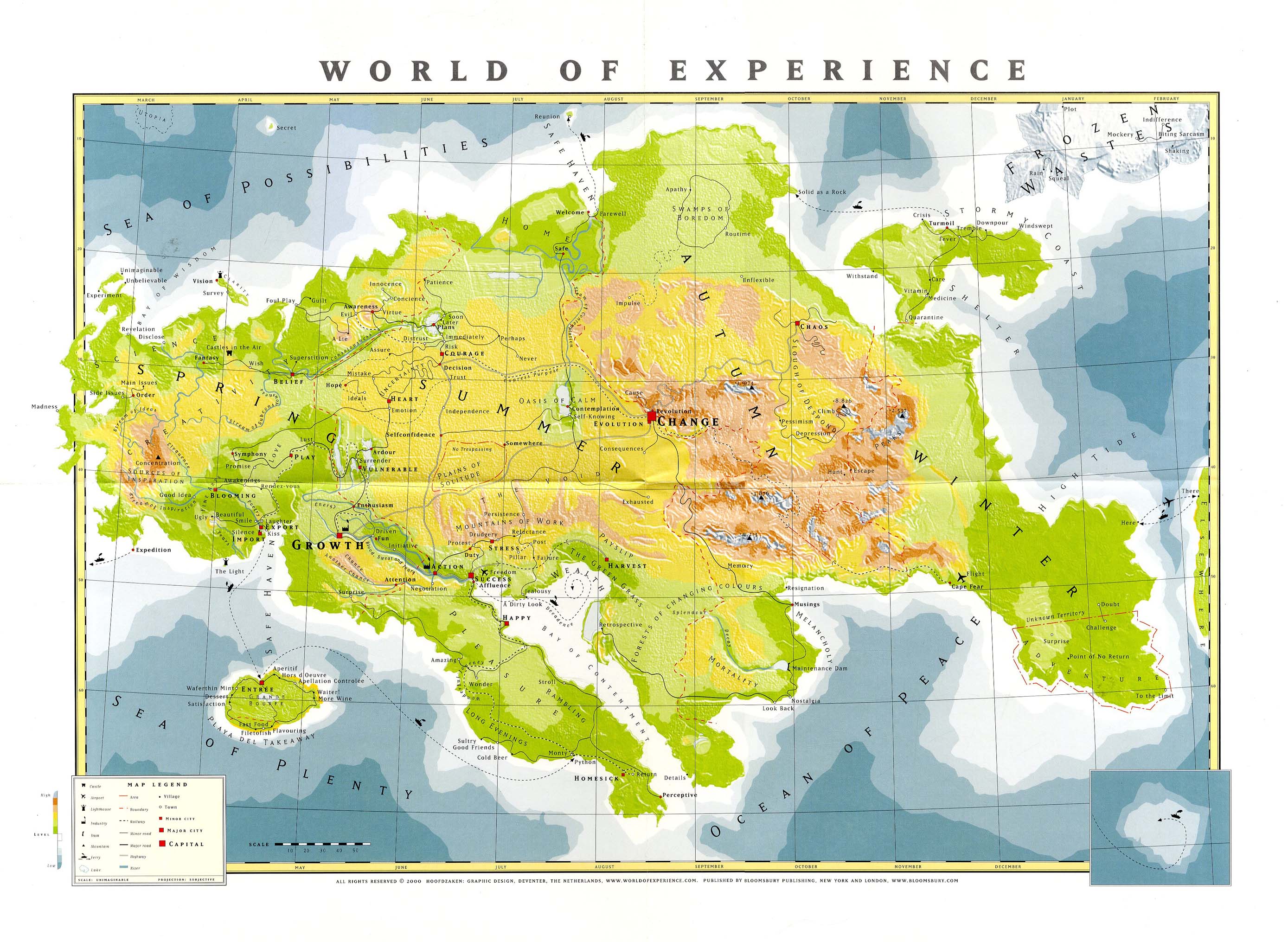
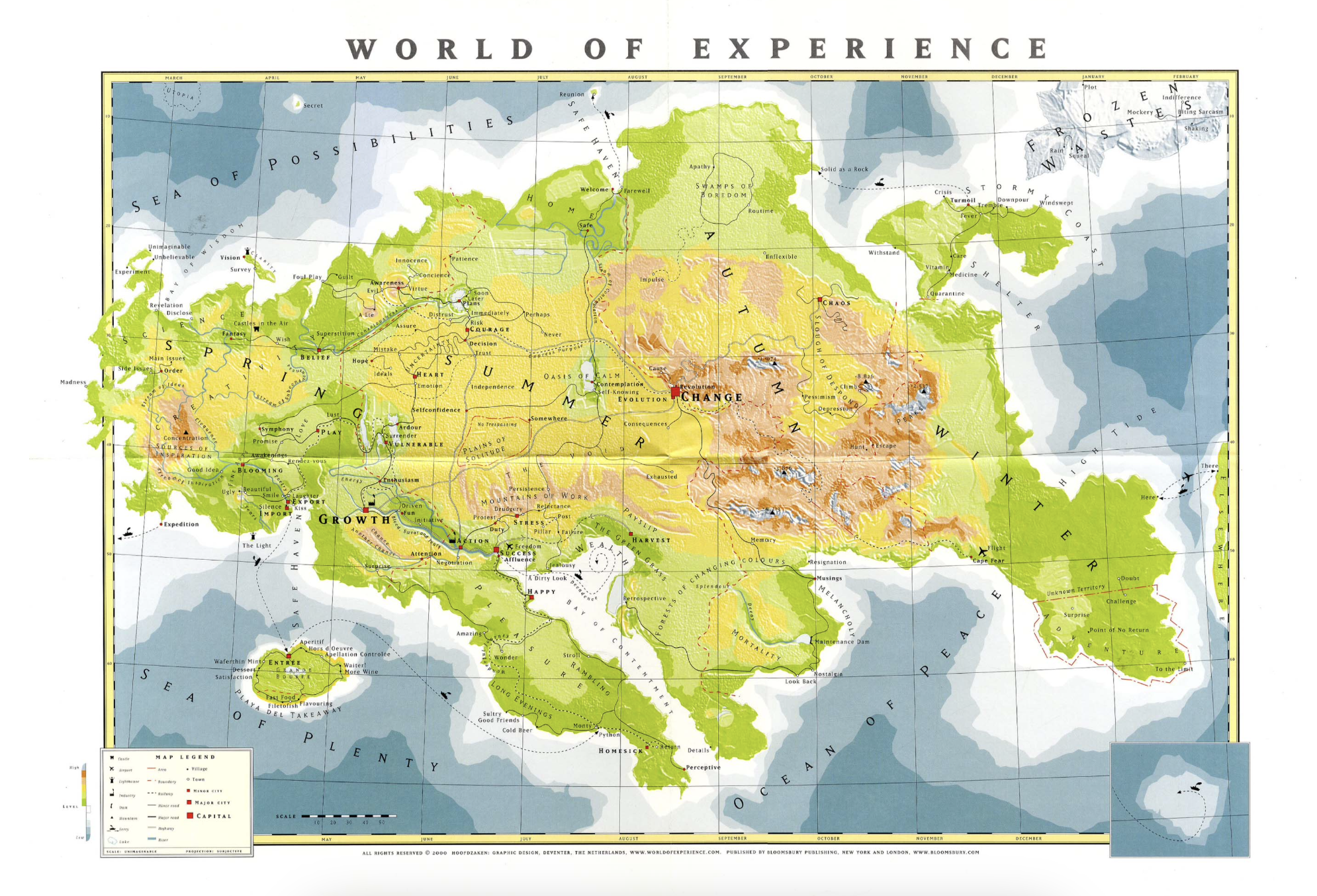
One of my favorite activities during the LEAD workshops was using the World of Experience as a tool to examine where I’ve been and where I want to go. If you’ve never seen it before, you can check out the World of Experience at the LEAD table in the fellowship hall after the service. In the meantime, picture this in your mind. A map that, at first glance, looks like it could be a two-dimensional representation of the Earth. On closer inspection, however, the familiar continents and oceans are replaced by other geographies, named for elements of the human experience. For example, the sea of possibilities, mountains of work, and plains of solitude.
On several occasions we used the World of Experience as a way to articulate the challenges or adventures in our past and present, and where we hoped to navigate in the future. In all of my conversations, my partners shared their journeys with unapologetic honesty, and invited the same vulnerability from me. The guiding principles practiced during the LEAD series were touchstones created by Parker Palmer and the Center for Courage and Renewal. One of these is “no fixing, saving, advising, or correcting each other.” In our type A problem solving culture, that’s a particularly tough one for many of us to follow, but it’s so important. Participating in the LEAD workshops reminded me that this congregation is a safe place for me, where my wild animal soul can show itself. That’s how I experience moments of mystery and wonder–when I feel truly seen and understood.
This year I attended General Assembly, the Unitarian Universalist Association’s annual gathering, for the first time. I had long wanted to experience GA, but to be honest I was also super anxious about it. When I arrived in Pittsburgh and checked into my airbnb, I texted Gay and Elizabeth. What am I doing here? I asked them. Of course, they were both kind and reassuring. I felt their hugs from 250 miles away. Then I arrived at the convention center, and I found Diane and Bruce and I knew everything would be ok. I had tacos with LeeAnn, and reconnected with folks who I first met at UUCA but who have moved on to other churches, and I made new friends. Knowing I was among so many people who share my UU values and commitment to repairing the world was exactly what I needed and hoped to experience at GA.
Of course, church is far from the only community that can nurture the soul. Some communities are intimate and some are vast but both can offer sustenance. My 16-year-old is a member of the seemingly infinite community of Swifties–devotees of pop star Taylor Swift. While her knowledge of Taylor Swift’s catalog and every minute detail of every concert on the Eras Tour may verge on obsessive, it is clear that she and other Swifties find joy and meaning in listening to the music, experiencing the music, and talking about the music with each other.
The community my 10-year-old thinks of as their second home is SMYAL, a DC-based organization that provides resources, connections, and activities for LGBTQIA+ young people ages 6 to 24. My kid has found kindred spirits, role models, and unwavering and unconditional support for their whole self. Their wild animal soul feels free to lead a dance party whenever they’re with their SMYAL peeps.
As Parker Palmer wrote, “If we want to support each other’s inner lives, we must remember a simple truth: the human soul does not want to be fixed, it wants simply to be seen and heard.” I am thankful to be a member of this and other communities where my soul can be seen and heard. Cultivating that kind of community–something greater than any of us individually, which can only be created with intention and love–is a sacred act. Sometimes we can build community, and other times we just stumble into it. We don’t always know where we will find community, or where we will experience that sensation of truly belonging, but we surely know it when we feel it. Some may call that providence, or divine intervention. To me, that certainty of belonging is a product of the mystery and wonder of the universe. Whatever you call it, I wish for you the comfort, safety, and nourishment of community, wherever you may find it. May it be so.
Share this:


I realized today that when friend after friend from church hugged me this weekend and said, “I haven’t seen you for so long! I’ve missed you! I’m so glad to see you!” that not a single one of them was trying to make me feel guilty about not coming to church or accusing me of being a bad friend. Every single hug was accompanied by genuine joy. Every single person made me feel loved and valued just for being me and for appearing right in front of them at that moment. I wasn’t required to do or accomplish or prove anything. They were just happy to see me because I’m me. And I was equally happy to see them. Now why is that so hard to believe? I’ve been letting that sink in all day.
While are long past the “stay in your bubble” phase of the pandemic, collectively and individually we’ve had to retreat into new bubbles, emerge from them, retreat again, and sometimes the bubbles just pop. There’s no more universal wisdom. I assume there is new science but if there is legitimate and agreed-upon public health guidance based on the new science, I sure haven’t heard about it. And so everyone has their own extremely specific ideas about what they should and shouldn’t do, although they might change from day to day or situation to situation, and they remain emotionally fraught. As of January 2023, every time you leave your house you have to take into account your tolerance for risk, the tolerance for risk of anyone you might be interacting with, and the house rules for anywhere you’re going to go. We’ve never been so aware of the fact that our behaviors can seriously affect others, even though we may still be unsure of exactly how.
Ever since I was a teenager, being part of a faith community has mattered to me. And because of my personality, my DNA, my enneagram type (two), or whatever other measure you might use, when I am in any community, I mean to make a difference. When I do not have a specific role to fulfill, I can feel lost and useless. I am not saying this is a good thing or a bad thing. It is simply how I have felt for most of my life. I have spent some amount of energy in recent years reminding myself that I am important not just for what I can do, but for just being me. You would think it would take the pressure off.

Being in a faith community can also be hard as hell. Yesterday I participated in a workshop at church for people who want to be–or already are–leaders in the church, about how leadership in a congregation should not simply be out of duty, but should be about. sharing our gifts with others to make the community better, and should include elements of holiness, joy, and fun. As Rev. Amanda jokingly reminded us, however, the challenge of church is that it’s made up of people. And people are human. And humans make mistakes. And sometimes church (or any other faith community) breaks your heart. She asked how many people had experienced that particular kind of heartbreak when the community you revere disappoints you. Most people raised their hands. I realized that every single congregation I’ve been a part of has broken my heart. I take that back–the church I attended in college did not at any point crush my spirit, but I’m not sure I was involved enough for that to count. I was part of the college ministry of the church for a few years and I don’t recall anything bad happening there. But four other congregations rocked by some kind of scandal or rift or bad behavior is plenty. Rev. Amanda said making the effort to repair and heal from the brokenness matters, and makes the community stronger. But it also requires a lot of courage and commitment to put yourself back into the fray.
In my current congregation, the Unitarian Universalist Church of Arlington, I was asked to be a leader soon after I arrived. I had come to the church warily, certain that I could not find a community where I both agreed with the theology and would be treated like I mattered. Immediately, I felt a sense of belonging. I served as a worship associate, helping craft and lead services. When the minister had to leave (i.e. heartbreaking experience #4), I was asked to help orient the temporary minister to her role until an interim minister was found. I helped the interim minister as a worship associate. Then I was asked to serve on the ministerial search committee to find a permanent minister. This was a two-year obligation that was beyond time-consuming and also incredibly rewarding. And just as we were concluding the search, the pandemic hit. Our new minister (the aforementioned Rev. Amanda) was called to a congregation that largely existed at that point as hundreds of little boxes in a zoom meeting. And then, my job was done. I tried to do zoom church for a while, but it made me too sad, for so many reasons. I did some church classes and workshops and meetings through zoom. Some of them were good. Some were frustrating because I had to do them from my bedroom, propped up in my bed, in an effort to find any semblance of privacy. There is no privacy in my house. I just got tired of it all. I’m an extrovert. Zoom is exhausting. There are no hugs.
At some point church reopened. Then it closed again. And reopened. I hate wearing a mask. I do it, of course, when called upon. But it still makes my face sweat and my glasses fog up unless I go through various machinations to adjust and readjust it. And I realized during the pandemic that I have a hard time understanding people speaking when I can’t see their mouths. I also realized I have a hard time recognizing people who are wearing masks, especially when I haven’t seen them for a couple years. So when I went back to in-person church for the first time in a while sometime last year, I felt so lost and confused. After the service I just sat in the back and cried. I felt like I had completely forgotten who I was or how to be with other people. It was awful.

I had dipped my toe in the church waters in the fall when I volunteered to co-facilitate a covenant group for parents of gender-expansive kids. I’ve remembered how satisfying it is to choose readings and music that make people think and feel. (See quotes sprinkled throughout this post.) Yesterday at the leadership workshop I remembered how, even though I cannot sit still for very long, I love being in a room with other humans who are trying to nurture themselves and use their spiritual gifts to do something good for their community. Tikkun olam! These are my people.
Today I went back to church for the service. I sat near the front where I love to sit. I wore my mask and had to adjust it and got a little sweaty but survived. More importantly, I listened to the wisdom lesson which was one of my all-time favorite children’s stories and beautifully illustrates what Unitarian Universalism is. I geeked out on the sermon about why the history and principles of the UU tradition matter and how we are still evolving and transforming, as individuals and as a faith. I sang hymns, some of which I like and some of which are just ok. And I hugged people. And they welcomed me. It’s been a while, but no one judged. My heart was full and I was home again. AMEN.

Share this:

- Does teenage angst have an evolutionary purpose?
- Why don’t people understand that it’s rude to have a protracted cell phone conversation in a confined public space?
- Why is it so hard for siblings to be kind to each other?
- Why aren’t all restaurants required to publish allergen information for their menu items on their websites?
- Why do so many products have soy in them?
- How do you find the right balance between teaching your kids to be independent and showing them what’s right?
- Why are there so many choices for anything you would possibly want to buy, at least in this country?
- How did someone invent the practice of applying hot wax to skin and ripping off the wax to remove hair?
- Why do dust and lint collect in little clumps? What makes them adhere?
- Why are certain words considered curse words while their synonyms are not? What makes something a bad word?
- What is the appeal of watching violence on tv or in movies?
- If it’s possible to have systems of law enforcement and criminal justice that are not needlessly violent, brutal, or corrupt, where did our country go wrong? Or were our systems doomed to fail because of the inherently racist founding of our nation?
- Why do some people feel threatened by LGBTQIA+ individuals?
- How are there people who have no books in their homes (but who could afford books)?
- Why are some birds extraordinarily colorful while others are just brown?
- Does anyone ever feel like they’ve figured it all out?
Do you have any answers?
Share this:

I give myself unlimited chances
and infinite wishes
That I can choose to grant
I cultivate curiosity
exchange skepticism for wonder
I create simply for creation’s sake
Offering the same opportunity to others
I draw with a thick black marker (chisel tip) the delineation between me and you
And I will shimmer and shine in my own space while you do as you wish in yours
Share this:

The truth is, I don’t want to have Thanksgiving without FG.
It’s not as if we would have physically been together this year, especially with COVID rampaging across the country, but we would have talked and texted and I would’ve sent her pictures of the food I made after consulting her about the right proportions of ingredients. Some of our family recipes are vague. For the stuffing, if it’s too dry you add more broth. If it’s too wet you add more dry ingredients. Every batch of stuffing is unique and special. I don’t usually make deviled eggs, but she made them perfectly. I was thinking about making some for tomorrow but I can’t call her for a reminder about whether or not she adds a little mustard in with the mayonnaise.
Today we had a wonderful surprise visit from two alpacas and a baby goat for my brother-in-law’s birthday. I would have loved to FaceTime FG during this encounter to see her reaction, which I know would have been expressive. I would print extra copies of the photos to send her at Christmas.
Every year I would choose one of my favorite novels that I’d read that year and I’d send her a copy for Christmas. Every February I would send her a valentine.
There is a picture of my parents and my kids and me with FG the last time we all visited, in early summer. It’s on my bulletin board above my desk and I look at it every day. It’s not the best photo of FG. Near the end of her life she had lost weight and her face changed shape. She seemed to be caving in on herself. I don’t think she was putting her teeth in most of the time. In the last few months she seemed to have aged 10 years. But I look at this picture anyway and look in everyone’s eyes and imagine what they were thinking and feeling at that moment.
I think FG was in some amount of pain then, even though she wouldn’t have said so to all of us. But she’s smiling as if she was happy we were there. That day when the photo was taken, she said something to me about when she would be able to come up to Virginia to visit again. I don’t know if she really thought that would happen or she was just talking. I would give anything to pick her up at the train station one more time.
I am thankful for so many people and so many things, but I am also broken-hearted this Thanksgiving. Not only because I miss FG, and I know other people I love are also desperately wishing she were here. But also for the family and friends of the nearly one and a half million people who have died from COVID. It’s hard to even comprehend. And I am heartbroken for the people I know who have lost a parent this year—whether from the coronavirus or another cause. Bethany, Bean, Melissa, Lee, Mark, Paige, Dave and Jim. And for the children and parents taken away from each other by our government at the US-Mexico border. And for the friends and family of George Floyd and Breonna Taylor and all the innocent people who were killed by police this year and over the centuries.
There are many more disasters and tragedies I could name, but I won’t. And of course there are just as many blessings and opportunities and fragments of goodness we’ve managed to cling to during these crushing circumstances. I will list some of those another time. For now I will just be thankful that I had FG in my life for 46 years. I hope she will be whispering in my ear when I make the stuffing to let me know when it looks just right.
Share this:

Never before
have I been asked
by so many people
to pray
This moment
must require
immense
energy
from all
of us
We understand
(at last)
how much
we are bound
up in each
other
Prayer
(to me)
is intention
not
transaction
So I breathe in
(deeply)
and breathe out
fully
and send
prayers
for
strength
courage
peace
relief
patience
healing
grace
calm
presence
Take what you need
and share
the rest
with
others
Share this:

In my closet hang 21 summer dresses in shades of blue and red and pink with flowers and stripes and paisley patterns. I usually wear them to church on Sundays and to meetings with clients and to plays. I have several pairs of strappy sandals with wedge heels to wear with the dresses. I like the kind of sandals that show off my toes because usually my toenails are painted some vibrant color with an impossible delicate design of daisies or something similar on my big toes, courtesy of the artisans at Nails 2000.
I am so not a girly girl. I hardly wear makeup and I haven’t blow dried my hair in decades and my typical outfit is a t-shirt and jeans–or in recent months–yoga pants. But it’s easy to dress up in the summer and it’s literally cooler. I don’t envy men who feel compelled to wear jackets and ties when it’s 80 degrees.
I suspect that this summer I won’t have any occasion to wear any of my dresses. I watched church this morning in my pajamas. All the concerts and plays have been canceled. All my meetings are online. And it doesn’t really matter what you wear online, as long as you’re clothed.
I recognize that none of this is a serious problem or anything worth complaining about when juxtaposed with the incomprehensible (and inexcusably somewhat preventable) suffering in the world right now. I understand that.
I only mention it because I spent hours cleaning out of closet yesterday and rearranging my clothes by season and seeing all my dresses reminded me all over again of what’s wrong with our world.
Seeing my dresses reminded me that the president told religious congregations to reopen their doors and return to services as usual, inviting their members to get sick and infect others or perhaps die. My church, like many others, has been holding services and offering programming online and will continue to do so indefinitely. In response to the president saying churches are essential, our newly called senior minister (who will join us in August) said to her current congregation, (I’m paraphrasing) you know who’s essential? Our people. That’s why we will not be gathering, because we want our people to stay healthy and alive. My dresses reminded me that the president does not care about people. While the New York Times ran a front page filled with the names of nearly 100,000 Americans who have died from coronavirus, on a weekend where we honor those who have died in military service, the president played golf.
Who knew my dresses were so fraught with meaning?

 You Ask a Lot of Questions