You are currently browsing the category archive for the ‘art’ category.
To celebrate Pride 2025, I’m writing about 30 of my favorite LGBTQIA+ authors and books that center queer characters. Reading builds empathy. Our world could use more.
Here are the first 10 of my 30 recommendations.
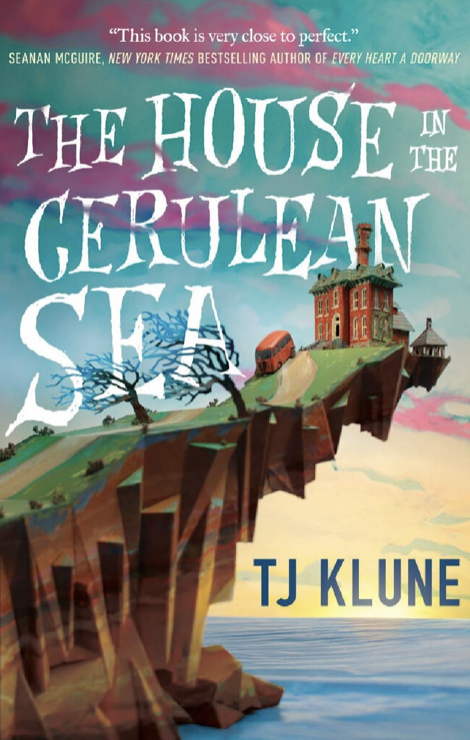
No. 1) TJ Klune https://www.tjklunebooks.com/
TJ Klune possesses a marvelous talent for creating characters–whether they are human or in any number of other fantastical forms–who immediately take up residence in your heart. His books are achingly good and I want to live inside them. I haven’t read all of them (yet) but I especially loved The House in the Cerulean Sea (and its companion) and the Wolfsong series.

No. 2) Becky Albertalli https://www.beckyalbertalli.com/
In a bookstore, you’d find Becky Albertalli’s books in the YA section, but I find that to be a meaningless way to categorize books. Certainly, many young adults like to read about other young adults, but we also encourage kids to read books about fighters in the French Revolution, and enslaved people, and old men in any number of settings. So I think books that happen to feature young adult characters can still appeal to and be relevant to readers of any age. Anyway, I love Becky Albertalli. I’ve read almost all her books (except the two that I just discovered on her website) and they are all compassionate and funny and sweet and teach me something about how to be a good and authentic human in a world that doesn’t always reward those traits.

No. 3) Laurie Frankel https://www.lauriefrankel.net/this-is-how-it-always-is.html
When I read this lovely book about a family whose youngest child expresses at age five that they are transgender, it was a couple years before my own child came out as nonbinary. I was inspired to read it because of other trans kids we knew, and the book proved to be sweet, heartbreaking, thought-provoking, and useful. Of course every individual’s story is unique, but unfortunately many of the challenges that gender-expansive kids face are common. I recommend this to anyone who has a child or was a child.

No. 4) Casey McQuiston https://www.caseymcquiston.com/
My daughter and I had the pleasure of seeing Casey McQuiston interviewed on their One Last Stop book tour by their best friend Sasha Peyton Smith and we’ve been smitten ever since. Casey’s books are smart, hilarious, and steamy and I would love to be friends with Casey in real life.
No. 5) Steven Rowley https://www.stevenrowley.com/about
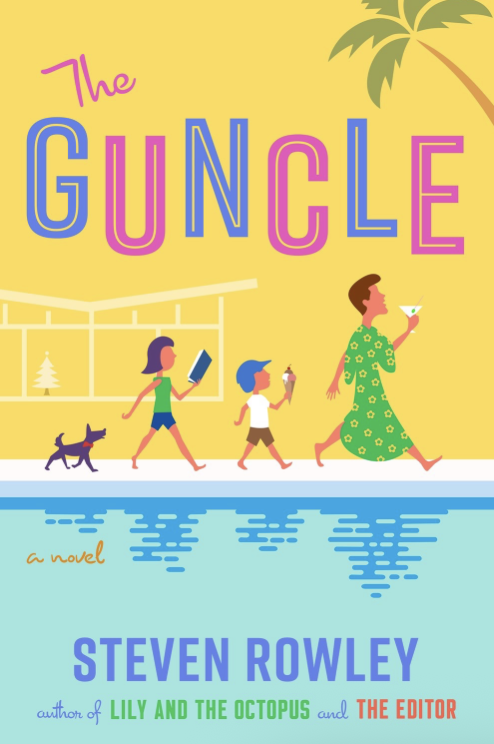
Steven Rowley narrates his own audiobooks in such an engaging and witty way that I expect him to call me on the phone to invite me to brunch at any minute. I adore his writing and his narration and I love how he talks about being gay in the context of family and all kinds of relationships, especially about what it’s like to be a “guncle.”
No. 6) The Civil War of Amos Abernathy https://michaelleali.com
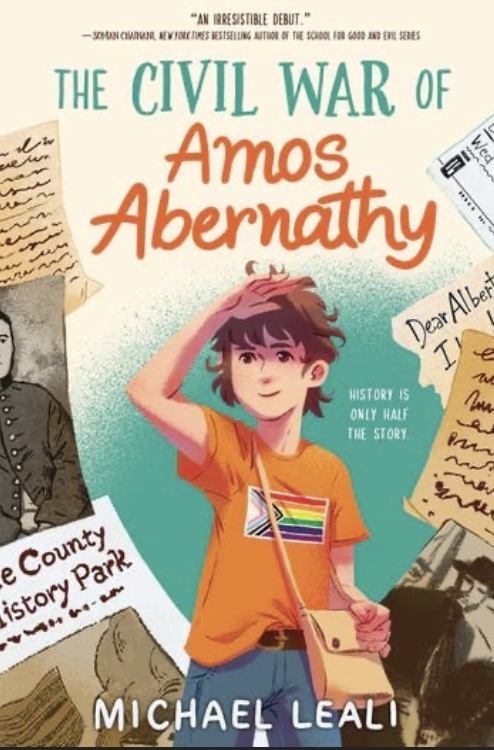
I read this with my nonbinary kid and we both learned a lot. I love books where the kids are smart and are willing to dig deep to show the less open-minded adults in the world what’s really true. Amos Abernathy is an openly gay middle-school-aged historical reenactor whose best friend–also a volunteer there–is a young Black woman. They love history but they also want to shine a light on people whose stories aren’t usually told.

No. 7) Freya Marske https://freyamarske.com
I devoured Marske’s Last Binding trilogy, interestingly recommended to me by my Unitarian Universalist minister. I’ll let Alix Harrow explain why: “Mystery! Magic! Murder! Long looks full of yearning! This book is a confection, both marvelous and light.” —Alix E. Harrow, author of The Once and Future Witches

No. 8) Becky Chambers https://www.otherscribbles.com/about
If you asked me to describe my vision for how the world should work, my hope for how all beings would treat each other, and my philosophy about how I want to live my life, I would hand you a stack of Becky Chambers’ books. Start with A Prayer for the Crown-Shy, which you can read in one sitting, but ideally will reread several times. My Unitarian Universalist minister and I created a whole Sunday service about this book and its companion, A Psalm for the Wild-Built. Just thinking again about Chambers’ characters makes me sigh with contentment.

No. 9) Disco Witches of Fire Island
Several years ago I happened to pick up The Sign for Home, a marvelous, fascinating novel about a college student who is DeafBlind and a Jehovah’s Witness, neither of which comes up a lot in books I’ve read. I’d never heard of Blair Fell before or since, until Disco Witches of Fire Island suddenly appeared. It’s the kind of book that you stay up until 2am to finish, which is what I did last night. The disco witches in question are a delightful group of compassionate, intuitive, and colorful friends who’ve made it their mission to protect unsuspecting young gay men from harm, while also caring for each other through the AIDS crisis and beyond. And of course they do it in spectacular style to a pumping soundtrack.

No. 10) The Miseducation of Cameron Post https://www.emilymdanforth.com/mcp
This book is a beautiful affirmation of identity and the struggle to remain authentic in the face of homophobia and hate. While the book was published 13 years ago, unfortunately the battle rages on between people who support and embrace all gender identities and sexualities and believe that each individual knows themself best and should live their truth vs. the small but virulent faction that fears difference and promotes bigotry, discrimination, and intolerance (and joy and the freedom to love).
Share this:

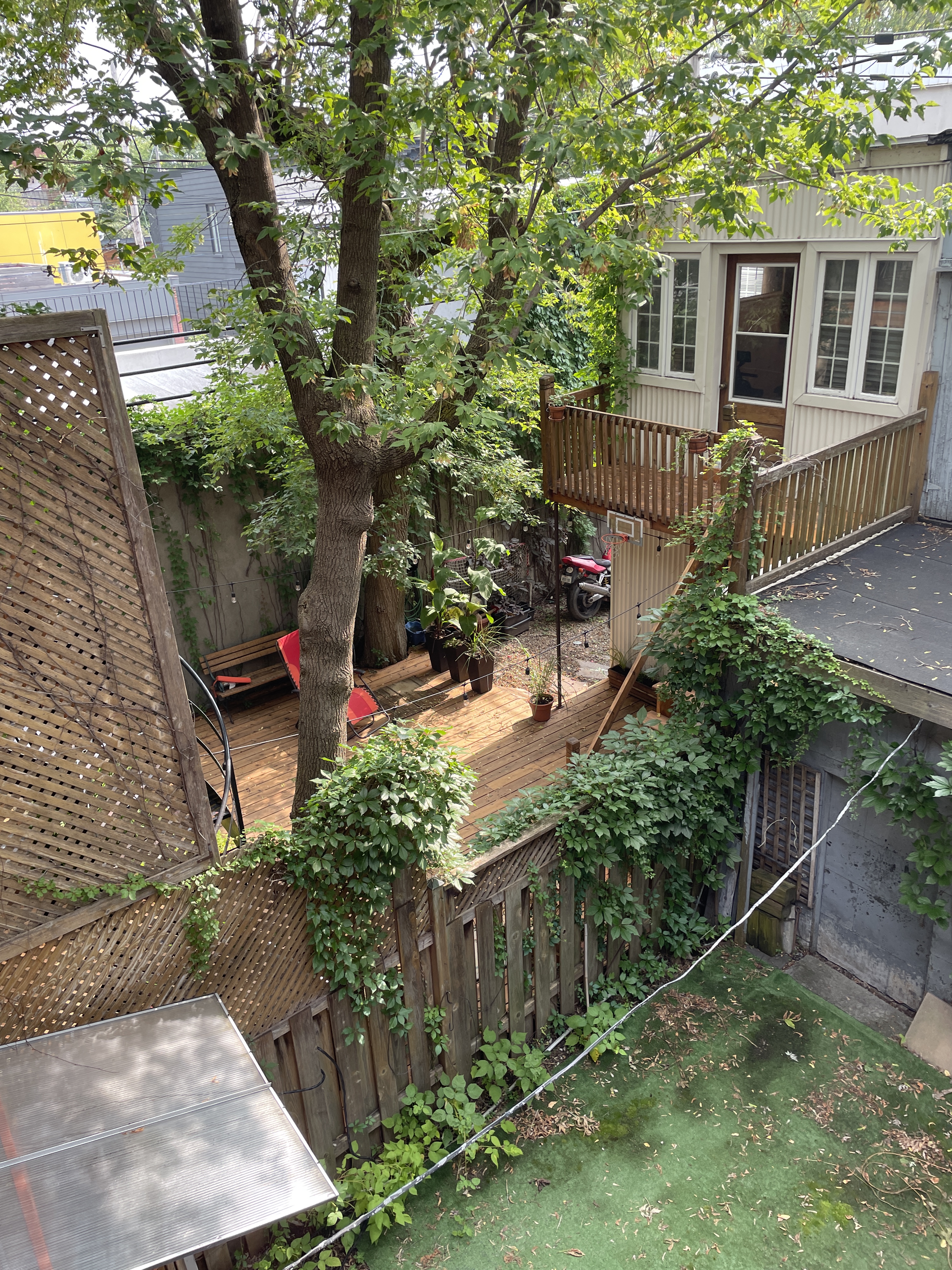
From where I’m sitting on the balcony of our Airbnb, I can see into the houses or yards of at least seven other apartments. Surprisingly, it’s quite quiet for a Saturday morning. The only activity I can observe right now is a guy in the yard below and to the right who is digging up some kind of slate tiles or chunks of flagstone that were haphazardly leading from the alley behind the building to the wooden patio of the house. I don’t know if this space is supposed to be a garden or a place to park your car (it’s big enough) but right now it’s dirt and plants (weeds?) and a large and lovely tree. I wish we could stay to see the “after” picture.
The cool breeze through the trees is a peaceful contrast with our adventure from last night, when we walked down Mont-Royal Avenue and Saint Denis Street looking for a place to eat a late dinner. This neighborhood is apparently the place to be on a Friday night if you’re young and cool in Montreal. And we were there anyway. There are infinite bars and restaurants, many with wooden, lighted outside seating areas. There are tons of benches out in the streets–closed off to traffic–seemingly for the sole purpose of people hanging out. There were chairs set up in an area where you could watch street performers. It was all thoughtfully designed with people enjoying themselves in mind. After walking up and down both streets to see what was on offer to eat, we decided to try a dumpling place, only to discover their kitchen was about to close. Then we decided to try a tapas place, only to discover that their kitchen was about to close. Finally we settled on a bar full of people (so we decided it must be decent) that was named after the Catholic church across the street. They were blasting American rock music from the 80s, but everyone was speaking French so it seemed authentic enough. We attempted to order in French and they quickly caught onto the fact that our French is terrible and switched to speaking to us in English, but in a friendly way. We ordered a cider and a beer and a half kilo of chicken wings (which seemed like a lot, and it was) and poutine, and relaxed after two long days of driving.
So far we’ve covered more than 700 miles on this trip, and gone back and forth through several states before reaching Canada. We delivered Niki to camp in Western New York on Thursday afternoon and stayed in a hotel in Pennsylvania, just a couple miles from the New York border. We planned to leave for Montreal first thing on Friday, but then things happened and we didn’t. But while Randy was on a call, I found a cool coffee shop that also had antique axes and knives on display and a vast array of tinned fish for sale. Sardines have never appealed to me, but these looked so cool!

We finally started heading north and stopped to use a bathroom in Catskill, New York. We happened to park in front of a used bookstore. This was not planned, I promise. So we bought some books! And there was an art gallery. So I bought some art! Then we drove north some more and decided to have lunch in Saratoga Springs, where I once lost $20 at the racetrack and decided never to gamble again because there’s so much other stuff I’d rather do with $20. Saratoga Springs is a lovely little city. Unfortunately, or fortunately depending on the way you look at it, there’s a phenomenal bookstore there. We swore to each other we would only stay for five minutes…
So…by the time we got to Montreal it was after 8pm. But we found our cute little apartment and rallied to go eat. Now we get to explore Montreal in the daytime.
Share this:

I am a pitcher pouring cool water into your cup
I am a clock taking its own time
I am a spiral staircase stepping up to the stars
I am the stitching of the quilt that you snuggle underneath
I am a match determined to ignite
I am a curl standing out from the crowd
I am a bear defending every cub
I am the opalescent wings fastened on
so I can fly
I am a rivulet of strawberry ice cream dripping pinkly down the side of a waffle cone
I am a pair of dice rolling the
wrong combinations
I am a broken heart that’s tender to the touch
I am a puddle showing you your reflection
I
I am a pitcher pouring cool water into your cup
I am a clock taking its own time
I am a spiral staircase stepping up to the stars
I am the stitching of the quilt you snuggle underneath
I am a match determined to ignite
I am a curl standing out from the crowd
I am a bear defending every cub
I am the opalescent wings fastened on
so I can fly
I am a rivulet of strawberry ice cream dripping pinkly
down the side of a waffle cone
I am a pair of dice rolling the wrong combinations
I am a broken heart too tender to touch
I am a puddle showing your reflection
I am a third door opening to a different world
I am the sunlit clearing when you emerge from the woods
I am buttery words spilling off the page like tight kernels bursting into hot popcorn
I am sometimes the salt
Share this:


I’m molting
Shedding haphazardly and with
intention
depending on the day
I’m curious
wondering what
will grow in next
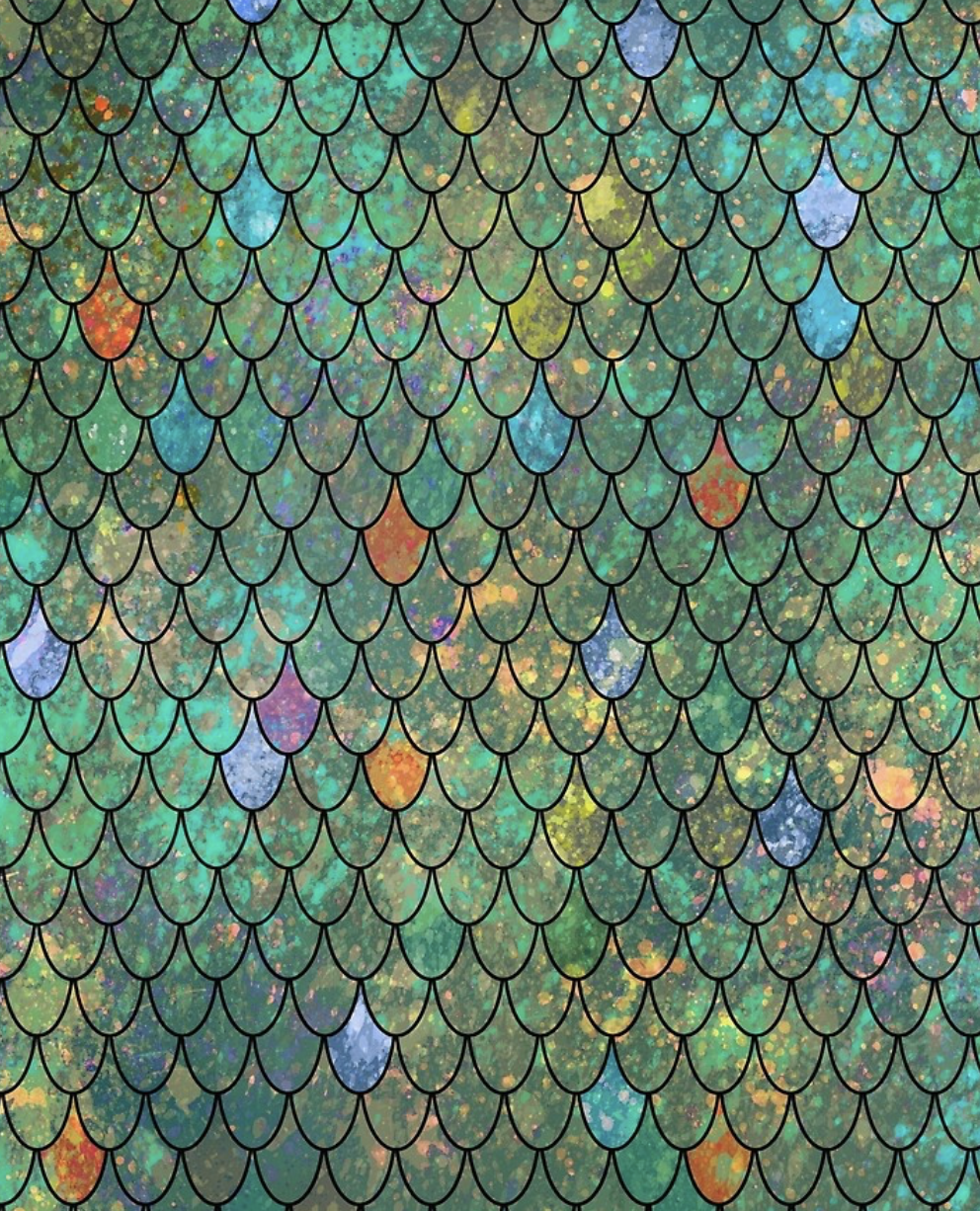
Feathers jewel toned or silvered
Shiny scales smooth or gently textured,
inviting you to brush your fingertips
lightly across them
I’m musing on which
spells or incantations
learned or improvised
I might whisper or chant
to shape
my new incarnation
plain and bejeweled
soft and fluffy
lined and spotted
strong and supple
until I molt again
This metamorphosis is not for you
© 2024 by Betsy Rosenblatt Rosso
Share this:


I feel like I’ve been holding it in all summer.
What it is I’ve been holding in, I’m not exactly sure. My breath? My thoughts? My feelings? You know when a writer holds in all those words for a long time it’s not healthy. Eventually they’re going to find a way out.
Maybe there’s an imbalance of words because I have spent so much of my time off this summer reading. I have devoured at least two dozen books. I attended the national gathering of Unitarian Universalists and absorbed ideas and songs and Pittsburgh and ate a lot of food and had a lot of conversations. I’ve returned to church and gotten back up on the chancel as a worship associate and a speaker. I’ve made new friends. I’ve eaten a lot of lunches and taken miles of walks with old friends. I’ve been rebuilding my soccer team–now known as Athena’s Arsenal! I am the only player who remains from the original Ice & Ibuprofen squad that made our debut in 2016. I&I merged last year with a team called Far Gone and we’ve had to recruit a lot of folks to build up our roster. In choosing our new name, someone suggested Tottenham Hotties (a riff on the Premiership team Tottenham Hotspurs) and I countered with Tottenham Hot Flashes, but that didn’t win. Perhaps it’s just a reflection of my personal situation. It turns out I am still not really any good at soccer and I’m not sure why I am playing other than to prove to myself that I can and to give myself the gift of two hours a week when I am not thinking about anything else even if I have to run around in circles while that happens. I am organizing an event through church called QA2: Queer or Questioning, Awareness and Acceptance to provide LGBTQIA+ kids and families with an opportunity to make connections and find resources and support. I’m still trying to teach myself to read tarot. What little I have learned so far has offered insights that given me pause and steered me in new directions with surprising confidence.
I’ve been watching my kids grow up before my eyes. It’s like time-lapse photography of their emotional maturity and ability to navigate the world. Niki can bake on their own from start to finish now after a week at baking camp. At the back-to-school open house, they brought cookies they made and gave them out to all the teachers and staff. At film camp they made a silent film–a dark and modern twist on Hansel and Gretel in which they played Gretel. They discovered a previously unknown talent for an interest in being an emcee after performing that role at the end-of-camp presentation at two different camps. They’ve made all kinds of friends at all these camps and are now immersed in various group chats and FaceTime calls. Niki earned their blue solid belt in martial arts after a long stint as a green solid and a final burst of energy and dedication that enabled them to move up. We’ve attended so many martial arts growth ceremonies and they never fail to move me to tears. Always and especially when there are those kids who struggle to break their boards long after their peers have had their new belts tied on by their instructors, I cheer the hardest. We did a bit of rearranging of their room this summer, taking down drawings they’d made during the pandemic (signed with their old name) and hanging photos of them with animals from our trip to the Houston Zoo, and pride posters, and a picture of Megan Rapinoe with the slogan “Be Proud.” And they are. They own their identity and their uniqueness 100% and I am there for it.
Zoe spent a month away from us at Camp Friendship, her home away from home. This was her eighth and final summer as a camper, and her plan is to return next year as a counselor. I remember when she was little and in martial arts and we’d be at the growth ceremony and I would ask her if she could imagine being a black belt, and for a long time she would shake her head, wide-eyed and in awe, and say no. Until one day she nodded and said yes. It’s been the same way at camp. We always asked her if she would be a counselor some day and she couldn’t see herself having that kind of responsibility, until suddenly she could. She said this summer as a camper, she imagined everything she did as if through a counselor’s eyes, and thought about what it would be like to lead little kids in the activities that she has loved learning so much herself. The first week of camp this year, she didn’t know many campers or counselors, as several of her favorite counselors had moved on to other jobs, and many of her camper friends had aged out. She wrote us saying she was homesick, but didn’t let it keep her from making the most of camp life. As more familiar faces arrived each week and she cultivated the relationships with folks she had just met, everything fell into place, as it always does. The camp has a system where parents can write emails through the parent portal and camp will print them out and give them to the campers, and campers can handwrite messages back and camp will scan them and email them to us. It’s much quicker than snail mail but eliminates the need for campers to have their phones with them at camp (which is one of my and Zoe’s favorite things about camp). I loved having the opportunity to update Zoe on the goings on of life at home (mostly boring, without her!) and hear from her about developments at camp. I wish we had some way of continuing that correspondence at home, even though we’re both in the same house. That’s one reason that I am so happy to be taking road trips with her to visit colleges. We’ve toured a bunch of colleges in Maryland and Pennsylvania and New England so far and have several more up and down the east coast on the calendar for this fall and next spring. I love claiming this time in the car with her, to listen to music and books and talk about anything and everything, and notice weird signs and unusual sights along the way, and stop at little bookstores and find cute coffeeshops with resident cats.
This fall, Niki will practice walking to and from school on their own. We’re going to teach them how to take the bus. Zoe is so close to finishing the requirements to earn her driver’s license. Then she will be given a vintage minivan by her grandparents and will be set loose on the world. We’ve discussed curfews and she has gainful employment. This morning at church it gave me so much joy to watch these four-year-old girls dancing around at the front of the sanctuary during the service. I love four-year-olds. But I don’t wish my kids were younger. Or older. I am so excited to be with them at this exact moment in their lives, where they are learning so much about themselves and about the world. Sometimes, that means seeing how people can be awful and the world is kind of a mess. But sometimes we get to fill it with cookies and music and hugs and laughter and forget about the rest of it for a while.
So I will take in a breath and remember to fully and deeply exhale. All the way from my belly up out into the world. I will take it all it, and release. Because I have to let it go so I can take another breath.
Share this:

If we want to support each other’s inner lives, we must remember a simple truth: the human soul does not want to be fixed, it wants simply to be seen and heard. If we want to see and hear a person’s soul, there is another truth we must remember: the swoul is like a wild animal — tough, resilient, and yet shy. When we go crashing through the woods shouting for it to come out so we can help it, the soul will stay in hiding. But if we are willing to sit quietly and wait for a while, the soul may show itself.
~Parker Palmer
This is a talk I shared during a Sunday service at the Unitarian Universalist Church of Arlington as part of the church’s series on the six sources of Unitarian Universalism. My writing was inspired by this source: direct experience of that transcending mystery and wonder, affirmed in all cultures, which moves us to a renewal of the spirit and an openness to the forces which create and uphold life.
For two years I spent a good chunk of my waking hours talking and writing about this church. As a member of the ministerial search committee, I met with my fellow committee members weekly, and we worked doggedly to discern what the congregation needed in a new minister. Surprise–Unitarian Universalists have a lot of opinions! Our committee had to digest, synthesize, and transform what we learned into UUCA’s church profile, an incredibly elaborate version of a job announcement. Then we spent months reviewing applications and sermons of prospective ministers. This role and its attendant responsibilities were heady–and hard–and ultimately richly rewarding. It was a privilege to serve UUCA in this capacity, and if I’m being honest, it made me feel kind of important. It’s easy for me to make the mistake that what I do for a community is more valuable than who I am.
Now, raise your hand if you were part of UUCA in any way in the spring of 2020. You may recall that, just as our committee was preparing to recommend Rev. Amanda as the candidate for our senior minister, the pandemic shut everything down. All of our plans to introduce her to the congregation, celebrate a new beginning, and enjoy the fruits of our committee’s labor were funneled online or simply forgotten in the crush of a worldwide crisis.
I know every one of you here in the sanctuary or watching online has a story like this–or a very different one. There are likely a million variations on the theme of how things changed in 2020. Now, four years later, I am still feeling the effects of those changes, for better or worse. Maybe you are too. Who knows how long the ripples will expand throughout our lives?
Church has always meant community for me. Throughout my life, community often outweighed theology in my choice of a congregation. I feel lucky to have found in UUCA a place where I feel both a sense of belonging and alignment with the tenets of the faith. From the moment I arrived at UUCA, I felt seen. I felt valued. I understood that my being here mattered.
Unfortunately, for a good portion of the years since 2020, I lost that sense of belonging, not just here, but really anywhere. Does that sound at all familiar to you? The isolation of the pandemic was soul crushing. And I am a big believer in silver linings. I love my family so much, and I am so thankful for the hours we spent playing board games, watching movies, making art, and going on hikes. But the four of us did not a whole community make. I need different kinds of people and multiple communities to nurture various aspects of my personality and my identity. All of us do.
There’s a wonderful graphic novel series called Heartstopper, which is now an amazing Netflix show, that my kids adore and introduced me to and which I love now as well. First of all, Heartstopper creator Alice Oseman does a masterful job portraying the pain and beauty of making your way as a teenager, particularly as you come into your gender identity and sexual orientation. Secondly, in book four of the series, Charlie–one of the main characters–comes face to face with what feels like an insurmountable struggle. His boyfriend, Nick, wants so badly, as all of us do when we love someone, to be able to fix Charlie’s problem, but of course he can’t. And Nick realizes that, no matter how much he loves Charlie, he can’t and shouldn’t be everything to Charlie. Charlie needs a community to help him. As do we all.
I took baby steps to return to UUCA. I co-facilitated a covenant group for parents of gender-expansive kids. That was an easy one–a way to test the waters by creating a small community. Coming back to church on Sunday mornings, however, was a challenge. The first few times I tried, I felt confused and out of sorts. When we were all masked, I felt embarrassed because I didn’t recognize people who I had known for years. That kept me home for a while longer. When I came back again, I felt like I had somehow forgotten how to interact with other humans. Once after the service ended, I just sat in the back and cried. Holly saw me and sat with me. She didn’t ask me to explain myself. She just kept me company.
When I heard about the LEAD program that Greg and LeeAnn were running, I knew I had found a path back to community. I wasn’t sure what my role was supposed to be in the congregation, but this was an opportunity to meet new people and reconnect with old friends, so I took it.
The irony–or perhaps the true intention–of joining LEAD was being reminded that I didn’t need to have a leadership position or a particular responsibility in the congregation to belong. When I arrived for that first workshop, I was so warmly welcomed back. Wendy and Kristen, among other folks, let me know that they were genuinely delighted to see me again, without asking why I hadn’t come back sooner, or what I was going to be doing for the church now that I was back, or without any other expectations of me whatsoever. After the session, I gave Kristen a ride home and we sat in my car, parked outside her house, for an hour catching up. It was such a relief to renew that connection. I know I’m name dropping a lot this morning. I intentionally want to recognize the people who have shown me so much grace and love in building and rebuilding community here.
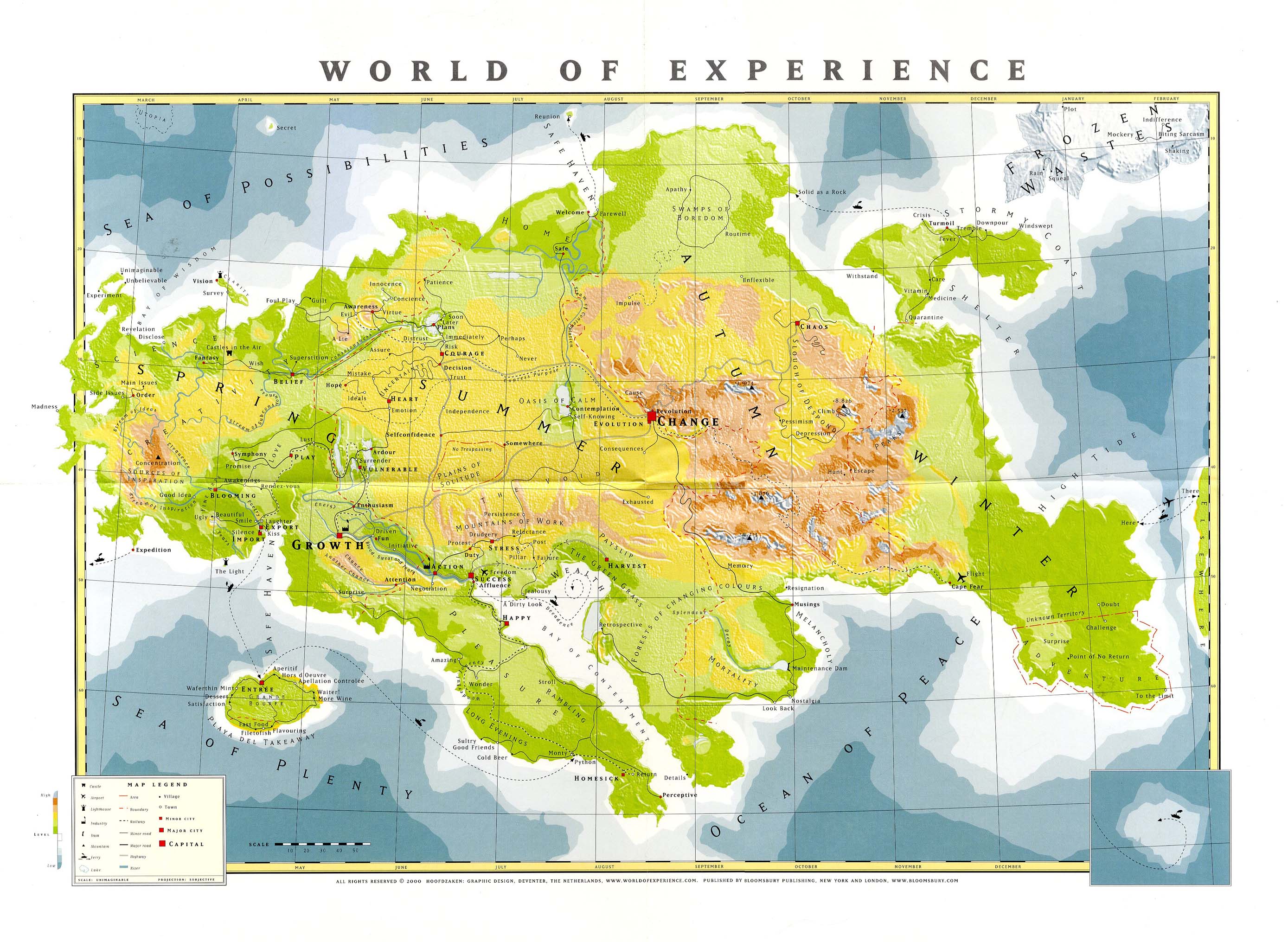
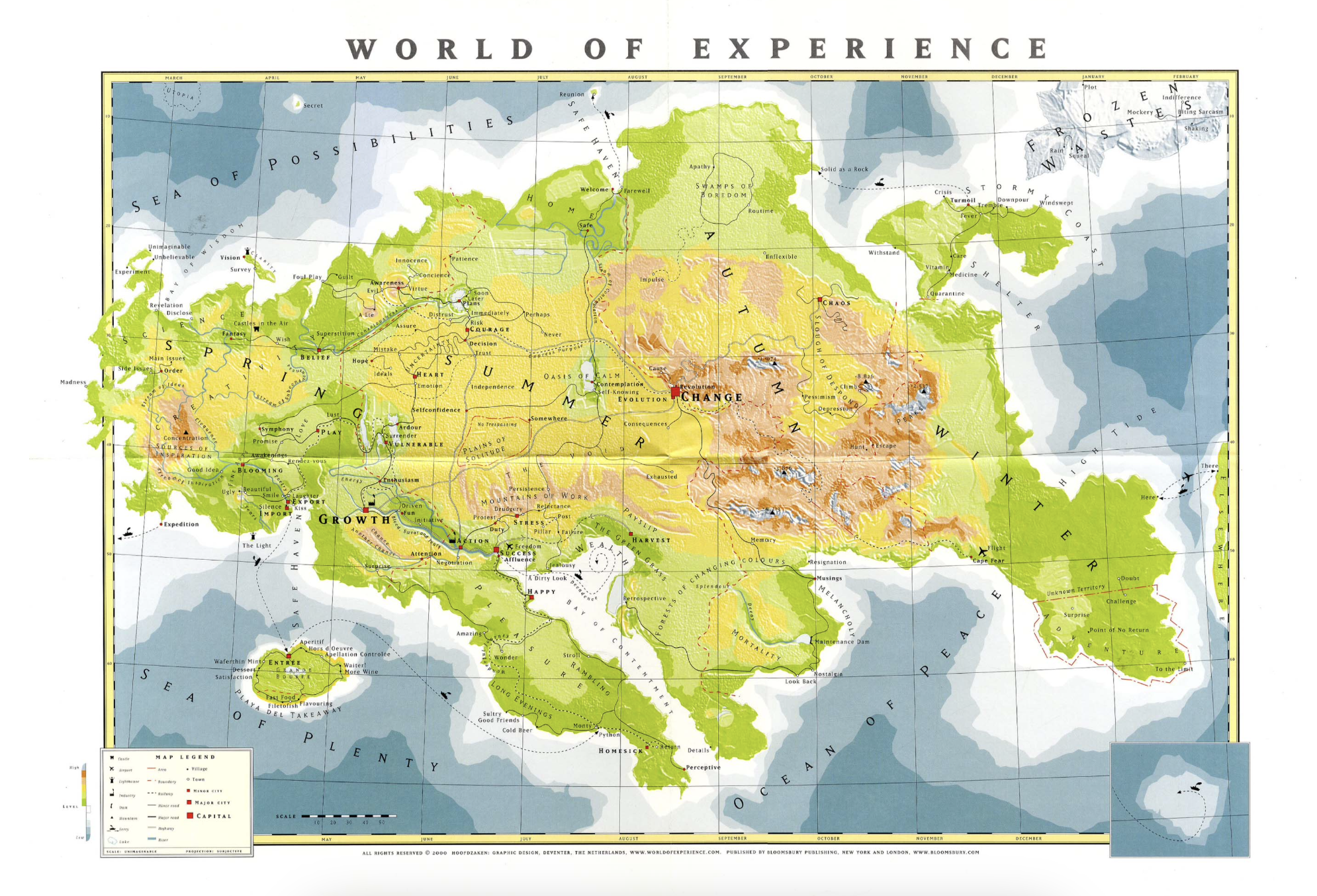
One of my favorite activities during the LEAD workshops was using the World of Experience as a tool to examine where I’ve been and where I want to go. If you’ve never seen it before, you can check out the World of Experience at the LEAD table in the fellowship hall after the service. In the meantime, picture this in your mind. A map that, at first glance, looks like it could be a two-dimensional representation of the Earth. On closer inspection, however, the familiar continents and oceans are replaced by other geographies, named for elements of the human experience. For example, the sea of possibilities, mountains of work, and plains of solitude.
On several occasions we used the World of Experience as a way to articulate the challenges or adventures in our past and present, and where we hoped to navigate in the future. In all of my conversations, my partners shared their journeys with unapologetic honesty, and invited the same vulnerability from me. The guiding principles practiced during the LEAD series were touchstones created by Parker Palmer and the Center for Courage and Renewal. One of these is “no fixing, saving, advising, or correcting each other.” In our type A problem solving culture, that’s a particularly tough one for many of us to follow, but it’s so important. Participating in the LEAD workshops reminded me that this congregation is a safe place for me, where my wild animal soul can show itself. That’s how I experience moments of mystery and wonder–when I feel truly seen and understood.
This year I attended General Assembly, the Unitarian Universalist Association’s annual gathering, for the first time. I had long wanted to experience GA, but to be honest I was also super anxious about it. When I arrived in Pittsburgh and checked into my airbnb, I texted Gay and Elizabeth. What am I doing here? I asked them. Of course, they were both kind and reassuring. I felt their hugs from 250 miles away. Then I arrived at the convention center, and I found Diane and Bruce and I knew everything would be ok. I had tacos with LeeAnn, and reconnected with folks who I first met at UUCA but who have moved on to other churches, and I made new friends. Knowing I was among so many people who share my UU values and commitment to repairing the world was exactly what I needed and hoped to experience at GA.
Of course, church is far from the only community that can nurture the soul. Some communities are intimate and some are vast but both can offer sustenance. My 16-year-old is a member of the seemingly infinite community of Swifties–devotees of pop star Taylor Swift. While her knowledge of Taylor Swift’s catalog and every minute detail of every concert on the Eras Tour may verge on obsessive, it is clear that she and other Swifties find joy and meaning in listening to the music, experiencing the music, and talking about the music with each other.
The community my 10-year-old thinks of as their second home is SMYAL, a DC-based organization that provides resources, connections, and activities for LGBTQIA+ young people ages 6 to 24. My kid has found kindred spirits, role models, and unwavering and unconditional support for their whole self. Their wild animal soul feels free to lead a dance party whenever they’re with their SMYAL peeps.
As Parker Palmer wrote, “If we want to support each other’s inner lives, we must remember a simple truth: the human soul does not want to be fixed, it wants simply to be seen and heard.” I am thankful to be a member of this and other communities where my soul can be seen and heard. Cultivating that kind of community–something greater than any of us individually, which can only be created with intention and love–is a sacred act. Sometimes we can build community, and other times we just stumble into it. We don’t always know where we will find community, or where we will experience that sensation of truly belonging, but we surely know it when we feel it. Some may call that providence, or divine intervention. To me, that certainty of belonging is a product of the mystery and wonder of the universe. Whatever you call it, I wish for you the comfort, safety, and nourishment of community, wherever you may find it. May it be so.
Share this:

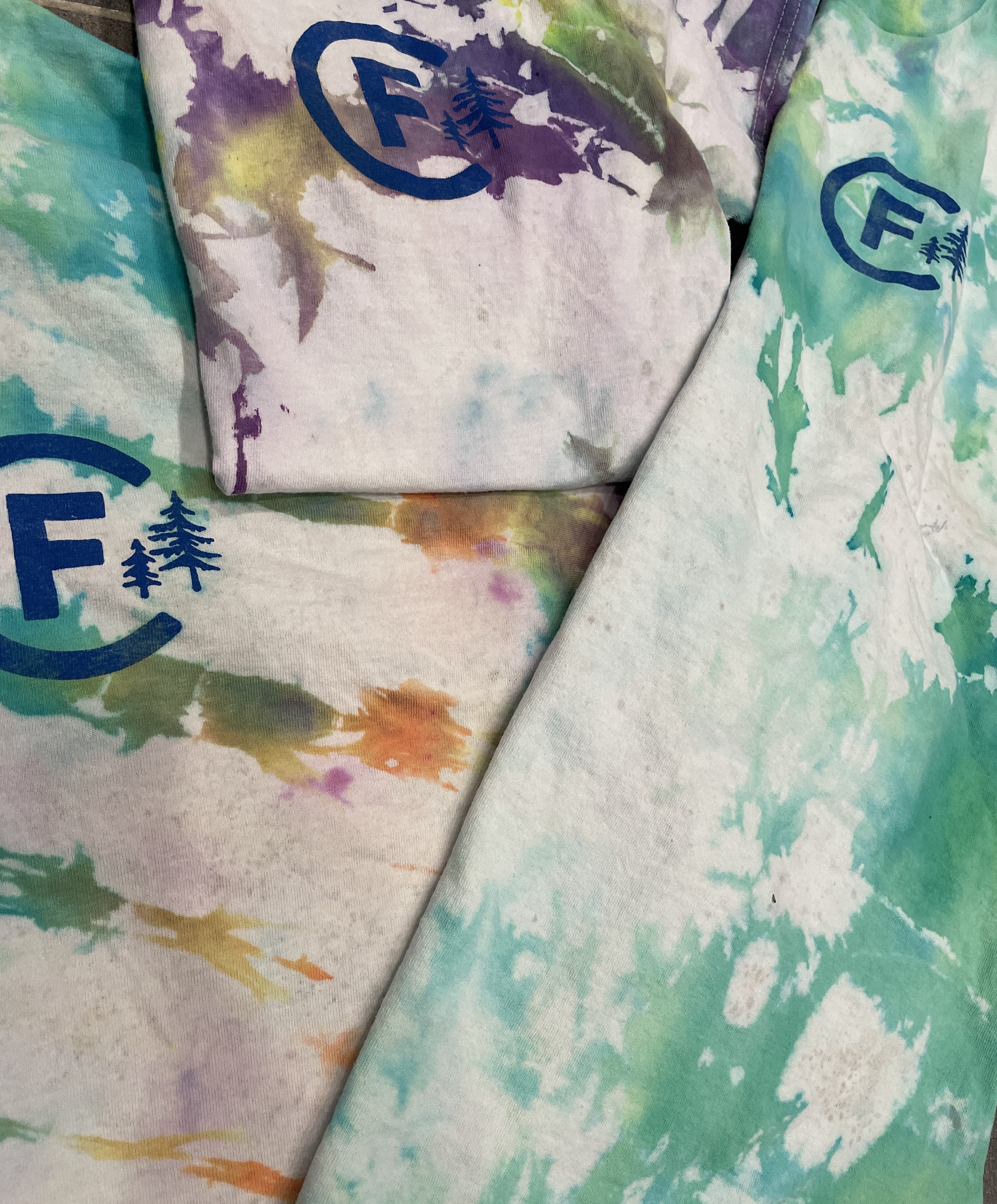
When you tie-dye a t-shirt, they tell you to keep it in the plastic bag for at least 24 hours, or several days more, to allow the dye to soak into the fabric so the colors of your shirt will be vibrant. What they don’t tell you is that after those first several days have come and gone and you’ve more or less forgotten about the tie-dying because you’re home from family camp and fully transitioned into school year mode, your wet shirt, which has been scrunched or twisted up and secured with rubber bands and enclosed in a sealed ziploc bag, will become fertile ground for colonies of mold. Or possibly mildew. I am honestly not sure of the difference, when it comes to gross spots growing on something I was planning to put on my body. Either way, when you remember to take the shirts out of their bags and start the chiropractic appointment-inducing process of rinsing them out in the bathtub, and you see the grayish brownish spots clustered across the shirts, you make a face that indicates an unpleasant mixture of disappointment, frustration, and disgust.
Yuck.
Your research reveals that a possible remedy could be soaking the shirts in vinegar. Although in your gut you feel like they’re too far gone, you have to try. Surprisingly, three different stores you visit are completely out of white vinegar. Finally, you order some online from Target, in one of your midnight shopping sprees where you make other exciting purchases such as frozen burritos, saltines, maxi pads, paper towels, and Cinnamon Toast Crunch. You are living the high life.
Because that’s the way you roll, it takes a few more weeks for you to actually soak the shirts, although they have been rinsed and are dryish and you are pretty sure no longer nurturing the fungus (if it even is fungus?) besmirching them. You’re just feeling kind of defeated by them. The giant jug of vinegar sits in the hallway, mocking your bad decision making and poor time management skills.
As time passes, you think a lot about preschool. One of the many mantras at your kids’ amazing cooperative preschool was “process, not product.” Emphasis on the kids doing whatever they wanted to do with the materials put in front of them — or that they unearthed while playing in the mud garden or tromping through the woods — rather than the ultimate creation of something recognizable or a specific end goal. This is a good rule of thumb for life with little ones, as products rarely–if ever–turn out as expected. Also a good thing for adults to remember, although we are usually held to the standard of producing some kind of acceptable end result. And process is how you learn. Process is the journey. Process is the sensory experience of getting your hands dirty–or stained with dye in the arts and crafts cabin at camp. You recall the peaceful hour spent with your nine-year-old carefully choosing tie-dye patterns, helping them rubber band the shirts, and finding exactly the right color combinations. You each made a shirt or two and a couple bandanas. The bandanas are easy but not quite as satisfying as a result.
If you’re being truthful, each of you already has several tie-dye shirts in your drawers, that you made at previous family camps or on summer vacations during the pandemic. So you’ve enjoyed the process many times before, and even managed to make some decent shirts.
Now that you have soaked the shirts (and stunk up the house with the aroma of vinegar) and washed the shirts and dried the shirts, you discover that three of the shirts still have enough remaining mold (or mildew!?) stains to make them unwearable. Somehow one shirt emerged unscathed, as well as two bandanas.
You wonder if there is anything useful to do with the rejected shirts. You already have enough dust rags for a squadron of Cinderellas. You fleetingly imagine cutting up sections of the shirts that aren’t stained and sewing them into something else. But what? A doll-sized blanket? Plus, you can’t sew. You think of your friend who can sew and wonder what she would do. In addition to sewing, she is an expert at tie-dying, and you’re certain she would never have made the mistake of allowing tie-dyed t-shirts to languish in their baggies until they grow things. But her kids attended that same preschool, and you know she would appreciate your “process not product” attempt at consolation.
Lately I’ve made a lot of mistakes. Somehow more than what I expect from myself, as if I am more than human. My new mantra, although I am many decades out of preschool, is process, not product. I am still learning.
Share this:


If my teenager devotes as much time and attention to preparing for and applying to college as she has plotting and organizing her efforts to buy tickets to see Taylor Swift, she will get in anywhere she wants with scholarship offers to boot. In fact she has said that she and her friends (both real life and online Swifties) are comparing receiving the magic presale code by text (required to buy tickets before the general public, if any are even left at that point) to hearing whether you’ve been accepted to your first choice school. Her excitement and anxiety around this concert tour have been enormous. She has said many times, “I am so scared.” As in, that we won’t get tickets, or maybe won’t get tickets for the right show, or won’t get good seats. The emotional intensity is palpable. I get it. This is someone whose music and persona she cares a lot about. I’ve certainly felt that way about musicians throughout my life. I know that problems, like gas or water, can expand to fill up all available room, regardless of their overall seriousness or significance. Hopefully we will be able to get the tickets tomorrow morning and all will be well. And between now and two years from now when she is actually applying for college, we will take lots and lots of deep breaths.
Meanwhile, we are also facing the superficially less dramatic but actually much more daunting prospect of her learning to drive. She and I attended a mandatory two-hour presentation about driver safety and education last week. Her school auditorium was filled with other sophomores and their parents and I wondered what was going through all of their heads. Here’s what I learned that night:
You’re no longer supposed to position your hands at 10 and 2 on the steering wheel. Now 8 and 4 are recommended, so you don’t have to cross your arms when you turn and if the airbag goes off you’re less likely to sustain injuries from your arms being crossed, and to reduce fatigue from driving. I thought this was an interesting tip, and wondered why no one is making an effort to tell adults who have already been driving for years to change their habits. There’s also a new way you’re supposed to position your side mirrors to eliminate the blind spot and avoid accidents. I know if you have a newer car you have the fancy indicators that tell you when someone is close by in the lanes next to you, but I drive a 2010 minivan so I have no such luxury. There were actually a few driving tips that seemed useful and I wondered why adults are required to do so little to renew their licenses. Not that I want extra administrative hurdles in my life, but I am sure my driving has gotten worse and I could use a little refresher course. I guess that’s what I was getting last week.

Allegedly, parents have the most influence on teens’ driving habits. The presentation was heavy on telling us to get ourselves together to both model proper behavior when we’re driving and set the rules and to feel free to take away driving privileges. We are supposed to go through step-by-step driving lessons in the booklet they gave us, and log 45 hours of driving practice with our kids while they have their learners permit. And review and sign and make them sign various contracts in the back of the booklet outlining what they are and are not allowed to do and what happens if they mess up. That is all in addition to the classroom portion of driver’s ed they take during gym class, and the behind-the-wheel training they have to take with licensed instructors. No pressure. The driver’s ed teachers who were presenting emphasized the importance of establishing a bond with your children to effectively encourage safe driving habits. If you haven’t already established a bond by the time they’re 15 and 6 months, it may be a challenge to start now. The slide show also included a smiling dad and daughter sitting in the front seat of a car and advised us to leave our family problems at home when we practice driving, to make it a fun experience for everyone.
I wondered how kids who don’t have reliable parents, or parents who drive, or parents who own a car, are supposed to manage all this. Today as part of my job I was downtown meeting with DC Council Members and their staffs to discuss issues related to youth homelessness. Included in our group were three young adults who have experienced homelessness and are now advocating on behalf of themselves and their peers for tailored workforce development programs and mobile mental health services that meet their needs. One of the service providers mentioned that abundant driver jobs are available in the DC area, working for Amazon or FedEx or UPS, among others. And many young people she works with are eager to apply for the jobs, but they don’t have driver’s licenses because they grew up taking public transportation, and they don’t have parents available to teach them to drive, or cars to learn on. One of the young people said that the logistical barriers are so significant that many teens don’t bother with them, and drive anyway, often taking cars that don’t belong to them because they literally have no legitimate way of getting a license and buying and insuring their own cars.
Which brings me back to the driver’s ed presentation and the talk by the police officer. He was there, ostensibly, to talk about how to behave when you’re pulled over while driving. He did that, but only after he offered a lot of his own perspective on teens and driving and how judges where we live don’t like to see teens in court for traffic violations because the judges know the teens should know better and are very strict. All of it felt like a lecture designed to scare the kids, which it probably was. But it irritated me. Perhaps because this is not my preferred parenting technique and I am not a police officer and I know a lot of the people in the audience probably bristled the moment the officer walked up to the front of the auditorium. I should mention that the officer was Black, and at least half if not three-quarters of the young people in the audience were people of color. So the officer said that if you’re pulled over, you should roll down the windows and put your hands on the steering wheel where they’re visible. He said that if the officer asks for your license you should say, “it’s in my pocket, can I reach behind me and get it out of my wallet,” or “it’s in my bag on the passenger seat, may I reach over and get it,” or whatever the case may be, so you have permission to move. “So we don’t have any accidents,” the officer said. Which translates to, “so we don’t shoot you and kill you for no reason,” I guess. He said, “Be polite. When you’re pulled over it’s not the time to practice your trial lawyer skills. If you feel like the officer did something wrong, your parents can deal with that later. It’s your job to be polite.” Are your parents really going to sort it out later? Whose parents are going to do that? Maybe parents who actually are trial lawyers? The more he talked, the more I did not want to listen.

I am a middle-aged white woman who has been pulled over a handful of times for stupid things. Mostly I have avoided getting tickets, perhaps because I legitimately didn’t know my tail light was out, or I wasn’t actually drunk but just trying to get the hair out of my eyes with a barrette (that did actually happen). Maybe I just seem idiotic and pathetic when they pull me over because I get flustered easily. And I seriously didn’t know that it’s illegal to drive through a parking lot in order to get onto a different road if the traffic is bad. Did you know that? (I did get the ticket for that one, and as a result I was even later to pick my kid up from day care). I am acutely aware that I have never been racially profiled and no officer has ever pulled out his gun when I reached for my license or registration. My daughter will likely be treated the same way because she is white. Unfortunately some of her friends and some of the teenagers in that auditorium will not be. We have to do a lot more to change the way police officers behave or even at a more basic level how we approach and achieve community safety with or without police, so no one else who is unarmed, nonthreatening, and completely innocent, gets killed by a cop for any reason.
Our lives are not perfect or without challenges, but I understand how privileged we are. Listening to the stories of these young people today talk about times in their lives when they were trying to find a place to stay from day to day, without any support from family, was important. One of them, who is currently studying for the LSAT and trying to figure out her path to law school, was homeless for her final two years of college. Another talked about the value of his lived experience as a prospective employee. He wants to be a social worker and he can draw on his knowledge of earning his GED while incarcerated, having been part of the foster care system, and being a parent, to help others. He’s already doing that by serving on several advisory boards and speaking at meetings and events across the city.
I try to provide all kinds of fun and enriching experiences for my kids. I want them to be exposed to all kinds of things. But hopefully they will never have to know what it’s like to be homeless or involved in the justice system or profiled by the police. Hopefully I will be able to model good behavior when I’m driving so none of us will crash because we’re distracted or sleepy. Hopefully my daughter will get a job so she can afford the concert tickets and the merch and the meals out with friends and excursions to Starbucks. And we will all keep in mind that even when we struggle, we do it with privilege.
Share this:


This morning I took the mouse that had been squeaking all night (because it was stuck in a glue trap designed to catch roaches and other insects) and carried it into the backyard and pried its little paws and matted fur off of the glue and left it in the grass. I have no idea if it will survive, but I didn’t know what else to do. I couldn’t kill it, although we’ve had mousetraps all over our house for months because of a persistent colony. When the mousetraps kill them, I bag the bodies and the traps and put them outside for the trash. The line between active and passive destruction is thin.
The mouse did not ask to be made into a metaphor. And yet.
There is nothing particularly wrong with me, any more than anyone else. I am more sensitive than most. I have a sleep disorder and other minor afflictions. But this world. The conflict. The cruelty. The confusion. The things that smell bad. It’s like layer upon layer of glue traps of injustice and illness and insecurity. No amount of alliteration can save us. Nothing we can do eliminates the suffering.
Today is Easter. Resurrection–to me–is another metaphor. An opportunity to remind ourselves of all the possibilities of life that emerge from the darkest of days.

This week we spent a few days at the beach. For most of our trip, it was cold and windy. Sitting on the sand and watching the waves was lovely but a bit chilly. The boardwalk was deserted at first. We spent time inside, reading and writing and drawing, and then it warmed up. Everyone else noticed too, and there were suddenly plenty of people on the beach, even though it was still too cool to swim. Who knows what all those other people were doing inside while it was cold, but when the sun came out, they did too. Possibilities opening up like the tulips that lined the sidewalks.
Traveling magnifies the intensity of parenting by 1,000. There are even more decisions than usual to make. Calculations become more complex when you factor in everyone’s desires, preferences, and needs–whether they are stated explicitly or you happen to know them or you’re somehow supposed to guess correctly what they are. Traveling reminds me that I cannot make everyone happy, and that no matter how much I might want to, it’s ultimately not my job and not within my power. I do a lot for my kids, but I can’t (and shouldn’t) do everything. The Easter Bunny did not come to our house today. I warned the kids yesterday that the Bunny was just not available this year, and that there were plenty of other celebrations happening, as both of their birthdays and mine are this month. They both said repeatedly that it was fine and they didn’t mind. Easter is much more of a cultural event to them than a religious one. They are both savvy about the nature of middle-of-the-night visiting creatures (our resident mice never bring us any treats). We just splurged on treats during our beach trip, and we still have plenty of candy left over from their Christmas stockings. Niki said, “I get it. The Easter Bunny is stuck in traffic, has bills to pay, calls to make.” They understand. They are not deprived. I had a couple flashes of guilt, but they were fleeting.
This afternoon I stepped outside to see if the sticky mouse was still in the grass where I had left them. I did not see any sign of them. I hoped that they managed to find refuge somewhere (other than back in our house, maybe?) and some way of removing the residue from their paws. I wonder if the mice still in here are missing that little dude. I can’t think too much more about this or I will become very sad. Absolutely there are much larger and more pressing problems in the world, but it comes back once again to my compulsion to bear witness to suffering, and examination of my role in alleviating it. The mouse remains a metaphor.
Share this:

Over the past four weeks I have:

- Sent my kid to robotics camp after he had been home or with family for 465 days. He did not like the camp, which was not at all what was advertised, but basically a reprise of various Lego camps he outgrew in previous years. They gave him an orange shirt to wear every day. Later, after the shirt had been laundered and returned to his drawer, he said we should “take it out and burn it.” The camp was held entirely outside. The second day it was canceled due to rain. On the fourth day, Zeke came home with a stuffy nose. I took him to get a rapid COVID test at an establishment called Same Day Testing that specializes in rapid COVID tests. That may actually be the only thing they do. Same Day Testing is adjacent to a shopping mall and looks like a day spa. The nurse? technician? person with the swab? had a lovely conversation with Zeke about their shared affinity for sloths. Thankfully, his test was negative.
- Sent my kid to fencing and archery camp, which he and I both fervently hoped would be more fun than the aforementioned robotics camp. He enjoyed the archery and learned about different kinds of materials used in construction of bows and arrows. He hit an occasional target. In the afternoon, they went inside for fencing, where they used sabers. Apparently they wore helmets and jackets, but nothing protected their legs so by the end of the week his legs were covered in saber bruises. Fencing was hard and tiring, he reported. The highlight of this camp seemed to be the instructor’s personal collection of medieval weapons, which he brought in for show and tell. One of them was a pole covered in spikes. Another one was a hammer that Zeke said was, “designed to crush someone’s skull.” It’s all fun and games until someone gets their skull crushed, right?
- Sent my kid to Broadway Disney camp. To my surprise, he agreed to this camp when I proposed it several months ago. He likes musicals, he likes Disney, he likes singing, and he likes dancing. However, when I picked him up after camp today, he said they “forced” the kids to sing “Supercalifragilisticexpialidocious,” from Mary Poppins, which he refused to do. I said, “I thought you liked to sing. You sing all the time at home.” He said, “I only like to sing to annoy people.” And they “forced” the kids to learn a dance to a song from The Lion King, which he did not care for because it involved complicated footwork and squatting. He said he likes to tap dance, and sometimes other kinds of dance, but apparently not that dance. He acknowledged that he enjoyed the games they played, and making up a story with one instructor, and the time he was allowed to draw, during which he drew “an angry potato” and alligator Loki.
- Gone shoe shopping with my kid, who chose slip-on Vans with elevated glittery rainbow soles that are really cool but apparently too heavy to run in. Fortunately we also bought rainbow tie-dye Skechers with a velcro strap because he says he won’t learn to tie his shoes until he’s 10 because he has other, more important things to do. The Skechers came from the “girls” section of the store, because obviously shoes must have genders. The tags I tore off when we got home said “Skechers Girl!” in swirly pastel letters. Because obviously only girls like rainbow colors. Boys can only wear shoes that are blue, green, red, or gray. Zeke said he cannot wear green shoes because, “green is my mortal enemy.” But I guess that does not apply to light green, because the Crocs he chose were light green and lavender. Also they were from the women’s section because the kids section did not have his size. Again, why can’t they just organize the shoe store in size order. Here are very small shoes, which you can see are appropriate for toddlers. Here are slightly larger shoes for young children. And so on, until you get to gigantic shoes for people with generously sized feet. Then people can come in and decide what color and style shoes they want that are in their size, without having to wade through gender and other labels. If Zeke is an 8-year-old boy (which he is) and the shoes that fit him are in the women’s section, the store is really missing out on selling more shoes to more people who don’t think to look across gender and age for the right size.

Heard my kid say numerous times that he doesn’t have any friends. Which is painful to hear, and also true. Not because he isn’t likable or great at making friends, but because I homeschooled him for over a year because of this damn pandemic. His best kid friend his is cousin, with whom he has a close but often fraught relationship. Apparently some of the kids at some of the camps have been nice, but he hasn’t yet met anyone with whom he really clicked. And of course it’s hard to do that in a week when you’re constantly in structured activities. I am sending all of my good intentions and positive energy into the universe that his third grade class will include at least a handful of awesome kids who Zeke will enjoy and who will appreciate him in all his cleverness and creativity and absurdity.
Read and listened to a lot of Norse mythology with Zeke. It turns out we both really like Norse mythology. We highly recommend listening to Neil Gaiman read his own book, aptly titled, Norse Mythology. And last night we finished the first installment of the ridiculously prolific Rick Riordon’s Magnus Chase and the Gods of Asgard trilogy. Zeke has also sprinkled some Greek mythology into his reading, including Percy Jackson of course, but his heart is in the nine worlds.
Reading a lot of books and a wide variety of genres and authors was probably the best thing Zeke did during his homeschool tenure. Mostly, he would still rather play video games than read, but he did read and he still likes to read and we enjoy reading together. So that’s something. In addition to the basic requirements, we also focused a lot on animals, art and art history, and the kind of social studies most kids don’t get in school–heavy on the civil rights, Black Lives Matter, women’s history, LGBTQIA+ history, Howard Zinn, etc. Our biggest struggle was writing, but somehow Zeke managed to craft a story that ended up on the Story Pirates podcast, which was exciting for both of us. Homeschooling wasn’t always easy, but I am proud of what we did together, and I’m pretty sure Zeke learned some things.
There are three more weeks of camp after this one. Perhaps it is too much to ask for me to pick him up at the end of the day and hear him say, “that was amazing! I can’t wait to go back tomorrow,” and “I made a friend today!” But I’m still hoping. If nothing else, camp is forcing us both to slowly get back into the habit of a regular bedtime and packing lunch and getting dressed before noon. We will need those skills come fall.

 You Ask a Lot of Questions