You are currently browsing the category archive for the ‘Unitarian Universalism’ category.

At my Unitarian Universalist church, we have a ritual every Sunday of lighting a candle of compassion, accompanied by a few words of meditation or prayer or our hopes for a better world–whatever you want to call it. Yesterday I served as the lay leader for the service and this is what I wrote when I lit the candle.
Each Sunday we light a candle of compassion for those in our community and around the world who are struggling or suffering. At this moment in history, the number of people who fall into those categories seems to be growing exponentially.
As UUs, we strive to cultivate equity, justice, and generosity, among other essential values. Meanwhile, a lot of people with a lot of power are working hard not only to remove these words from our shared vocabulary, but also to destroy their meaning and manifestation in our society. Which means we need to dig deep for compassion and hold tight to love. Our faith compels us to double down on kindness and refuse to abandon our commitment to our fellow humans.
It’s not always easy, though, as we bear witness day after day to selfishness, callousness, and utter disregard for humanity. So we must start by offering compassion to ourselves. We need to do what it takes to care for ourselves if we are to continue caring for others.
We share our compassion with all people who are isolated, persecuted, marginalized, or abused because of who they are or how they look or where they live or what they believe or their desire to be fully themselves. We hope for them mercy, relief, wholeness, and ease. We extend compassion to those who feel demoralized, devalued, and lost, and wish for them affirmation and encouragement and the understanding that something better is possible.
And, as we begin our celebration of pride month, may we offer our compassion to our LGBTQIA+ siblings and those who support them. We hope for them not just safety and belonging, but also love, and joy. We strive for a world where members of the queer community are not just accepted but authentically embraced.
May we extend compassion to all who need it, including ourselves.
Share this:

Yesterday I had the privilege of leading the service at UUCA with my friend and fellow worship associate Tommy Lo, featuring insightful reflections from Amy Dryer and Roberta Finkelstein, all on the theme of genuine invitations. Also great music from our new music director, David Mann. We heard people were moved to tears, so we did our job. 🙂 Click the video above to watch the service.
Here is my reflection from the service:
Last week my 11-year-old and I received an unexpected invitation. Our poet friend Regie Cabico called to ask if Niki and I would write poems for an event celebrating the freedom to read. We met Regie last year when he taught a poetry unit to Niki’s class, which unleashed the poet in Niki who we had previously never met. Niki actually won the inaugural poetry slam at their school, and was a finalist in the UU Congregation of Sterling’s poetry slam, where all the other poets were adults, including me.
The Celebration of Reading event was designed to clap back at the rising tide of book bannings, especially books by and about queer people, people of color, people with disabilities, and other identities that are unfathomably threatening to those who love censorship. Apparently some of these folks also feel threatened by great soccer players and cows. One of the books on the table was a little golden book about Argentinian soccer star Lionel Messi. Was it banned by soccer fans who preferred Real Madrid to Barcelona, where Messi spent most of his career? Another banned book was Click Clack Moo: Cows that Type, a long-time favorite in our family, about farm animals who find a typewriter and demand upgrades in their accommodations from the farmer. Perhaps those who want to ban this book fear an uprising from cows who might read it?
Anyway, Regie wanted Niki and me to write about how books have shaped our identities and changed our lives. In my poem I wrote about Are You There God? It’s Me, Margaret, and thanked Judy Blume for unlocking the mysteries of puberty. I wrote about The Color Purple and thanked Alice Walker for teaching me the universality of tenderness and tenacity. I wrote about The Hate You Give and thanked Angie Thomas for replacing headlines with humanity and empathy.
And I wrote about books featuring queer characters that have opened the world for my family. Here’s one short passage from my poem, about a book called Sir Callie and the Champions of Helston.
Thank you to Esme Symes-Smith
for bringing Callie into our lives.
I’ve never had a wish to be a knight of the realm
or a princess in the palace,
but I have never felt more seen than
reading about how Callie’s dad did his best
to fight for his nonbinary would-be knight
to claim their power
in the old-fashioned
heteronormative kingdom of Helston.
In Niki’s poem, they wrote about times they were criticized for disrupting gender stereotypes, long before they came out as nonbinary. And they wrote about Magnus Chase and the Gods of Asgard, a series by Rick Riordan, which includes a character named Alex Fierro who identifies as gender fluid. Niki wrote that they always knew they were different, but they didn’t have the language to describe how they felt until they read Alex Fierro’s words explaining how they weren’t just a boy or just a girl.
Niki and I read the Magnus Chase books together the summer between their second and third grade years. I had no idea when we started reading them that gender identity would be a major theme in the books, which are largely based on Norse mythology. Although I’ve since learned there is a lot of gender expansiveness in Norse mythology, so it makes sense. I am thankful to Rick Riordan for creating Alex Fierro and giving my kid the vocabulary to articulate their identity.
In the years since Niki came out, I have spent a lot of time educating myself about gender and sexuality and making sure that my kid is surrounded by people who support them and embrace their identity, and the resources they need to grow up healthy and confident as their unique awesome self. When we invite young people to be themselves, we have to actually mean it. We owe it to them to do everything in our power to ensure that their schools and teams and troops and congregations and all the environments they’re in are willing and able to show them they are perfect just as they are.
I also try to make sure other families have the information and connections they need to support their LGBTQIA+ kids. That’s why my friend Tracey and I started a covenant group a few years ago for parents of gender-expansive kids. And why we created QA2: Queer and Questioning, Awareness and Acceptance–an event for LGBTQIA+ young people and their families last year. At last year’s gathering we invited dozens of community organizations to participate so kids and their families could see what resources are available, ask questions, and make connections. We invited a fantastic panel of queer individuals and advocates to speak about their experiences and offer advice.
This year, we’re doing it again, but bigger and better. We’re going to have workshops on gender-affirming care, legal issues, and queer futures. We’re going to have vendors who offer products and services that specifically meet the needs of queer young people. This event is open to the public and we hope to have hundreds of folks from across the DMV coming through our doors, knowing they will be 100% welcomed and supported by everyone we’ve invited to be here.
Which brings me to my invitation to you. We have some fierce mama bears organizing this year’s QA2, but we still need help. If you have connections to LGBTQIA+ friendly service providers, we want to hear about them. If you are part of an LGBTQIA+ organization, we want to hear from you. And even if you don’t have any of these connections, or even know any queer youth, but you want to help, we will absolutely find a job for you. We need people to help organize, and also folks to help with logistics on the day of the event–October 5. If you have any questions or suggestions or want to volunteer, I invite you to talk with me after the service or email me. If you go to the church website and search for QA2 you can find the address to contact me directly.
Like I said before, when we invite someone to come out, we’ve got to make sure they’re coming out into a safe and welcome space. I invite all of us to create that space, and protect it fiercely and unapologetically. May it be so.
Throughout the service we talked about different kinds of invitations. And we created some actual invitations for folks to take with them when they left the service. We invited everyone to take an invitation of their choice for themselves, or for someone else, or both. Accept the invitation, we said, and see what happens. Here are the pages of cards that we cut up and offered to everyone.


Share this:

You shared only your
smoothest prayers
sent them sailing
on the winter wind
through moonless night skies
from where you sit in the universe
to the small space
I occupy tonight
in an unfamiliar room
our momentary home
On their way
from you to me
they glided into the
open hearts of
all the gods and goddesses
who whispered them aloud
and with strong and
gentle hands
surrounded us
with love
Share this:


I feel like I’ve been holding it in all summer.
What it is I’ve been holding in, I’m not exactly sure. My breath? My thoughts? My feelings? You know when a writer holds in all those words for a long time it’s not healthy. Eventually they’re going to find a way out.
Maybe there’s an imbalance of words because I have spent so much of my time off this summer reading. I have devoured at least two dozen books. I attended the national gathering of Unitarian Universalists and absorbed ideas and songs and Pittsburgh and ate a lot of food and had a lot of conversations. I’ve returned to church and gotten back up on the chancel as a worship associate and a speaker. I’ve made new friends. I’ve eaten a lot of lunches and taken miles of walks with old friends. I’ve been rebuilding my soccer team–now known as Athena’s Arsenal! I am the only player who remains from the original Ice & Ibuprofen squad that made our debut in 2016. I&I merged last year with a team called Far Gone and we’ve had to recruit a lot of folks to build up our roster. In choosing our new name, someone suggested Tottenham Hotties (a riff on the Premiership team Tottenham Hotspurs) and I countered with Tottenham Hot Flashes, but that didn’t win. Perhaps it’s just a reflection of my personal situation. It turns out I am still not really any good at soccer and I’m not sure why I am playing other than to prove to myself that I can and to give myself the gift of two hours a week when I am not thinking about anything else even if I have to run around in circles while that happens. I am organizing an event through church called QA2: Queer or Questioning, Awareness and Acceptance to provide LGBTQIA+ kids and families with an opportunity to make connections and find resources and support. I’m still trying to teach myself to read tarot. What little I have learned so far has offered insights that given me pause and steered me in new directions with surprising confidence.
I’ve been watching my kids grow up before my eyes. It’s like time-lapse photography of their emotional maturity and ability to navigate the world. Niki can bake on their own from start to finish now after a week at baking camp. At the back-to-school open house, they brought cookies they made and gave them out to all the teachers and staff. At film camp they made a silent film–a dark and modern twist on Hansel and Gretel in which they played Gretel. They discovered a previously unknown talent for an interest in being an emcee after performing that role at the end-of-camp presentation at two different camps. They’ve made all kinds of friends at all these camps and are now immersed in various group chats and FaceTime calls. Niki earned their blue solid belt in martial arts after a long stint as a green solid and a final burst of energy and dedication that enabled them to move up. We’ve attended so many martial arts growth ceremonies and they never fail to move me to tears. Always and especially when there are those kids who struggle to break their boards long after their peers have had their new belts tied on by their instructors, I cheer the hardest. We did a bit of rearranging of their room this summer, taking down drawings they’d made during the pandemic (signed with their old name) and hanging photos of them with animals from our trip to the Houston Zoo, and pride posters, and a picture of Megan Rapinoe with the slogan “Be Proud.” And they are. They own their identity and their uniqueness 100% and I am there for it.
Zoe spent a month away from us at Camp Friendship, her home away from home. This was her eighth and final summer as a camper, and her plan is to return next year as a counselor. I remember when she was little and in martial arts and we’d be at the growth ceremony and I would ask her if she could imagine being a black belt, and for a long time she would shake her head, wide-eyed and in awe, and say no. Until one day she nodded and said yes. It’s been the same way at camp. We always asked her if she would be a counselor some day and she couldn’t see herself having that kind of responsibility, until suddenly she could. She said this summer as a camper, she imagined everything she did as if through a counselor’s eyes, and thought about what it would be like to lead little kids in the activities that she has loved learning so much herself. The first week of camp this year, she didn’t know many campers or counselors, as several of her favorite counselors had moved on to other jobs, and many of her camper friends had aged out. She wrote us saying she was homesick, but didn’t let it keep her from making the most of camp life. As more familiar faces arrived each week and she cultivated the relationships with folks she had just met, everything fell into place, as it always does. The camp has a system where parents can write emails through the parent portal and camp will print them out and give them to the campers, and campers can handwrite messages back and camp will scan them and email them to us. It’s much quicker than snail mail but eliminates the need for campers to have their phones with them at camp (which is one of my and Zoe’s favorite things about camp). I loved having the opportunity to update Zoe on the goings on of life at home (mostly boring, without her!) and hear from her about developments at camp. I wish we had some way of continuing that correspondence at home, even though we’re both in the same house. That’s one reason that I am so happy to be taking road trips with her to visit colleges. We’ve toured a bunch of colleges in Maryland and Pennsylvania and New England so far and have several more up and down the east coast on the calendar for this fall and next spring. I love claiming this time in the car with her, to listen to music and books and talk about anything and everything, and notice weird signs and unusual sights along the way, and stop at little bookstores and find cute coffeeshops with resident cats.
This fall, Niki will practice walking to and from school on their own. We’re going to teach them how to take the bus. Zoe is so close to finishing the requirements to earn her driver’s license. Then she will be given a vintage minivan by her grandparents and will be set loose on the world. We’ve discussed curfews and she has gainful employment. This morning at church it gave me so much joy to watch these four-year-old girls dancing around at the front of the sanctuary during the service. I love four-year-olds. But I don’t wish my kids were younger. Or older. I am so excited to be with them at this exact moment in their lives, where they are learning so much about themselves and about the world. Sometimes, that means seeing how people can be awful and the world is kind of a mess. But sometimes we get to fill it with cookies and music and hugs and laughter and forget about the rest of it for a while.
So I will take in a breath and remember to fully and deeply exhale. All the way from my belly up out into the world. I will take it all it, and release. Because I have to let it go so I can take another breath.
Share this:

If we want to support each other’s inner lives, we must remember a simple truth: the human soul does not want to be fixed, it wants simply to be seen and heard. If we want to see and hear a person’s soul, there is another truth we must remember: the swoul is like a wild animal — tough, resilient, and yet shy. When we go crashing through the woods shouting for it to come out so we can help it, the soul will stay in hiding. But if we are willing to sit quietly and wait for a while, the soul may show itself.
~Parker Palmer
This is a talk I shared during a Sunday service at the Unitarian Universalist Church of Arlington as part of the church’s series on the six sources of Unitarian Universalism. My writing was inspired by this source: direct experience of that transcending mystery and wonder, affirmed in all cultures, which moves us to a renewal of the spirit and an openness to the forces which create and uphold life.
For two years I spent a good chunk of my waking hours talking and writing about this church. As a member of the ministerial search committee, I met with my fellow committee members weekly, and we worked doggedly to discern what the congregation needed in a new minister. Surprise–Unitarian Universalists have a lot of opinions! Our committee had to digest, synthesize, and transform what we learned into UUCA’s church profile, an incredibly elaborate version of a job announcement. Then we spent months reviewing applications and sermons of prospective ministers. This role and its attendant responsibilities were heady–and hard–and ultimately richly rewarding. It was a privilege to serve UUCA in this capacity, and if I’m being honest, it made me feel kind of important. It’s easy for me to make the mistake that what I do for a community is more valuable than who I am.
Now, raise your hand if you were part of UUCA in any way in the spring of 2020. You may recall that, just as our committee was preparing to recommend Rev. Amanda as the candidate for our senior minister, the pandemic shut everything down. All of our plans to introduce her to the congregation, celebrate a new beginning, and enjoy the fruits of our committee’s labor were funneled online or simply forgotten in the crush of a worldwide crisis.
I know every one of you here in the sanctuary or watching online has a story like this–or a very different one. There are likely a million variations on the theme of how things changed in 2020. Now, four years later, I am still feeling the effects of those changes, for better or worse. Maybe you are too. Who knows how long the ripples will expand throughout our lives?
Church has always meant community for me. Throughout my life, community often outweighed theology in my choice of a congregation. I feel lucky to have found in UUCA a place where I feel both a sense of belonging and alignment with the tenets of the faith. From the moment I arrived at UUCA, I felt seen. I felt valued. I understood that my being here mattered.
Unfortunately, for a good portion of the years since 2020, I lost that sense of belonging, not just here, but really anywhere. Does that sound at all familiar to you? The isolation of the pandemic was soul crushing. And I am a big believer in silver linings. I love my family so much, and I am so thankful for the hours we spent playing board games, watching movies, making art, and going on hikes. But the four of us did not a whole community make. I need different kinds of people and multiple communities to nurture various aspects of my personality and my identity. All of us do.
There’s a wonderful graphic novel series called Heartstopper, which is now an amazing Netflix show, that my kids adore and introduced me to and which I love now as well. First of all, Heartstopper creator Alice Oseman does a masterful job portraying the pain and beauty of making your way as a teenager, particularly as you come into your gender identity and sexual orientation. Secondly, in book four of the series, Charlie–one of the main characters–comes face to face with what feels like an insurmountable struggle. His boyfriend, Nick, wants so badly, as all of us do when we love someone, to be able to fix Charlie’s problem, but of course he can’t. And Nick realizes that, no matter how much he loves Charlie, he can’t and shouldn’t be everything to Charlie. Charlie needs a community to help him. As do we all.
I took baby steps to return to UUCA. I co-facilitated a covenant group for parents of gender-expansive kids. That was an easy one–a way to test the waters by creating a small community. Coming back to church on Sunday mornings, however, was a challenge. The first few times I tried, I felt confused and out of sorts. When we were all masked, I felt embarrassed because I didn’t recognize people who I had known for years. That kept me home for a while longer. When I came back again, I felt like I had somehow forgotten how to interact with other humans. Once after the service ended, I just sat in the back and cried. Holly saw me and sat with me. She didn’t ask me to explain myself. She just kept me company.
When I heard about the LEAD program that Greg and LeeAnn were running, I knew I had found a path back to community. I wasn’t sure what my role was supposed to be in the congregation, but this was an opportunity to meet new people and reconnect with old friends, so I took it.
The irony–or perhaps the true intention–of joining LEAD was being reminded that I didn’t need to have a leadership position or a particular responsibility in the congregation to belong. When I arrived for that first workshop, I was so warmly welcomed back. Wendy and Kristen, among other folks, let me know that they were genuinely delighted to see me again, without asking why I hadn’t come back sooner, or what I was going to be doing for the church now that I was back, or without any other expectations of me whatsoever. After the session, I gave Kristen a ride home and we sat in my car, parked outside her house, for an hour catching up. It was such a relief to renew that connection. I know I’m name dropping a lot this morning. I intentionally want to recognize the people who have shown me so much grace and love in building and rebuilding community here.
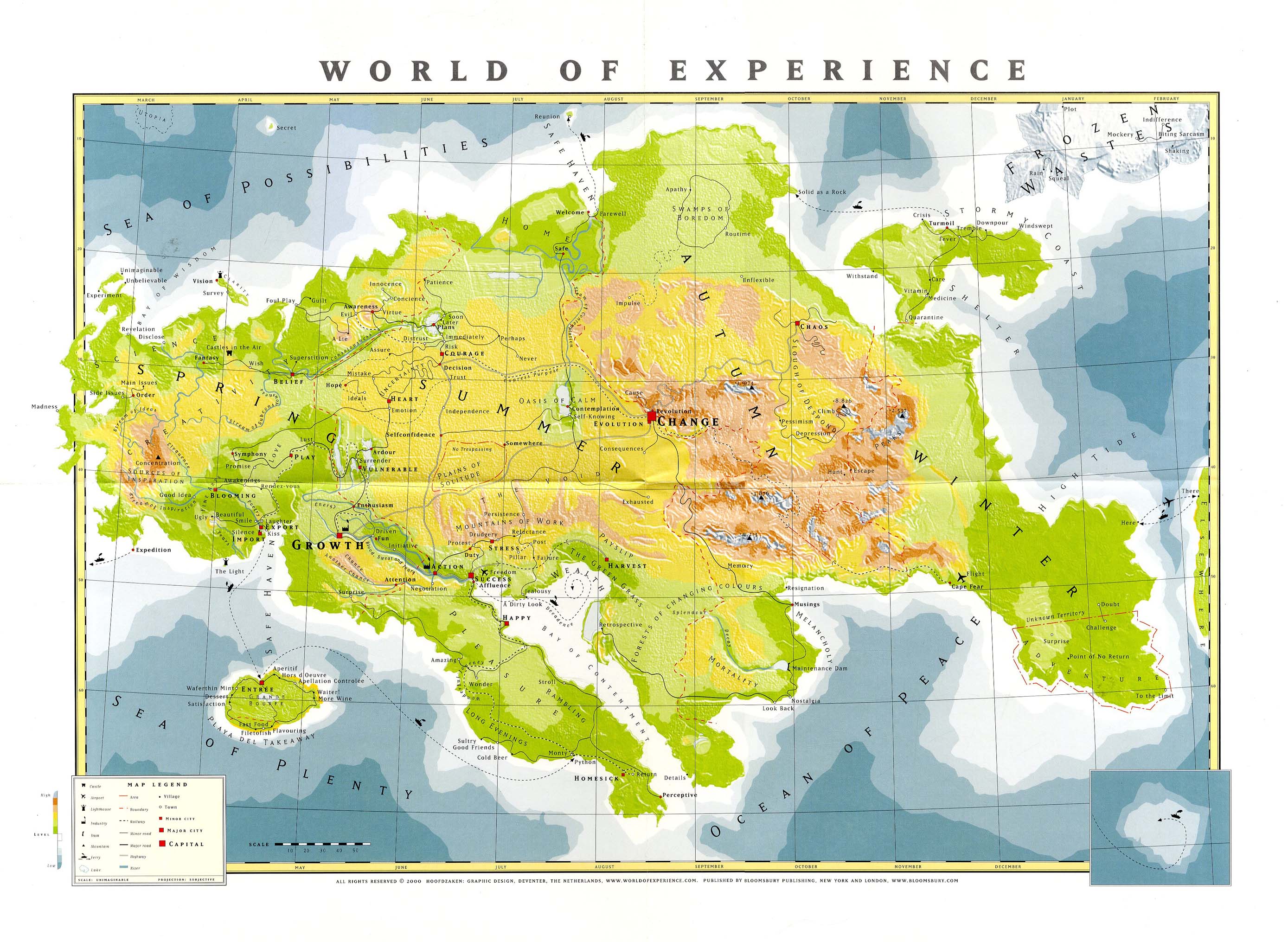
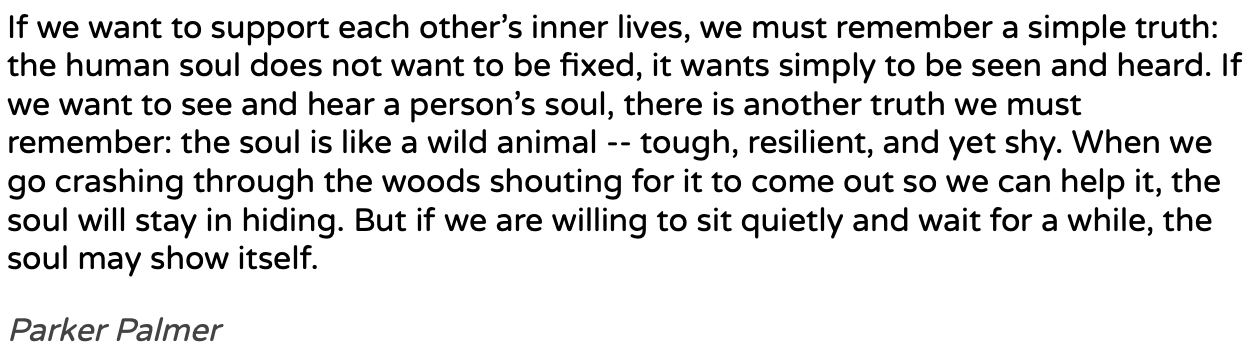
One of my favorite activities during the LEAD workshops was using the World of Experience as a tool to examine where I’ve been and where I want to go. If you’ve never seen it before, you can check out the World of Experience at the LEAD table in the fellowship hall after the service. In the meantime, picture this in your mind. A map that, at first glance, looks like it could be a two-dimensional representation of the Earth. On closer inspection, however, the familiar continents and oceans are replaced by other geographies, named for elements of the human experience. For example, the sea of possibilities, mountains of work, and plains of solitude.
On several occasions we used the World of Experience as a way to articulate the challenges or adventures in our past and present, and where we hoped to navigate in the future. In all of my conversations, my partners shared their journeys with unapologetic honesty, and invited the same vulnerability from me. The guiding principles practiced during the LEAD series were touchstones created by Parker Palmer and the Center for Courage and Renewal. One of these is “no fixing, saving, advising, or correcting each other.” In our type A problem solving culture, that’s a particularly tough one for many of us to follow, but it’s so important. Participating in the LEAD workshops reminded me that this congregation is a safe place for me, where my wild animal soul can show itself. That’s how I experience moments of mystery and wonder–when I feel truly seen and understood.
This year I attended General Assembly, the Unitarian Universalist Association’s annual gathering, for the first time. I had long wanted to experience GA, but to be honest I was also super anxious about it. When I arrived in Pittsburgh and checked into my airbnb, I texted Gay and Elizabeth. What am I doing here? I asked them. Of course, they were both kind and reassuring. I felt their hugs from 250 miles away. Then I arrived at the convention center, and I found Diane and Bruce and I knew everything would be ok. I had tacos with LeeAnn, and reconnected with folks who I first met at UUCA but who have moved on to other churches, and I made new friends. Knowing I was among so many people who share my UU values and commitment to repairing the world was exactly what I needed and hoped to experience at GA.
Of course, church is far from the only community that can nurture the soul. Some communities are intimate and some are vast but both can offer sustenance. My 16-year-old is a member of the seemingly infinite community of Swifties–devotees of pop star Taylor Swift. While her knowledge of Taylor Swift’s catalog and every minute detail of every concert on the Eras Tour may verge on obsessive, it is clear that she and other Swifties find joy and meaning in listening to the music, experiencing the music, and talking about the music with each other.
The community my 10-year-old thinks of as their second home is SMYAL, a DC-based organization that provides resources, connections, and activities for LGBTQIA+ young people ages 6 to 24. My kid has found kindred spirits, role models, and unwavering and unconditional support for their whole self. Their wild animal soul feels free to lead a dance party whenever they’re with their SMYAL peeps.
As Parker Palmer wrote, “If we want to support each other’s inner lives, we must remember a simple truth: the human soul does not want to be fixed, it wants simply to be seen and heard.” I am thankful to be a member of this and other communities where my soul can be seen and heard. Cultivating that kind of community–something greater than any of us individually, which can only be created with intention and love–is a sacred act. Sometimes we can build community, and other times we just stumble into it. We don’t always know where we will find community, or where we will experience that sensation of truly belonging, but we surely know it when we feel it. Some may call that providence, or divine intervention. To me, that certainty of belonging is a product of the mystery and wonder of the universe. Whatever you call it, I wish for you the comfort, safety, and nourishment of community, wherever you may find it. May it be so.
Share this:


I realized today that when friend after friend from church hugged me this weekend and said, “I haven’t seen you for so long! I’ve missed you! I’m so glad to see you!” that not a single one of them was trying to make me feel guilty about not coming to church or accusing me of being a bad friend. Every single hug was accompanied by genuine joy. Every single person made me feel loved and valued just for being me and for appearing right in front of them at that moment. I wasn’t required to do or accomplish or prove anything. They were just happy to see me because I’m me. And I was equally happy to see them. Now why is that so hard to believe? I’ve been letting that sink in all day.
While are long past the “stay in your bubble” phase of the pandemic, collectively and individually we’ve had to retreat into new bubbles, emerge from them, retreat again, and sometimes the bubbles just pop. There’s no more universal wisdom. I assume there is new science but if there is legitimate and agreed-upon public health guidance based on the new science, I sure haven’t heard about it. And so everyone has their own extremely specific ideas about what they should and shouldn’t do, although they might change from day to day or situation to situation, and they remain emotionally fraught. As of January 2023, every time you leave your house you have to take into account your tolerance for risk, the tolerance for risk of anyone you might be interacting with, and the house rules for anywhere you’re going to go. We’ve never been so aware of the fact that our behaviors can seriously affect others, even though we may still be unsure of exactly how.
Ever since I was a teenager, being part of a faith community has mattered to me. And because of my personality, my DNA, my enneagram type (two), or whatever other measure you might use, when I am in any community, I mean to make a difference. When I do not have a specific role to fulfill, I can feel lost and useless. I am not saying this is a good thing or a bad thing. It is simply how I have felt for most of my life. I have spent some amount of energy in recent years reminding myself that I am important not just for what I can do, but for just being me. You would think it would take the pressure off.

Being in a faith community can also be hard as hell. Yesterday I participated in a workshop at church for people who want to be–or already are–leaders in the church, about how leadership in a congregation should not simply be out of duty, but should be about. sharing our gifts with others to make the community better, and should include elements of holiness, joy, and fun. As Rev. Amanda jokingly reminded us, however, the challenge of church is that it’s made up of people. And people are human. And humans make mistakes. And sometimes church (or any other faith community) breaks your heart. She asked how many people had experienced that particular kind of heartbreak when the community you revere disappoints you. Most people raised their hands. I realized that every single congregation I’ve been a part of has broken my heart. I take that back–the church I attended in college did not at any point crush my spirit, but I’m not sure I was involved enough for that to count. I was part of the college ministry of the church for a few years and I don’t recall anything bad happening there. But four other congregations rocked by some kind of scandal or rift or bad behavior is plenty. Rev. Amanda said making the effort to repair and heal from the brokenness matters, and makes the community stronger. But it also requires a lot of courage and commitment to put yourself back into the fray.
In my current congregation, the Unitarian Universalist Church of Arlington, I was asked to be a leader soon after I arrived. I had come to the church warily, certain that I could not find a community where I both agreed with the theology and would be treated like I mattered. Immediately, I felt a sense of belonging. I served as a worship associate, helping craft and lead services. When the minister had to leave (i.e. heartbreaking experience #4), I was asked to help orient the temporary minister to her role until an interim minister was found. I helped the interim minister as a worship associate. Then I was asked to serve on the ministerial search committee to find a permanent minister. This was a two-year obligation that was beyond time-consuming and also incredibly rewarding. And just as we were concluding the search, the pandemic hit. Our new minister (the aforementioned Rev. Amanda) was called to a congregation that largely existed at that point as hundreds of little boxes in a zoom meeting. And then, my job was done. I tried to do zoom church for a while, but it made me too sad, for so many reasons. I did some church classes and workshops and meetings through zoom. Some of them were good. Some were frustrating because I had to do them from my bedroom, propped up in my bed, in an effort to find any semblance of privacy. There is no privacy in my house. I just got tired of it all. I’m an extrovert. Zoom is exhausting. There are no hugs.
At some point church reopened. Then it closed again. And reopened. I hate wearing a mask. I do it, of course, when called upon. But it still makes my face sweat and my glasses fog up unless I go through various machinations to adjust and readjust it. And I realized during the pandemic that I have a hard time understanding people speaking when I can’t see their mouths. I also realized I have a hard time recognizing people who are wearing masks, especially when I haven’t seen them for a couple years. So when I went back to in-person church for the first time in a while sometime last year, I felt so lost and confused. After the service I just sat in the back and cried. I felt like I had completely forgotten who I was or how to be with other people. It was awful.

I had dipped my toe in the church waters in the fall when I volunteered to co-facilitate a covenant group for parents of gender-expansive kids. I’ve remembered how satisfying it is to choose readings and music that make people think and feel. (See quotes sprinkled throughout this post.) Yesterday at the leadership workshop I remembered how, even though I cannot sit still for very long, I love being in a room with other humans who are trying to nurture themselves and use their spiritual gifts to do something good for their community. Tikkun olam! These are my people.
Today I went back to church for the service. I sat near the front where I love to sit. I wore my mask and had to adjust it and got a little sweaty but survived. More importantly, I listened to the wisdom lesson which was one of my all-time favorite children’s stories and beautifully illustrates what Unitarian Universalism is. I geeked out on the sermon about why the history and principles of the UU tradition matter and how we are still evolving and transforming, as individuals and as a faith. I sang hymns, some of which I like and some of which are just ok. And I hugged people. And they welcomed me. It’s been a while, but no one judged. My heart was full and I was home again. AMEN.

Share this:


This morning I took the mouse that had been squeaking all night (because it was stuck in a glue trap designed to catch roaches and other insects) and carried it into the backyard and pried its little paws and matted fur off of the glue and left it in the grass. I have no idea if it will survive, but I didn’t know what else to do. I couldn’t kill it, although we’ve had mousetraps all over our house for months because of a persistent colony. When the mousetraps kill them, I bag the bodies and the traps and put them outside for the trash. The line between active and passive destruction is thin.
The mouse did not ask to be made into a metaphor. And yet.
There is nothing particularly wrong with me, any more than anyone else. I am more sensitive than most. I have a sleep disorder and other minor afflictions. But this world. The conflict. The cruelty. The confusion. The things that smell bad. It’s like layer upon layer of glue traps of injustice and illness and insecurity. No amount of alliteration can save us. Nothing we can do eliminates the suffering.
Today is Easter. Resurrection–to me–is another metaphor. An opportunity to remind ourselves of all the possibilities of life that emerge from the darkest of days.

This week we spent a few days at the beach. For most of our trip, it was cold and windy. Sitting on the sand and watching the waves was lovely but a bit chilly. The boardwalk was deserted at first. We spent time inside, reading and writing and drawing, and then it warmed up. Everyone else noticed too, and there were suddenly plenty of people on the beach, even though it was still too cool to swim. Who knows what all those other people were doing inside while it was cold, but when the sun came out, they did too. Possibilities opening up like the tulips that lined the sidewalks.
Traveling magnifies the intensity of parenting by 1,000. There are even more decisions than usual to make. Calculations become more complex when you factor in everyone’s desires, preferences, and needs–whether they are stated explicitly or you happen to know them or you’re somehow supposed to guess correctly what they are. Traveling reminds me that I cannot make everyone happy, and that no matter how much I might want to, it’s ultimately not my job and not within my power. I do a lot for my kids, but I can’t (and shouldn’t) do everything. The Easter Bunny did not come to our house today. I warned the kids yesterday that the Bunny was just not available this year, and that there were plenty of other celebrations happening, as both of their birthdays and mine are this month. They both said repeatedly that it was fine and they didn’t mind. Easter is much more of a cultural event to them than a religious one. They are both savvy about the nature of middle-of-the-night visiting creatures (our resident mice never bring us any treats). We just splurged on treats during our beach trip, and we still have plenty of candy left over from their Christmas stockings. Niki said, “I get it. The Easter Bunny is stuck in traffic, has bills to pay, calls to make.” They understand. They are not deprived. I had a couple flashes of guilt, but they were fleeting.
This afternoon I stepped outside to see if the sticky mouse was still in the grass where I had left them. I did not see any sign of them. I hoped that they managed to find refuge somewhere (other than back in our house, maybe?) and some way of removing the residue from their paws. I wonder if the mice still in here are missing that little dude. I can’t think too much more about this or I will become very sad. Absolutely there are much larger and more pressing problems in the world, but it comes back once again to my compulsion to bear witness to suffering, and examination of my role in alleviating it. The mouse remains a metaphor.
Share this:

I give myself unlimited chances
and infinite wishes
That I can choose to grant
I cultivate curiosity
exchange skepticism for wonder
I create simply for creation’s sake
Offering the same opportunity to others
I draw with a thick black marker (chisel tip) the delineation between me and you
And I will shimmer and shine in my own space while you do as you wish in yours
Share this:

I have heard that the cracks are where the light comes in
And in the places we were broken we are stronger
That’s what the poets say
But someone has to sweep up the pieces, to find every last one, and set to work with toothpicks and superglue
Because we the people are shattered, scattered, smashed to bits
According to the sages
our scars make us who we are
But to have a scar we must stop the bleeding and heal the wound.
For now the blood still flows
the wounds are open
the battle continues
Share this:

Never before
have I been asked
by so many people
to pray
This moment
must require
immense
energy
from all
of us
We understand
(at last)
how much
we are bound
up in each
other
Prayer
(to me)
is intention
not
transaction
So I breathe in
(deeply)
and breathe out
fully
and send
prayers
for
strength
courage
peace
relief
patience
healing
grace
calm
presence
Take what you need
and share
the rest
with
others

 You Ask a Lot of Questions