You are currently browsing the category archive for the ‘sermon’ category.
Yesterday I had the privilege of leading the service at UUCA with my friend and fellow worship associate Tommy Lo, featuring insightful reflections from Amy Dryer and Roberta Finkelstein, all on the theme of genuine invitations. Also great music from our new music director, David Mann. We heard people were moved to tears, so we did our job. 🙂 Click the video above to watch the service.
Here is my reflection from the service:
Last week my 11-year-old and I received an unexpected invitation. Our poet friend Regie Cabico called to ask if Niki and I would write poems for an event celebrating the freedom to read. We met Regie last year when he taught a poetry unit to Niki’s class, which unleashed the poet in Niki who we had previously never met. Niki actually won the inaugural poetry slam at their school, and was a finalist in the UU Congregation of Sterling’s poetry slam, where all the other poets were adults, including me.
The Celebration of Reading event was designed to clap back at the rising tide of book bannings, especially books by and about queer people, people of color, people with disabilities, and other identities that are unfathomably threatening to those who love censorship. Apparently some of these folks also feel threatened by great soccer players and cows. One of the books on the table was a little golden book about Argentinian soccer star Lionel Messi. Was it banned by soccer fans who preferred Real Madrid to Barcelona, where Messi spent most of his career? Another banned book was Click Clack Moo: Cows that Type, a long-time favorite in our family, about farm animals who find a typewriter and demand upgrades in their accommodations from the farmer. Perhaps those who want to ban this book fear an uprising from cows who might read it?
Anyway, Regie wanted Niki and me to write about how books have shaped our identities and changed our lives. In my poem I wrote about Are You There God? It’s Me, Margaret, and thanked Judy Blume for unlocking the mysteries of puberty. I wrote about The Color Purple and thanked Alice Walker for teaching me the universality of tenderness and tenacity. I wrote about The Hate You Give and thanked Angie Thomas for replacing headlines with humanity and empathy.
And I wrote about books featuring queer characters that have opened the world for my family. Here’s one short passage from my poem, about a book called Sir Callie and the Champions of Helston.
Thank you to Esme Symes-Smith
for bringing Callie into our lives.
I’ve never had a wish to be a knight of the realm
or a princess in the palace,
but I have never felt more seen than
reading about how Callie’s dad did his best
to fight for his nonbinary would-be knight
to claim their power
in the old-fashioned
heteronormative kingdom of Helston.
In Niki’s poem, they wrote about times they were criticized for disrupting gender stereotypes, long before they came out as nonbinary. And they wrote about Magnus Chase and the Gods of Asgard, a series by Rick Riordan, which includes a character named Alex Fierro who identifies as gender fluid. Niki wrote that they always knew they were different, but they didn’t have the language to describe how they felt until they read Alex Fierro’s words explaining how they weren’t just a boy or just a girl.
Niki and I read the Magnus Chase books together the summer between their second and third grade years. I had no idea when we started reading them that gender identity would be a major theme in the books, which are largely based on Norse mythology. Although I’ve since learned there is a lot of gender expansiveness in Norse mythology, so it makes sense. I am thankful to Rick Riordan for creating Alex Fierro and giving my kid the vocabulary to articulate their identity.
In the years since Niki came out, I have spent a lot of time educating myself about gender and sexuality and making sure that my kid is surrounded by people who support them and embrace their identity, and the resources they need to grow up healthy and confident as their unique awesome self. When we invite young people to be themselves, we have to actually mean it. We owe it to them to do everything in our power to ensure that their schools and teams and troops and congregations and all the environments they’re in are willing and able to show them they are perfect just as they are.
I also try to make sure other families have the information and connections they need to support their LGBTQIA+ kids. That’s why my friend Tracey and I started a covenant group a few years ago for parents of gender-expansive kids. And why we created QA2: Queer and Questioning, Awareness and Acceptance–an event for LGBTQIA+ young people and their families last year. At last year’s gathering we invited dozens of community organizations to participate so kids and their families could see what resources are available, ask questions, and make connections. We invited a fantastic panel of queer individuals and advocates to speak about their experiences and offer advice.
This year, we’re doing it again, but bigger and better. We’re going to have workshops on gender-affirming care, legal issues, and queer futures. We’re going to have vendors who offer products and services that specifically meet the needs of queer young people. This event is open to the public and we hope to have hundreds of folks from across the DMV coming through our doors, knowing they will be 100% welcomed and supported by everyone we’ve invited to be here.
Which brings me to my invitation to you. We have some fierce mama bears organizing this year’s QA2, but we still need help. If you have connections to LGBTQIA+ friendly service providers, we want to hear about them. If you are part of an LGBTQIA+ organization, we want to hear from you. And even if you don’t have any of these connections, or even know any queer youth, but you want to help, we will absolutely find a job for you. We need people to help organize, and also folks to help with logistics on the day of the event–October 5. If you have any questions or suggestions or want to volunteer, I invite you to talk with me after the service or email me. If you go to the church website and search for QA2 you can find the address to contact me directly.
Like I said before, when we invite someone to come out, we’ve got to make sure they’re coming out into a safe and welcome space. I invite all of us to create that space, and protect it fiercely and unapologetically. May it be so.
Throughout the service we talked about different kinds of invitations. And we created some actual invitations for folks to take with them when they left the service. We invited everyone to take an invitation of their choice for themselves, or for someone else, or both. Accept the invitation, we said, and see what happens. Here are the pages of cards that we cut up and offered to everyone.


Share this:

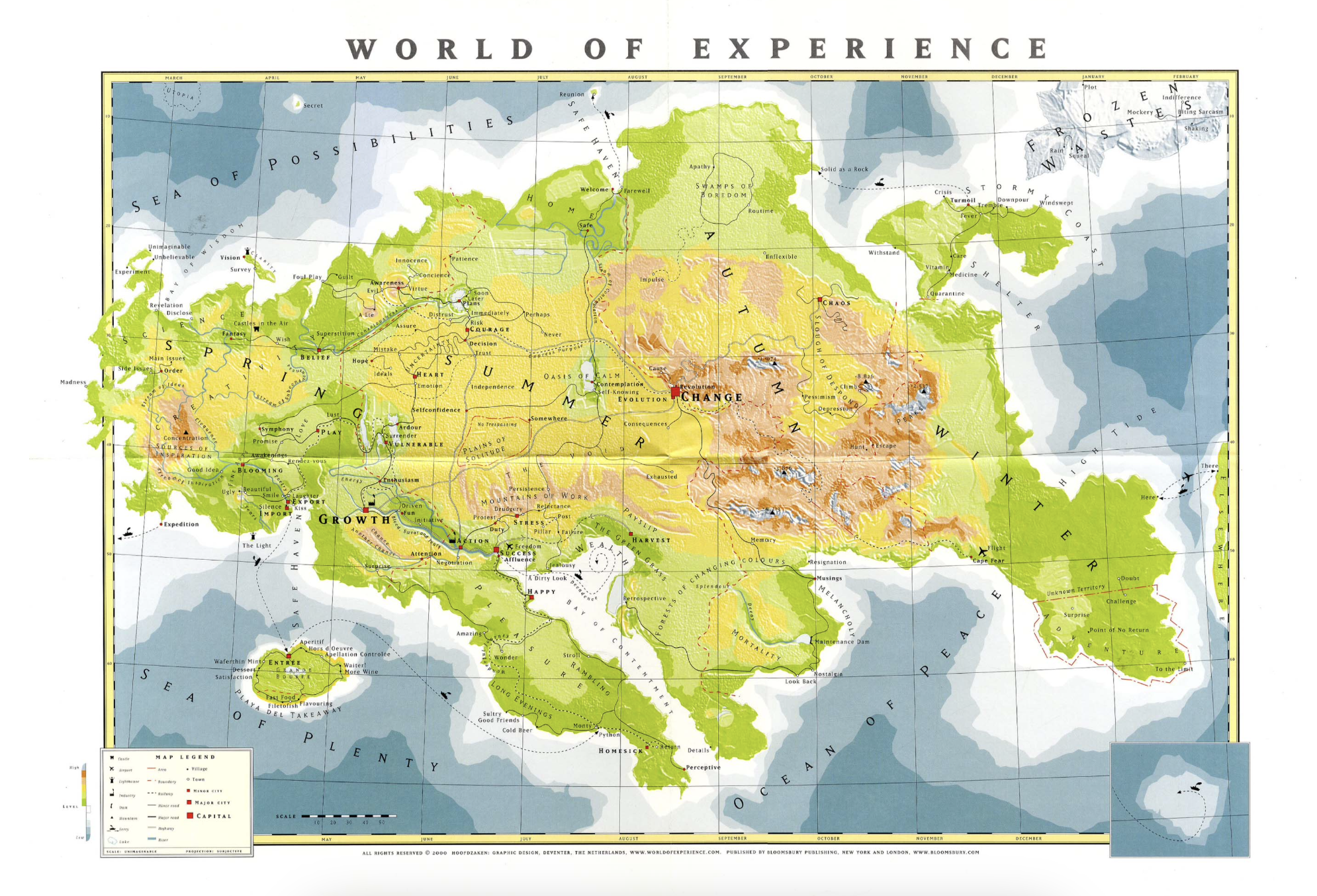
If we want to support each other’s inner lives, we must remember a simple truth: the human soul does not want to be fixed, it wants simply to be seen and heard. If we want to see and hear a person’s soul, there is another truth we must remember: the swoul is like a wild animal — tough, resilient, and yet shy. When we go crashing through the woods shouting for it to come out so we can help it, the soul will stay in hiding. But if we are willing to sit quietly and wait for a while, the soul may show itself.
~Parker Palmer
This is a talk I shared during a Sunday service at the Unitarian Universalist Church of Arlington as part of the church’s series on the six sources of Unitarian Universalism. My writing was inspired by this source: direct experience of that transcending mystery and wonder, affirmed in all cultures, which moves us to a renewal of the spirit and an openness to the forces which create and uphold life.
For two years I spent a good chunk of my waking hours talking and writing about this church. As a member of the ministerial search committee, I met with my fellow committee members weekly, and we worked doggedly to discern what the congregation needed in a new minister. Surprise–Unitarian Universalists have a lot of opinions! Our committee had to digest, synthesize, and transform what we learned into UUCA’s church profile, an incredibly elaborate version of a job announcement. Then we spent months reviewing applications and sermons of prospective ministers. This role and its attendant responsibilities were heady–and hard–and ultimately richly rewarding. It was a privilege to serve UUCA in this capacity, and if I’m being honest, it made me feel kind of important. It’s easy for me to make the mistake that what I do for a community is more valuable than who I am.
Now, raise your hand if you were part of UUCA in any way in the spring of 2020. You may recall that, just as our committee was preparing to recommend Rev. Amanda as the candidate for our senior minister, the pandemic shut everything down. All of our plans to introduce her to the congregation, celebrate a new beginning, and enjoy the fruits of our committee’s labor were funneled online or simply forgotten in the crush of a worldwide crisis.
I know every one of you here in the sanctuary or watching online has a story like this–or a very different one. There are likely a million variations on the theme of how things changed in 2020. Now, four years later, I am still feeling the effects of those changes, for better or worse. Maybe you are too. Who knows how long the ripples will expand throughout our lives?
Church has always meant community for me. Throughout my life, community often outweighed theology in my choice of a congregation. I feel lucky to have found in UUCA a place where I feel both a sense of belonging and alignment with the tenets of the faith. From the moment I arrived at UUCA, I felt seen. I felt valued. I understood that my being here mattered.
Unfortunately, for a good portion of the years since 2020, I lost that sense of belonging, not just here, but really anywhere. Does that sound at all familiar to you? The isolation of the pandemic was soul crushing. And I am a big believer in silver linings. I love my family so much, and I am so thankful for the hours we spent playing board games, watching movies, making art, and going on hikes. But the four of us did not a whole community make. I need different kinds of people and multiple communities to nurture various aspects of my personality and my identity. All of us do.
There’s a wonderful graphic novel series called Heartstopper, which is now an amazing Netflix show, that my kids adore and introduced me to and which I love now as well. First of all, Heartstopper creator Alice Oseman does a masterful job portraying the pain and beauty of making your way as a teenager, particularly as you come into your gender identity and sexual orientation. Secondly, in book four of the series, Charlie–one of the main characters–comes face to face with what feels like an insurmountable struggle. His boyfriend, Nick, wants so badly, as all of us do when we love someone, to be able to fix Charlie’s problem, but of course he can’t. And Nick realizes that, no matter how much he loves Charlie, he can’t and shouldn’t be everything to Charlie. Charlie needs a community to help him. As do we all.
I took baby steps to return to UUCA. I co-facilitated a covenant group for parents of gender-expansive kids. That was an easy one–a way to test the waters by creating a small community. Coming back to church on Sunday mornings, however, was a challenge. The first few times I tried, I felt confused and out of sorts. When we were all masked, I felt embarrassed because I didn’t recognize people who I had known for years. That kept me home for a while longer. When I came back again, I felt like I had somehow forgotten how to interact with other humans. Once after the service ended, I just sat in the back and cried. Holly saw me and sat with me. She didn’t ask me to explain myself. She just kept me company.
When I heard about the LEAD program that Greg and LeeAnn were running, I knew I had found a path back to community. I wasn’t sure what my role was supposed to be in the congregation, but this was an opportunity to meet new people and reconnect with old friends, so I took it.
The irony–or perhaps the true intention–of joining LEAD was being reminded that I didn’t need to have a leadership position or a particular responsibility in the congregation to belong. When I arrived for that first workshop, I was so warmly welcomed back. Wendy and Kristen, among other folks, let me know that they were genuinely delighted to see me again, without asking why I hadn’t come back sooner, or what I was going to be doing for the church now that I was back, or without any other expectations of me whatsoever. After the session, I gave Kristen a ride home and we sat in my car, parked outside her house, for an hour catching up. It was such a relief to renew that connection. I know I’m name dropping a lot this morning. I intentionally want to recognize the people who have shown me so much grace and love in building and rebuilding community here.
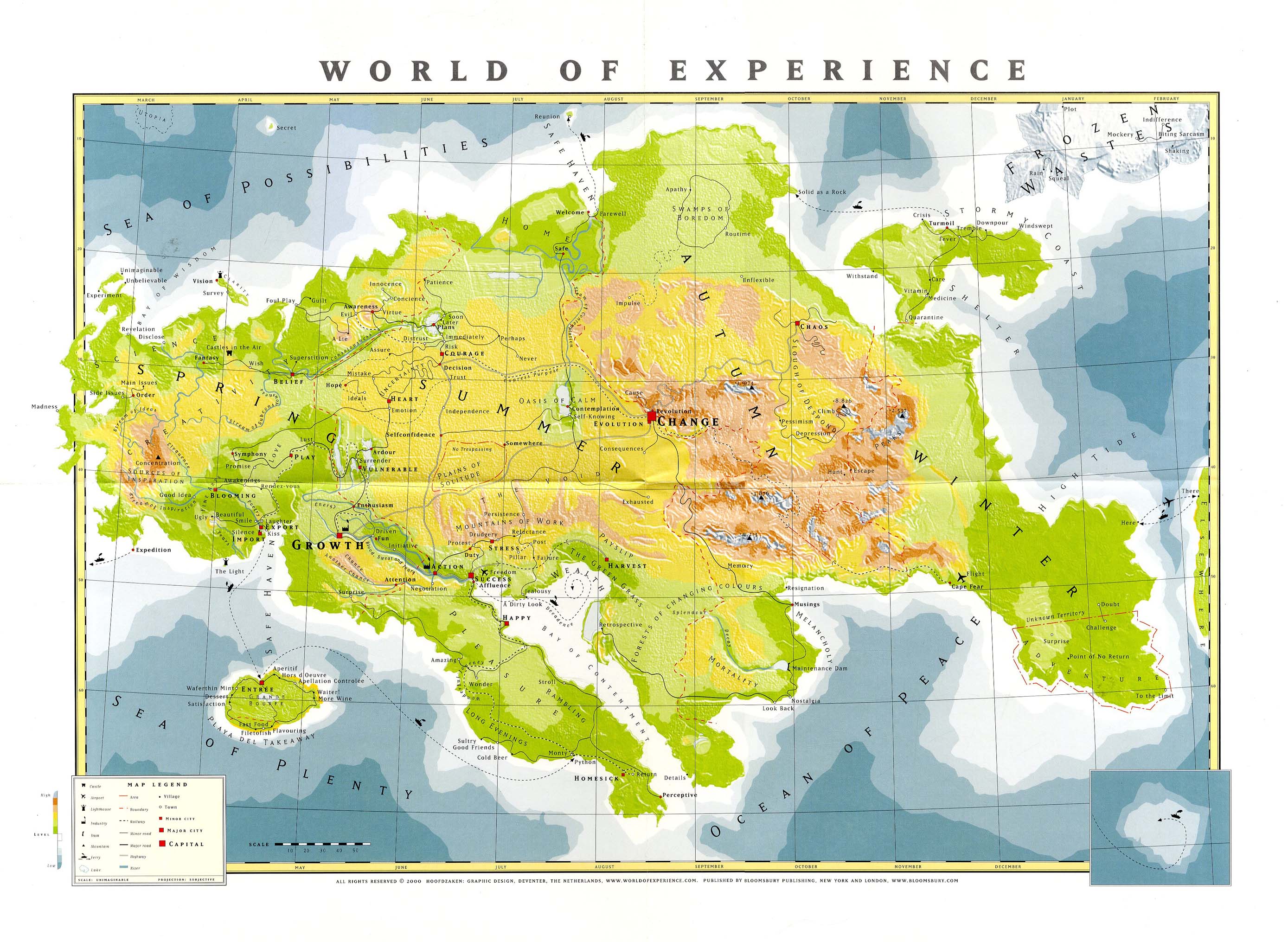
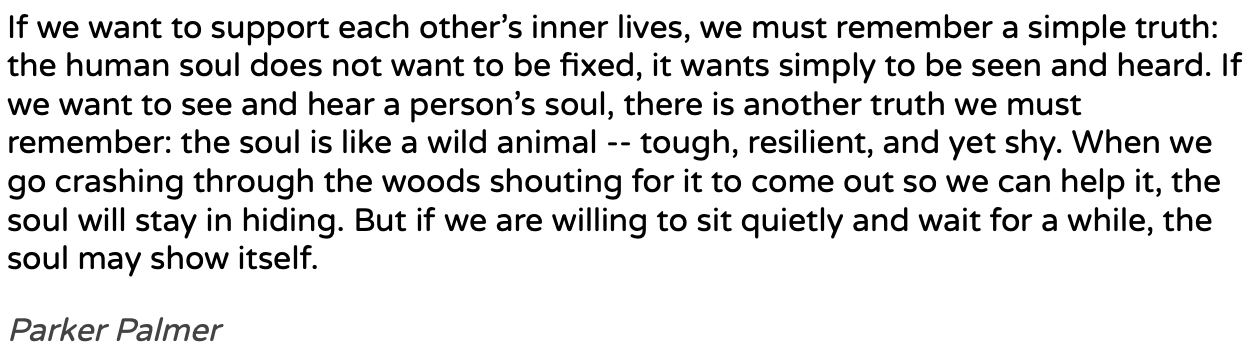
One of my favorite activities during the LEAD workshops was using the World of Experience as a tool to examine where I’ve been and where I want to go. If you’ve never seen it before, you can check out the World of Experience at the LEAD table in the fellowship hall after the service. In the meantime, picture this in your mind. A map that, at first glance, looks like it could be a two-dimensional representation of the Earth. On closer inspection, however, the familiar continents and oceans are replaced by other geographies, named for elements of the human experience. For example, the sea of possibilities, mountains of work, and plains of solitude.
On several occasions we used the World of Experience as a way to articulate the challenges or adventures in our past and present, and where we hoped to navigate in the future. In all of my conversations, my partners shared their journeys with unapologetic honesty, and invited the same vulnerability from me. The guiding principles practiced during the LEAD series were touchstones created by Parker Palmer and the Center for Courage and Renewal. One of these is “no fixing, saving, advising, or correcting each other.” In our type A problem solving culture, that’s a particularly tough one for many of us to follow, but it’s so important. Participating in the LEAD workshops reminded me that this congregation is a safe place for me, where my wild animal soul can show itself. That’s how I experience moments of mystery and wonder–when I feel truly seen and understood.
This year I attended General Assembly, the Unitarian Universalist Association’s annual gathering, for the first time. I had long wanted to experience GA, but to be honest I was also super anxious about it. When I arrived in Pittsburgh and checked into my airbnb, I texted Gay and Elizabeth. What am I doing here? I asked them. Of course, they were both kind and reassuring. I felt their hugs from 250 miles away. Then I arrived at the convention center, and I found Diane and Bruce and I knew everything would be ok. I had tacos with LeeAnn, and reconnected with folks who I first met at UUCA but who have moved on to other churches, and I made new friends. Knowing I was among so many people who share my UU values and commitment to repairing the world was exactly what I needed and hoped to experience at GA.
Of course, church is far from the only community that can nurture the soul. Some communities are intimate and some are vast but both can offer sustenance. My 16-year-old is a member of the seemingly infinite community of Swifties–devotees of pop star Taylor Swift. While her knowledge of Taylor Swift’s catalog and every minute detail of every concert on the Eras Tour may verge on obsessive, it is clear that she and other Swifties find joy and meaning in listening to the music, experiencing the music, and talking about the music with each other.
The community my 10-year-old thinks of as their second home is SMYAL, a DC-based organization that provides resources, connections, and activities for LGBTQIA+ young people ages 6 to 24. My kid has found kindred spirits, role models, and unwavering and unconditional support for their whole self. Their wild animal soul feels free to lead a dance party whenever they’re with their SMYAL peeps.
As Parker Palmer wrote, “If we want to support each other’s inner lives, we must remember a simple truth: the human soul does not want to be fixed, it wants simply to be seen and heard.” I am thankful to be a member of this and other communities where my soul can be seen and heard. Cultivating that kind of community–something greater than any of us individually, which can only be created with intention and love–is a sacred act. Sometimes we can build community, and other times we just stumble into it. We don’t always know where we will find community, or where we will experience that sensation of truly belonging, but we surely know it when we feel it. Some may call that providence, or divine intervention. To me, that certainty of belonging is a product of the mystery and wonder of the universe. Whatever you call it, I wish for you the comfort, safety, and nourishment of community, wherever you may find it. May it be so.
Share this:


I realized today that when friend after friend from church hugged me this weekend and said, “I haven’t seen you for so long! I’ve missed you! I’m so glad to see you!” that not a single one of them was trying to make me feel guilty about not coming to church or accusing me of being a bad friend. Every single hug was accompanied by genuine joy. Every single person made me feel loved and valued just for being me and for appearing right in front of them at that moment. I wasn’t required to do or accomplish or prove anything. They were just happy to see me because I’m me. And I was equally happy to see them. Now why is that so hard to believe? I’ve been letting that sink in all day.
While are long past the “stay in your bubble” phase of the pandemic, collectively and individually we’ve had to retreat into new bubbles, emerge from them, retreat again, and sometimes the bubbles just pop. There’s no more universal wisdom. I assume there is new science but if there is legitimate and agreed-upon public health guidance based on the new science, I sure haven’t heard about it. And so everyone has their own extremely specific ideas about what they should and shouldn’t do, although they might change from day to day or situation to situation, and they remain emotionally fraught. As of January 2023, every time you leave your house you have to take into account your tolerance for risk, the tolerance for risk of anyone you might be interacting with, and the house rules for anywhere you’re going to go. We’ve never been so aware of the fact that our behaviors can seriously affect others, even though we may still be unsure of exactly how.
Ever since I was a teenager, being part of a faith community has mattered to me. And because of my personality, my DNA, my enneagram type (two), or whatever other measure you might use, when I am in any community, I mean to make a difference. When I do not have a specific role to fulfill, I can feel lost and useless. I am not saying this is a good thing or a bad thing. It is simply how I have felt for most of my life. I have spent some amount of energy in recent years reminding myself that I am important not just for what I can do, but for just being me. You would think it would take the pressure off.

Being in a faith community can also be hard as hell. Yesterday I participated in a workshop at church for people who want to be–or already are–leaders in the church, about how leadership in a congregation should not simply be out of duty, but should be about. sharing our gifts with others to make the community better, and should include elements of holiness, joy, and fun. As Rev. Amanda jokingly reminded us, however, the challenge of church is that it’s made up of people. And people are human. And humans make mistakes. And sometimes church (or any other faith community) breaks your heart. She asked how many people had experienced that particular kind of heartbreak when the community you revere disappoints you. Most people raised their hands. I realized that every single congregation I’ve been a part of has broken my heart. I take that back–the church I attended in college did not at any point crush my spirit, but I’m not sure I was involved enough for that to count. I was part of the college ministry of the church for a few years and I don’t recall anything bad happening there. But four other congregations rocked by some kind of scandal or rift or bad behavior is plenty. Rev. Amanda said making the effort to repair and heal from the brokenness matters, and makes the community stronger. But it also requires a lot of courage and commitment to put yourself back into the fray.
In my current congregation, the Unitarian Universalist Church of Arlington, I was asked to be a leader soon after I arrived. I had come to the church warily, certain that I could not find a community where I both agreed with the theology and would be treated like I mattered. Immediately, I felt a sense of belonging. I served as a worship associate, helping craft and lead services. When the minister had to leave (i.e. heartbreaking experience #4), I was asked to help orient the temporary minister to her role until an interim minister was found. I helped the interim minister as a worship associate. Then I was asked to serve on the ministerial search committee to find a permanent minister. This was a two-year obligation that was beyond time-consuming and also incredibly rewarding. And just as we were concluding the search, the pandemic hit. Our new minister (the aforementioned Rev. Amanda) was called to a congregation that largely existed at that point as hundreds of little boxes in a zoom meeting. And then, my job was done. I tried to do zoom church for a while, but it made me too sad, for so many reasons. I did some church classes and workshops and meetings through zoom. Some of them were good. Some were frustrating because I had to do them from my bedroom, propped up in my bed, in an effort to find any semblance of privacy. There is no privacy in my house. I just got tired of it all. I’m an extrovert. Zoom is exhausting. There are no hugs.
At some point church reopened. Then it closed again. And reopened. I hate wearing a mask. I do it, of course, when called upon. But it still makes my face sweat and my glasses fog up unless I go through various machinations to adjust and readjust it. And I realized during the pandemic that I have a hard time understanding people speaking when I can’t see their mouths. I also realized I have a hard time recognizing people who are wearing masks, especially when I haven’t seen them for a couple years. So when I went back to in-person church for the first time in a while sometime last year, I felt so lost and confused. After the service I just sat in the back and cried. I felt like I had completely forgotten who I was or how to be with other people. It was awful.

I had dipped my toe in the church waters in the fall when I volunteered to co-facilitate a covenant group for parents of gender-expansive kids. I’ve remembered how satisfying it is to choose readings and music that make people think and feel. (See quotes sprinkled throughout this post.) Yesterday at the leadership workshop I remembered how, even though I cannot sit still for very long, I love being in a room with other humans who are trying to nurture themselves and use their spiritual gifts to do something good for their community. Tikkun olam! These are my people.
Today I went back to church for the service. I sat near the front where I love to sit. I wore my mask and had to adjust it and got a little sweaty but survived. More importantly, I listened to the wisdom lesson which was one of my all-time favorite children’s stories and beautifully illustrates what Unitarian Universalism is. I geeked out on the sermon about why the history and principles of the UU tradition matter and how we are still evolving and transforming, as individuals and as a faith. I sang hymns, some of which I like and some of which are just ok. And I hugged people. And they welcomed me. It’s been a while, but no one judged. My heart was full and I was home again. AMEN.

Share this:


Ordinarily I am distracted by looking at myself on zoom calls, but tonight at UUCA’s congregational meeting where we announced our call of Rev. Amanda Poppei to be our next senior minister and she accepted, I was beaming. I couldn’t stop smiling.
There are few endeavors I’ve been a part of that have been as demanding and singularly focused as the ministerial search committee. The two that come to mind are pregnancy and childbirth. While those experiences were definitely more physically taxing, I think serving on the MSC may have been more emotionally and intellectually challenging. Of course since it’s been 7 years since I was last pregnant I could be misremembering in that way that the details of childbirth become hazy when you’re removed from it.
In one of the books I just read, Writers & Lovers, the narrator—Casey—talks about how all the male writers she’s known have been unwaveringly confident that they have at least one great book inside, ready to be written. But neither she nor her female writer friends ever seem so sure, even when they devote their lives to writing that book. In one scene, Casey is talking with her obnoxious landlord and he says to her about her book something like, “I can’t imagine you have anything to say.” Which makes Casey wonder if she does.
I was thinking tonight about this and about a conversation I had with my friend Art from church at a leadership retreat a couple years ago. I don’t remember exactly what we were talking about except that it had to do with my writing, and what was keeping me from sharing more of it with the world. I think he asked me something like what was I afraid of, and I didn’t know. I realize now that this is vague and doesn’t sound particularly motivational, but whatever he said made me feel braver.
At first I resisted the nomination to join the MSC, for a variety of good reasons. Then my friend D, who is also a writer, and who served on a previous MSC, told me that the heart of the search process is storytelling, and that’s why I needed to serve. She explained that the first part of the search is listening to the congregation’s stories and crafting a narrative from them about the church. The next part of the process is listening to the stories of the ministers who apply for the position. And finally, you have to tell the story of your candidate to the congregation so they will see in the candidate what you saw and vote to call them as your minister. Of course this is a significant oversimplification, and she didn’t mention how many thousands of hours the whole thing takes, but what D describes was true. And I thought, that’s what I’m good at—listening to people and helping tell their stories.
Often when strangers ask what I do for a living and I say writer, they ask if I’ve written any books. No, I haven’t written any books, I explain. And most people move on or tune out after that. But if they actually want to know more, I tell them. And I am really proud of what I do. I’m proud of the people who I interview and write about and they say, “you made me sound so much more interesting than I actually am.” But they really are more interesting than they realize. I’m proud of the stories I write about nonprofit organizations that educate and inspire people to get involved or contribute. I’m proud of the essays and poems I write that people can relate to, or that make people laugh, or think about something differently. And I am proud of everything I wrote for the ministerial search committee because what I wrote helped us find a spectacular new minister. Of course I didn’t do it alone. Our team was made up of some of the most thoughtful, intelligent, and hardworking people I have ever known. The rest of them have skills and insights that I do not possess. But I am proud that my skills and insights mattered. D was absolutely correct that the search process is about storytelling. I feel so lucky to have had the opportunity to be a storyteller for this community that I love, especially knowing that the person we found to be our next minister is going to change people’s lives and those people will change the world, in ways large and small. To know this, and to know that words I wrote are catalysts, like the object at the beginning of a Rube Goldberg invention that gets the ball rolling to cause a spectacular chain reaction, fills me with joy.
I think girls and women are often told, subconsciously or overtly, to stay small and be nice, and are criticized when they stand up for themselves or proudly stand by their hard work. Elizabeth Warren, Taylor Swift, Megan Rapinoe, and Glennon Doyle are women I admire who come to mind, but there are a million more examples. I will probably never be famous, but I am a role model for my kids, and I’m a writer, and I’m proud of what I do.
Share this:


I’ve been taking for granted all the things I love to do that involve being surrounded by strangers. Hearing live music and singing along with people you’ve never met but who find meaning in the same songs that you do. Seeing a movie and laughing or crying along with everyone else who is laughing or crying. Eating delicious food at your favorite restaurant, noticing everyone else satisfying their craving for that same food. Exploring a museum, learning something new, being inspired, wondering how the exhibit is speaking to those around you. Going to the beach and watching people fly kites and build sandcastles and splash and swim and throw frisbees and soak up vitamin D. Being at church and listening to a sermon that might be preached just for you and also for hundreds of other souls searching for ways to make sense of the world, and lighting candles, and praying and meditating together, and holding hands and agreeing to help each other be a force for good in the world.

Even reading, which you might think of as a solitary activity, often involves strangers. I love going to the library–helping my kids pick out books and finding something for myself. And in Arlington I almost always run into someone I know at any library. Browsing in bookstores, which is as much a sensory experience as an intellectual one. I’m one of those people who likes to feel the covers of the books and inhale the scent of paper and ink. At my favorite bookstores there are post-it notes or little notecards taped to the shelves explaining which books are recommended by which of their booksellers and why. I love discovering wonderful things to read thanks to mysterious other readers who are humans rather than algorithms. This month I had planned to go with three good friends to hear Glennon Doyle read from and talk about her new book, Untamed. I would’ve been in the audience at the Lisner Auditorium with thousands of other fans, mostly middle-aged moms like me, feeling intense sisterly solidarity. I was also excited to go with one of my best friends to see one of my all-time favorite authors Ann Patchett speak at a local middle school. Being in a room with strangers and knowing they have all read the same books you’ve read and have been moved by them too is heady.
I’ve spent a considerable amount of time over the past 13 years at playgrounds, which are usually lively and well-populated. Around here, if you spend more than 10 minutes at a playground, you’re likely to hear families speaking in at least a couple languages besides English. It’s always fun for me to guess what language they’re speaking and where they might be from. I haven’t heard any languages besides English (random French, Spanish, or German phrases thrown around by my family notwithstanding) in a couple weeks now. Even when we’ve been out on hiking trails in Northern Virginia, I feel like I hear mostly English. We see a lot of white guys in their teens and 20s, some of them talking on their bluetooth earpieces, looking like they’re training for something big.
Just before coronavirus exploded in the US (fortuitously), I had the opportunity to be part of literacy activities at both my kids’ schools. At Zoe’s middle school, I coordinated Booktopia, where invited all 1,100 students to come to the gym (not all at once) to pick out a book to keep. Any book they wanted (that we had)! This involved a lot of volunteers who helped me sort, organize, and restock the books, then sell the leftovers at the used book sale at the school a few days later. Booktopia involved conversations with students and teachers and touching a lot of books that a lot of people had touched. I didn’t think too much about that at the time. The book fair at Zeke’s school was held the same week. This year the book fair was presented by one of my new favorite Arlington organizations–READ (Read Early and Daily). READ’s mission is “ensuring babies and young children have new, quality, culturally relevant books of their own that are mirrors and windows into their everyday lives and communities.” One of the ways READ funds its book giveaways is by running school book fairs. One of the best things about this set-up is that our school book fair had the most spectacular selection of books with diverse characters by diverse authors that I have ever encountered. And since I had just spent several months ordering books for Booktopia that featured diverse (in every possible way) characters written by diverse authors, I was super impressed. The point here is that book fairs are another occasion where many kids and teachers and parents are swirling around. I love helping kids pick out books. I love reading with kids. Now when I think about that I just think about all the possibility for transmission of germs.
Then there’s substituting as a co-oper at Arlington Unitarian Cooperative Preschool, which I have enjoyed doing on occasion since my kids graduated from there. Turns out it’s much less stressful to co-op when A) you’re not required to do it but you’re getting paid for it and B) your own child is not demanding your attention when you’re supposed to be helping with the whole class. The bad news is that infants, toddlers, and preschoolers are pretty indiscriminate about who or what they touch and when and it doesn’t matter where their hands have been. The good news is that AUCP is really into good handwashing. Every kid and every adult washes their hands before snack and after snack and after the playground and before lunch and after lunch and of course after diaper changes and using the potty. One of the lines I always remember from the many parent orientation sessions we attended there was the preschool’s fabulous director Susan Parker saying, “I suggest you invest in a good hand cream because you will be washing your hands all day long.” All that hand washing practice has paid off! So many adults have had to come up with creative ways to remember how to wash their hands properly, but I guarantee you that the five and under set at AUCP have it down already.

Next Monday would’ve been the first game of the soccer season with my amazing women’s team Ice & Ibuprofen. We have cool new jerseys for the season, with a new logo. I don’t know when we’ll have a chance to wear them. Soccer involves a lot of contact with other people. You could kick a ball back and forth while standing six feet apart, but you couldn’t play a game. I know a lot of my teammates know each other because they live in the same neighborhood and their kids go to school together, but I only see them on the field. We had tickets for our family to see the Washington Spirit play their season opener at Audi Field for my birthday. Randy has season tickets to DC United. There are few things as thrilling as cheering on your favorite players and teams in a stadium filled with tens of thousands of other fans. No matter how big your TV is, it’s not the same watching from your couch.
Even though we’re going a little stir-crazy, my family is fine. We have more than enough stimulating and fun activities to do in the house. And we’ve been hiking. We’ve been FaceTiming and Zooming with friends and family. All that is absolutely saving our sanity and keeping our brains engaged. But there’s something about being out in the world, surrounded by strangers, doing something you love and they love too, that I am missing deeply.
Share this:

Last Sunday my friend D and I led the service at UUCA, on the theme of Embracing the Mess. D wrote a great scene in which our kids (and one bonus kids) demonstrated how to make a mess and we figured out how to deal with it. This was not much of a stretch for any of us.
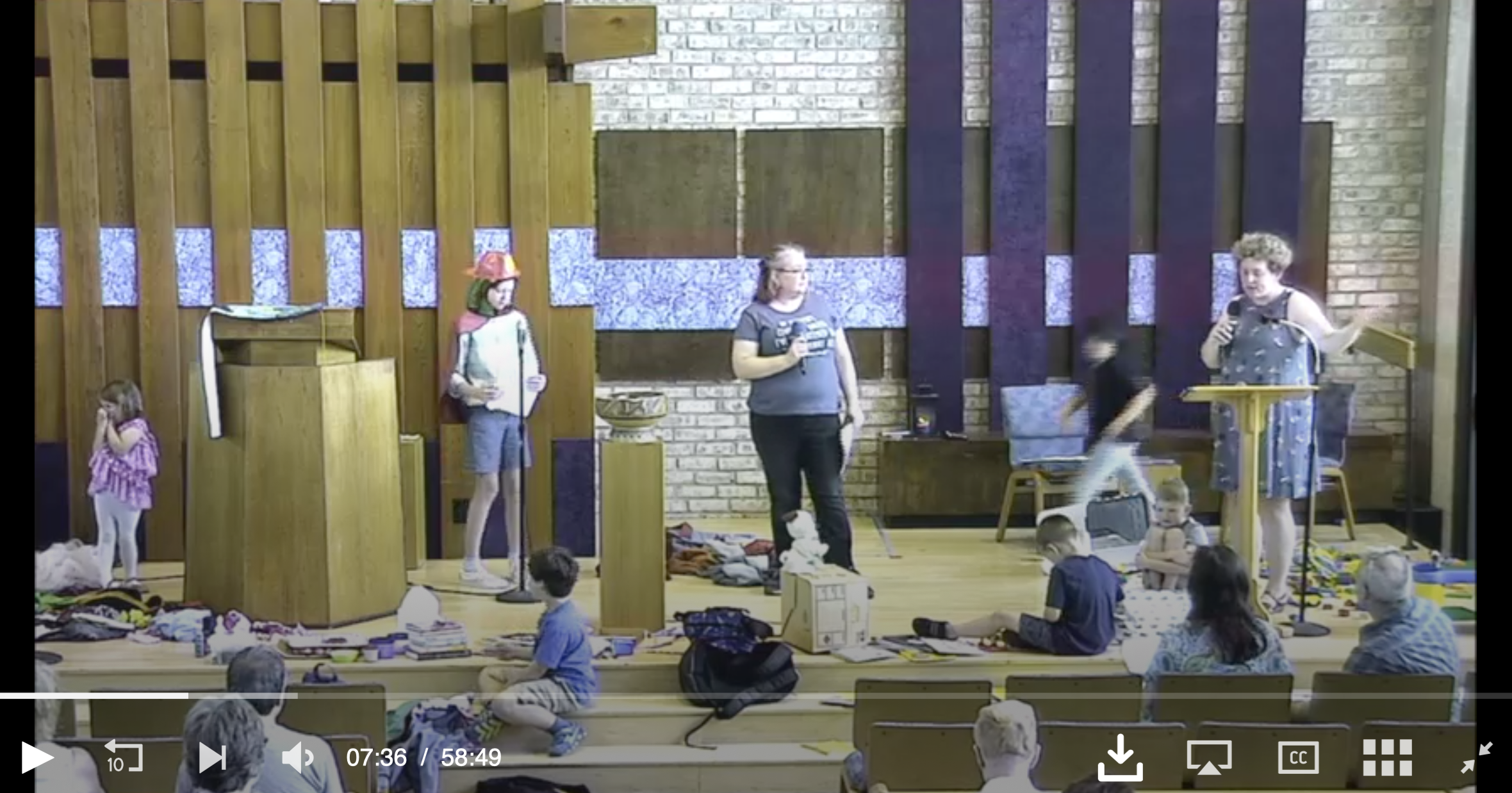
If you’d like to watch the service, visit http://www.uucava.org/livestream/ and click on archives and click on the July 14, 2019 service.
Here’s my reflection from Sunday:
One of the reasons I became a Unitarian Universalist after spending many formative years as a Presbyterian was that I wanted more variety than the Bible seemed to offer. When I discovered that UUs looked to many sacred and secular texts as sources of inspiration, I was delighted. As a writer and reader, I love discovering wisdom from new people and places.
That said, I acknowledge that the Bible includes some great stories. They’re not always easy to understand, universal truths are embedded in those parables. My perspective on Jesus is that he was a kind, compassionate, and generous person and a powerful teacher. When I think about embracing the mess, I keep coming back to this story from the book of Luke, chapter 10, verses 38-42.
As Jesus and his disciples were on their way, he came to a village where a woman named Martha opened her home to him. She had a sister called Mary, who sat at the Lord’s feet listening to what he said. But Martha was distracted by all the preparations that had to be made. She came to him and asked, “Lord, don’t you care that my sister has left me to do the work by myself? Tell her to help me!”
“Martha, Martha,” the Lord answered, “you are worried and upset about many things, but few things are needed—or indeed only one. Mary has chosen what is better, and it will not be taken away from her.”
Picture the scene. You have an unexpected celebrity guest—plus his entourage—and you’re working frantically in the kitchen to find something suitable to serve. You’re pouring chips and salsa into your best bowls. You’re searching for the corkscrew to open a bottle of sauvignon blanc. You’re preheating the oven to pop in some Trader Joe’s appetizers.
And you’re doing it all by yourself, while your sister is in the other room laughing at your guest’s amusing anecdotes and not lifting a finger to help you. Maybe it’s not your sister, but your significant other or your roommate. Regardless, you’re growing increasingly frustrated at them for having a good time while you’re working your tush off.
I have a question for you. How many of are familiar with the enneagram? How many of you are type 2?
For those of you who don’t know the enneagram, it’s an ancient tool used to help us understand motivations and behaviors. The enneagram can be a useful way to examine the choices we make and help us to become emotionally healthier.
Type 2 is known as the helper or the giver. Martha was likely a type 2. A bunch of guys show up on her doorstep and she immediately gets to work making dinner. There is a need to be met, and she assumes it is her responsibility to meet it. She does not understand why no one else is helping, because it is so obvious to herthat there is work to be done.
I will confess that I am also a type 2. After years of emotional work, however, I would like to think I am a healthy 2. This means I would probably head to the kitchen to get snacks for Jesus and his friends, but then I would order pizza so I could join in the conversation sooner. I might ask the apostles to take everyone’s drink orders.
Unhealthy 2s plow ahead with all the work themselves, becoming increasingly resentful. Healthy 2s will ask for help when they need it, or even decline a request that someone makes of them. My spiritual director calls this “the holy freedom to say no.” The enneagram provides a direction for each type to move toward in order to balance out unhealthy tendencies. For type 2s, we are guided toward 4, known as the romantic or the individualist. I suspect Mary in this story was a 4. When Jesus showed up at her house, she knew exactly what she wanted to do, which was sit and hang out with him. What could possibly be more important?
I can’t count the number of times when I was younger that I cleared the table and started doing dishes when I had friends over just to get the mess out of the way. And then missed out on time I could have spent having fun and laughing with people I loved. The dishes will always be there. I have learned that community, conversation, and connection are much more important.
A couple months ago, a friend of mine from college emailed me to say he and family were going to be in town and wanted to get together. He asked if we wanted to meet at a restaurant, but I suggested they come to our house, knowing it would be more relaxing, and that the kids could play, and we would have more time to talk. He agreed, although he suggested we get takeout and he offered to bring wine and dessert. I ordered dinner from Bangkok 54 and we had a fabulous time, and I did very little work.
Of course, I’m not saying you never have to clean your house, but that embracing the mess provides an opportunity to cultivate both connection and creativity.
How many of you have ever lived in a house overrun by Legos?
This has been my house for the past decade.
We have built Lego sets of a lunar lander, Hogwarts, the Millennium Falcon, the Beatles’ Yellow Submarine, countless superheroes and villains and their vehicles, and many more. We have thousands of Legos that have been used to build fabulous creations even more imaginative than the sets you buy at the store. Everyone at our house is a builder, but Zeke in particular is on his way to becoming a master builder. Where I see Legos scattered all over the coffee table and the floor, he sees superhero hideouts and innovative spaceships and cars that can dive and fly and so many technologies that might actually come to fruition someday. I have no doubt that he could become an engineer and design the prototype for an actual car that flies.
Our house is also littered with overflowing bins of art supplies, books piled up next to densely packed bookshelves, and magazines with ideas for making new stuff out of old stuff you have lying around. Sure, sometimes I wish my house looked like something out of a magazine, where you’re sure no one actually lives there because there’s no stuff. But at the same time, I wouldn’t want to give up the time our family spends making art, reading, and creating with everything that surrounds us.
Embracing the mess opens up possibilities and allows for freedom. This can be risky. And liberating.
Both my kids attended AUCP, the phenomenal preschool located here at UUCA. After Zoe graduated and before Zeke started, AUCP launched a program called Timber Tuesday, where, every other week, a class spends the entire three-hour school day in the woods near Long Branch Nature Center. Rain or shine. I have never been an outdoorsy person, and I was skeptical about this at first, but AUCP’s director Susan Parker quickly sold me on the value of spending this time outside. Kids who struggled to conform to classroom expectations thrived outside when given plenty of space to explore. Kids with sensory or motor challenges pushed themselves to climb rocks and touch trees and splash in the creek. As a parent, one of the most important lessons I learned was that it’s ok to get messy. Just bring a change of clothes. Or be prepared to ride home in your underwear.
I remember sometime after I had become a Timber Tuesday convert that my kids and I were out after a rainstorm. Instead of instructing my kids to avoid a puddle, I encouraged them to jump in it. They were astonished.
They have certainly taken that encouragement to heart. Two weeks ago, our family was on vacation in Lewes, Delaware. One evening we went to the beach to watch the sunset. One minute we were walking with our toes in the water, and next thing I knew both of my kids were laughing and splashing, submerged up to their chests in the Delaware Bay, fully clothed. Then we went to get ice cream. Because why not?
Share this:

Today was the final Sunday of our November theme of abundance at UUCA. I led worship, along with my friends Bob and Kendra. You can watch a video of the service here: http://www.uucava.org/livestream/.
You can read my meditation and prayer here:
I encourage you to put your feet on the floor. Feel your seat beneath you and observe the presence beside you of caring people, whether they are friends or family or strangers. Notice your breath. Breathe in peace. Breathe out love. Breathe in comfort. Breathe out compassion. Breathe in strength. Breathe out generosity. Whatever you need right now, feel it filling your body every time you inhale. Whatever you wish to share with the world, feel it gliding into the atmosphere on your breath.
Spirit of life, we come together here today after having been scattered near and far during the past week. Some of us are refreshed and rejuvenated by time off from work and reunions with beloved family and friends. Some of us are weary from tense and difficult moments and feelings of obligation rather than joy. Some of us labored, some of us were served. Some of us were surrounded by love, some of us were lonely.
Whoever we are, may we find refuge here.
Spirit of life, as we begin again today, we ask for another chance. An opportunity to be kind to ourselves. To truly love ourselves so we can better love others. We seek relief and ease because some of us are Just. So. Tired. We seek clarity when facing an uncertain diagnosis, or no diagnosis at all, in the midst of debilitating symptoms. We seek reassurance as we endeavor to do right by our children when parenting can be so stressful. When we are young and when we are old, we seek acknowledgment. We want to know that we matter. At every age, we wish to be heard and understood. We seek grace along the path that is littered with our mistakes. We seek courage to be bold and step onto a new, unfamiliar path. We wish for the strength to unclench our fists and let the anxieties, the fears, the old hurts be carried away on the winds, leaving our hands and our hearts free. We long for the freedom to laugh and to cry with abandon. We seek release.
Whatever we seek, may we glimpse it today in this place, and claim it for our own.
And here’s my reflection:
FINDING YOUR ABUNDANCE
I have a contentious relationship with time. I am always running late, always composing an apology in my head. I promise it’s not because I don’t respect you or value our relationship. It’s because I am overly optimistic. I always think I have time to do one more thing before I go. Write one more sentence, put away one more load of laundry, cross one more thing off my to-do list. I am wildly unrealistic about how much time something is going to take. You would think that by this point in my life I would’ve figured this out, but no.
My family is so often late that we’ve invented a game called the good excuse bad excuse game. Note that we do not play this in the exact moment when we’re tumbling out of the house and into the minivan, because I would be way too flustered. But in a moment of calm, we can play. Here’s how it works. One person says, “sorry I was late, I decided I didn’t feel like getting out of bed, but eventually I did.” Everyone responds, BAD EXCUSE! Another person says, “Sorry I was late, I was rescuing 100 puppies from a burning building.” GOOD EXCUSE! And we continue to come up with the most pathetic or most heroic excuses we can think of.
As silly as this might seem, the good excuse bad excuse game points to an unspoken truth. The most valuable use of your time is often when you are helping someone else, when you are sharing your abundance, just like in the story Kendra read earlier. But what are the abundances we have to share? How can we find them when we so often focus on what’s scarce in our lives?
If you’re a Harry Potter fan, you may have sorted yourself into one of the Hogwarts houses. Is your abundance bravery, loyalty, intelligence, or ambition? Do you possess an abundance of patience in a world that prioritizes speed and multitasking? Are you able to bring presence into a culture of preoccupation? I know that I am awed by people who are able to be fully present with me, to make me feel like I am the only person in the world who matters at that moment. Yet this quality is not one of my abundances. For better or for worse, my mind is always tuned in to several channels at once. I can’t NOT hear a conversation happening across the room, or the oven timer going off, or notice that someone in the vicinity needs something. One of my abundances is an astute power of observation, but not focused presence.
Maybe your abundance is more practical, like agility with numbers and the ability to manage or make money. I interview a lot of people on behalf of one of my clients who say they became budget counselors because they always loved numbers. I have always felt like I am allergic to numbers. At the annual meeting at church, my eyes glaze over when they talk about the budget. I am terrible with money. I sometimes wish our currency were only in words instead of numbers. Then I could understand. This trouble with numbers often comes into conflict with another of my abundances, which is generosity. Are you raising money for Multiple Sclerosis research, or orphans in Haiti, or school supplies for girls in Nigeria? I am guaranteed to donate, whether or not I can afford it.
In fact, one of my favorite holiday traditions, for the past 10 or 15 years, has been giving alternative gifts to nonprofits that I hand pick—and now my husband and children help choose—for all of our family members. We do this at an alternative gift fair, like those sponsored by Alternative Gifts of Greater Washington, or in Arlington, Gifts that Give Hope—which is hosting this year’s event on December 9 at Discovery Elementary. Or online through the Catalogue for Philanthropy. What these organizations do is bring together wonderful charitable groups and tell you what exactly your $10 or $20 or $50 donation would do for their beneficiaries. For example, a $5 donation to your local animal shelter would buy chew toys for a dog waiting to be adopted. A $25 donation to a nonprofit that serves single moms who are survivors of domestic violence would buy a week’s worth of diapers. A $50 donation would buy a bike for a young person in an African village to have the transportation needed to start a business. We take time to think about what kind of donations would be meaningful to each family member. Like the dog toys for Uncle Larry and Aunt Susan who have loved dozens of dogs and cats over the years. Cooking classes in honor of my aunt who taught me to make delicious food from scratch. You get the idea. On Christmas morning, we open these gifts along with all the others and read out loud where the charitable gift will be going. My family’s goal on Christmas morning is to make people laugh or cry, and often these gifts elicit tears. And they don’t take up room on anyone’s shelf, and they’re making the world a better place. These gifts also remind us of just how much abundance we have in our family and our community.
Going for the laugh is also fun, like when I got my mom an autographed 8×10 photo of Adam Levine because she’s a huge fan of the Voice. You have to balance things out.
The paradox about my contentious relationship with time is that time is what people want most from me. Time is what my kids want, time is what my parents want. My husband, my dog, my friends, my clients, the church. Even though it doesn’t feel like I have a lot of it, time is my most valuable abundance to give.
My parents have everything they could possibly want, and more. But my mom is thrilled if I give her a Christmas gift of a day where I help her clean out her closet and go to lunch. We take each other to concerts and plays and readings, where we share the gift of time spent together, sharing an experience. Seeing and hearing live music is one of the great joys that my husband and I share. When we devote so many hours to working and managing the house and taking care of our children and our dog, the simple act of making the time to be together and do something we both love can seem monumental, but it’s so important.
What Facebook has abundance of is memes, and many of them are silly, and some are annoying, and some are offensive. But some are really good reminders of what matters. One I remember said something like, “if you have a stack of dishes in your sink, it means you have enough food to eat. If you have a pile of laundry to fold, it means you have enough clothes to wear.” It’s easy in Arlington, or in Northern Virginia, or Greater Washington, to feel like we don’t have enough. We have plenty of first world problems. But we also have plenty of abundance. Abundant opportunities, abundant amusements, abundant things to see and people to meet. Abundant chances to serve. Abundant ways to receive.
As we close out our month of abundance, and our weekend of abundant food and company, and we look ahead to a month that may be filled with hope or anxiety, love or loneliness, generosity or uncertainty, or maybe all of these. Remember to take with you this month your inner abundance. Is it compassion? Vision? Wit? Steadiness? Creativity? Maybe you can’t name your inner abundance right now. If that’s the case, give yourself time to find it. And when you find it, give it away.
May it be so, may it be so, may it be so.
Share this:

I had the privilege of leading the service this morning at the Unitarian Universalist Church of Arlington, in a fabulous collaboration with Ashley Greve and Bob Blinn. Our wonderful artist in residence Maya Rogers led the music.
You can watch the service here!
I included this poem by Naomi Shihab Nye as part of my prayer and meditation.
Different Ways to Pray
There was the method of kneeling,
a fine method, if you lived in a country
where stones were smooth.
The women dreamed wistfully of bleached courtyards,
hidden corners where knee fit rock.
Their prayers were weathered rib bones,
small calcium words uttered in sequence,
as if this shedding of syllables could somehow
fuse them to the sky.
There were the men who had been shepherds so long
they walked like sheep.
Under the olive trees, they raised their arms—
Hear us! We have pain on earth!
We have so much pain there is no place to store it!
But the olives bobbed peacefully
in fragrant buckets of vinegar and thyme.
At night the men ate heartily, flat bread and white cheese,
and were happy in spite of the pain,
because there was also happiness.
Some prized the pilgrimage,
wrapping themselves in new white linen
to ride buses across miles of vacant sand.
When they arrived at Mecca
they would circle the holy places,
on foot, many times,
they would bend to kiss the earth
and return, their lean faces housing mystery.
While for certain cousins and grandmothers
the pilgrimage occurred daily,
lugging water from the spring
or balancing the baskets of grapes.
These were the ones present at births,
humming quietly to perspiring mothers.
The ones stitching intricate needlework into children’s dresses,
forgetting how easily children soil clothes.
There were those who didn’t care about praying.
The young ones. The ones who had been to America.
They told the old ones, you are wasting your time.
Time?—The old ones prayed for the young ones.
They prayed for Allah to mend their brains,
for the twig, the round moon,
to speak suddenly in a commanding tone.
And occasionally there would be one
who did none of this,
the old man Fowzi, for example, Fowzi the fool,
who beat everyone at dominoes,
insisted he spoke with God as he spoke with goats,
and was famous for his laugh.
Here’s my reflection: The New Kid
The New Kid
Picture me, age 7, wearing a sunshine yellow Izod shirt and matching cotton shorts, missing a couple teeth, cruising down the sidewalk in blue and white roller skates. I would happily skate up people’s driveways to see who was available to play. Some days we watched monster movies with Geoff and David, some days we twirled batons with Amy and Karen, some days we played king of the hill on the pile of mulch in the Perrys’ driveway. It was all very suburban and lovely. Until…
After I finished second grade, our neighborhood elementary school closed and became a police station. The kids in our neighborhood were sent to two different schools, one of which included the gifted program that I had been assigned to. I was nervous about going to a new school, but then third grade started, and I found my people, and absolutely loved my new school. One of my best friends from third grade remains one of my best friends today.
Meanwhile, back in my neighborhood, something strange was happening. When the kids I used to play with in the cul-de-sac realized I wasn’t going to school with them anymore, they stopped playing with me. Or speaking to me. Somehow, they got this idea, whether it was from their parents or each other or who knows where, that I thought I was better than them. I didn’t. I wasn’t. Just because I was going to a different school with a different program did not mean I didn’t still want to ride bikes and play tag with them. I did. But I wasn’t allowed to anymore. They unceremoniously unwelcomed me from their midst. It was awkward and painful. They assumed something about me that wasn’t true—that I was suddenly arrogant, or a snob, even though I wasn’t behaving any differently than I had when we were hanging out in their basements. But that was that.
Fast forward a few years to ninth grade and another fork in the academic road. My friends from junior high were scattering to different high schools. My neighborhood school did not have a stellar reputation. I had heard rumors of chain-wielding gangs of immigrants roaming the hallways. Somehow, I bought into some bizarre stereotypes. I assumed the worst. So, I found a math class I could take at another, allegedly better, high school, and transferred. And I had the absolute worst year of my entire public education career. At this school, which was much richer and much whiter than my neighborhood school, people were mean to me. I was turned away from activities I wanted to do. Hardly anyone in my classes spoke to me. I was miserable. I made a handful of friends who sustained me that year, mostly people from the literary magazine who considered themselves willing outcasts of the school’s elitist culture. By the end of the year I was willing to face the prospect of roving gangs at my neighborhood school because I figured they couldn’t possibly be more unkind than the privileged white kids I’d been surrounded by all year.
First period in 10th grade I walked into Mr. Lunsford’s biology class at my neighborhood school and a whole bunch of people, most of whom I had never met, seemed surprisingly, genuinely happy to see me. As the days and weeks went on I was warmly greeted by familiar faces from elementary school and total strangers. I felt at home instantly. And guess what? No threatening thugs anywhere. Whatever I had assumed turned out not to be true. Surprise!
Recently I’ve been reading this book—Wonder by RJ Palacio—with my daughter at bedtime. I read it originally when it came out in 2012, and it’s one of my favorite books. Wonder is about a boy named August Pullman who is starting middle school and he’s nervous. Not just because he’s been homeschooled his whole life, or because it’s middle school, but also because he has a severe craniofacial anomaly. Genetics conspired to make Auggie’s face startlingly different from typical faces. By age 10 he has already undergone dozens of surgeries. When Auggie introduces himself at the beginning of the book, he says, “I won’t describe what I look like. Whatever you’re thinking, it’s probably worse.” Our only insight into Auggie’s appearance comes from his description of people’s reactions to him. Stares, gasps, kids running away on the playground. At his new school, all but a couple kids give him a wide berth. They cover their mouths when they whisper about him, but he knows exactly what they’re saying. Many of them play a cruel game they call the Plague, where they try not to touch Auggie, even in passing, and if they do they have to immediately wash their hands to prevent catching what they somehow imagine is the disease that caused Auggie’s facial differences.
The few kids who actually get to know Auggie discover that he’s awesome. He’s funny, he’s smart, he’s kind. He loves all things Star Wars, and playing video games, and when his dog Daisy licks his face. But because he looks so different, most kids, and many parents, don’t give him a chance. They make assumptions, such as that the school made an exception to admit a student with special needs who requires extra accommodations, none of which is true. One mom goes so far as to Photoshop Auggie’s face out of the class picture, saying he just doesn’t fit in.
Later in the book we do read a detailed description of Auggie’s looks from the point of view of his big sister, Olivia. She is realizing that there’s the Auggie she sees, of whom she has always been fiercely protective, and the Auggie that other people see. She is candid about the effects that having a little brother who looks so shockingly different has had on her life. She is loving, and patient, but also weary. And honest.
Olivia’s voice is one of several we hear in Wonder, in addition to August’s, which is one of the reasons I love this book so much. Mr. Tushman, the director of August’s school, says at one point, “there are almost always more than two sides to every story,” and RJ Palacio offers us windows into the many facets of this story. She wrote a companion book in 2014 called Auggie & Me, which tells the same story through the lens of three other characters, including Julian, who is Auggie’s greatest antagonist in Wonder. Just as so many kids make assumptions about Auggie based on his looks, the reader makes assumptions about Julian based on his behavior. Clearly, he’s just a jerk, right? But there are, as Mr. Tushman points out, almost always more than two sides to every story.
Our brains are hardwired to categorize for survival—is this creature friendly or likely to eat me? Is this food edible or poisonous? But what happens when that desire to classify everything you see gets out of control? I struggle with this constantly. Is that person thinner than me or fatter than me? Does that person have holes in her clothes because she can’t afford better clothes or because she’s trying to be fashionable? Why is it fashionable to have holes in your clothes? My brain goes into overdrive. So while I want to be welcoming, while I aspire to be friendly, while I deeply wish I were the person who goes over and sits down at the lunch table where the different looking new kid is sitting all alone on the first day of school, I don’t know if I really am. I am convinced that sometimes my assumptions—about someone else or myself—get in the way. What if that person who is crying just wants to be left alone? What if I am insensitive because of my white privilege? What if I ask an intrusive question because I am curious?
Sometimes this interrogation of myself keeps me from being welcoming, inclusive, or brave. Our theme here at UUCA for September is welcome. So today I’m making a commitment to be more welcoming, everywhere I go, whether I am greeting the new kid or I am the new kid. I’m making a commitment to not let those questions and assumptions ricocheting around my head get in the way of reaching out to someone. I’m making a commitment to remember that there are almost always more than two sides to every story, and to do what I can to listen to all the sides.
One of the great characters in Wonder is Auggie’s English teacher, Mr. Browne, who teaches his students about precepts—words to live by—and encourages them to come up with their own. I’ll leave you with Mr. Browne’s precept for September, a quote from Dr. Wayne Dyer: “When given the choice between being right or being kind, choose kind.”
May it be so. May it be so. May it be so. Amen.
Share this:


Photos by my cousin Lauren. Thanks, Lauren!
I have never seen so many pictures of and words for and references to vaginas, vulvas, ovaries, and uteruses in my entire life.
At the Women’s March in Washington, DC yesterday, of the half-million plus people gathered, thousands of them were holding up signs protesting Donald Trump’s vulgar description of his proclivity for sexual assault, and advocating for women’s reproductive rights.
It’s a good thing we talked to our nine-year-old daughter the night before about why everyone was wearing those pink knit hats. I’ve never been a fan of the word pussy, but I’ve become pretty comfortable saying it lately as feminists have reclaimed the word in recent months with images of angry cats saying “PUSSY GRABS BACK.” So we explained to Zoe what Trump had said and done. We told her no one has a right to touch her or any other girl or woman in a way they don’t want to be touched. We told her that, sadly, that doesn’t stop some men from doing it anyway. We explained that’s one reason we were marching.
I decided we needed to go step by step about everything the Women’s March represented, so I read Zoe the unity principles of the movement. If you discuss reproductive rights, you have to explain what birth control is. When kids have pretty much been taught that sex is for making babies, you have to explain that people also have sex for fun, and sometimes even when they’re not married, and sometimes when they’re teenagers. By this point she was kind of burying her face in a pillow but still listening. Every once in a while I would ask if she had any questions and she would shake her head. I would also ask if she was ok learning all this and she would nod.
We talked about disability rights and how some of her friends wouldn’t have been able to attend public school or easily go to public places before the Americans with Disabilities Act and the Individuals with Disabilities Education Act were passed. We talked about our friends who live in this country but who the government hasn’t given legal status to even though they work hard and contribute to the economy and pay taxes and are good people. We talked about our friends who are gay and married and how that wasn’t allowed until very recently. Zoe was a little kid when she watched one of our best friends marry her wife, so in her mind marriage has always been between any two people who love each other. We talked about how some people–including parents of her classmates–can’t get good-paying jobs so they have to work multiple jobs and they can’t leave their jobs to come to school whenever they want or they’d be fired.
It was a lot to process.
But then Saturday night when we were all home from the march, I asked her if she saw or heard anything that was confusing or she didn’t understand, and she said no. She said, “if we hadn’t had that talk I wouldn’t have understood most of it, but I did. I’m glad you told me that stuff.”

Photos by my cousin Lauren. Thanks, Lauren!
What we heard:
TELL ME WHAT DEMOCRACY LOOKS LIKE! THIS IS WHAT DEMOCRACY LOOKS LIKE!
***
Men: HER BODY, HER CHOICE!
Women: MY BODY, MY CHOICE!
***
WE WANT A LEADER, NOT A CREEPY TWEETER! WE WANT A LEADER, NOT A CREEPY TWEETER!
***
WHOSE STREETS? OUR STREETS! WHOSE STREETS? OUR STREETS!
***
NO HATE! NO KKK! NO FASCIST USA!
***
WE ARE THE POPULAR VOTE! WE ARE THE POPULAR VOTE!
***
NO HATE! NO FEAR! IMMIGRANTS ARE WELCOME HERE!
***
HEY HO! DONALD TRUMP HAS GOT TO GO!
***
YOU CAN’T BUILD A WALL! YOUR HANDS ARE TOO SMALL!
People led chants from the crowd, from trees, from the top of traffic poles.
You’ve probably seen pictures by now and heard that there were way way way more people there than were expected, so the plans for where the rally and march were supposed to take place quickly went out the window. So for the first several hours we were there, it was a little disorganized and chaotic. But it was the friendliest, most polite chaos I’ve ever experienced. Even during the hour we spent waiting to get on the metro, people were so pleasant. When the Metro employee took the microphone to update us on the wait situation, everyone got quiet. I mean silent. I have never heard people be so respectful to a Metro employee. After he made his announcement everyone said thank you. Seriously. One female Metro employee was wearing a pink pussy hat which she told us a marcher had given her earlier. She was pumping her fist in the air and people were high fiving her and cheering for her.
And everywhere we went downtown, everyone was nice. People shared snacks. People said, “excuse me,” when they tried to get by. We weren’t anywhere near the stage and we couldn’t hear or see anything official that was going on. But we were definitely in the midst of thousands of people who were excited to be there–people wearing pink hats and fabulous shirts and suffragette sashes and all manner of activist accessories. We just enjoyed reading the signs for a while.
After a couple hours my sister and my daughter decided to head home. The rest of our group attempted to make our way closer to Independence Avenue in hopes of joining the march as it went by. We ended up trapped in a throng of people who had the same idea, but we were all stopped before we made it to the street. We were standing extremely close to each other. For over an hour. Finally we got word from a march volunteer perched on something high that the reason we couldn’t move is that the street was completely packed with people. And in fact, all the streets were completely packed with people. We didn’t learn until we got home that the entire route that the march was supposed to take was totally full of people, so there was nowhere to march. But people stayed calm. They passed out chocolate. A guy next to us laughed at my husband’s joke and told him he got an A+. Someone told me she liked me Unitarian Universalist shirt and had gone to UU summer camp in the midwest. Anytime someone felt ill in the crowd, everyone shouted “medical” and people moved out of the way to let the person get to the street where there was a police officer on hand to help. When we heard cheering from the general direction of the stage, we cheered. We read each other the signs we spotted in the distance.

Photos by my cousin Lauren. Thanks Lau
Eventually the woman on the perch instructed us to turn around and head to the mall, so we did. Soon we found ourselves enveloped by the march, which was exciting. I don’t even know if we were on the planned route or if there were multiple routes at that point. In every direction there were marchers as far as we could see. It was incredible. Not only were we in the largest group of people we’d ever experienced, but with all these people who shared our core values. If this is a bubble, it was a freaking enormous bubble that I was happy to live in.
As we approached the Washington Monument, a woman asked if she could take a picture
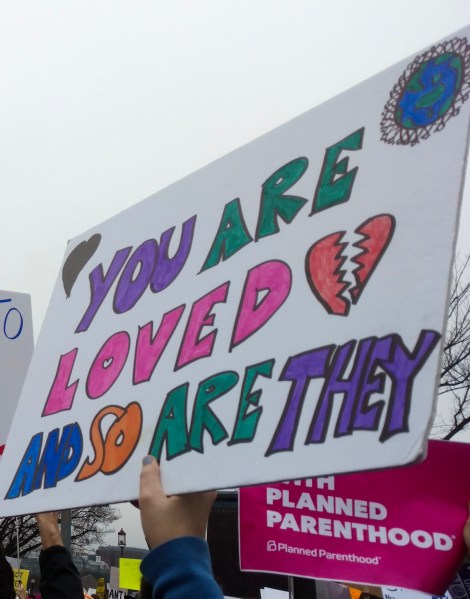
Our sign: the slogan was Randy’s idea, inspired by the book Old Turtle and the Broken Truth by Douglas Wood.
of our sign with the monument in the background. There was more chanting, more singing (mostly “This Land Is Your Land”) and a drum line somewhere nearby helping us keep the beat. There was a topless woman astride the shoulders of a topless man. Her nipples had black tape across them and she and her partner were shouting “FREE THE NIPPLE” and holding a sign saying “DESEXUALIZE WOMEN’S BODIES.”
When we first got there, Randy asked how many people I thought we would see who we knew. I guessed 50. He said five. He ended up being closer, as we actually only spotted two of his co-workers and the reading teacher from Zoe’s school who I sometimes substitute for. In my head I’d been thinking about the Arlington County Fair, where we always see lots of people we know, because there are only a few hundred people there and we know a lot of people in Arlington. But when you’re in the midst of more than half a million people, it’s statistically unlikely you will unexpectedly wind up marching next to your friends. Thanks to Facebook, I realized later that there had actually been hundreds of our friends and co-workers there. People from our preschool (including the director); our current UU church, previous UU church, and previous Presbyterian church; Zoe’s school; my elementary, middle, and high schools and William and Mary; work; martial arts; my soccer team; and basically any other group I can think of that I was every a part of. I feel like virtually everyone I know was there, although I didn’t see them. I saw the photos and there were those same signs behind them! I also had friends who marched in cities around the country and around the world. The word solidarity has never meant so much to me before.
When we finally decided to head home to see our kids, many marchers were headed to the White House to deliver their message more directly to Trump. I understand that many of them left their signs on the White House lawn as calling cards. It took us a long time to get home, but as we walked through the city people were still chanting, smiling, singing, wearing their pink hats. Everyone was exhausted but inspired.
Rev. Aaron’s sermon today at church reminded us that yesterday was just day 1. It wasn’t the end of the world, but the beginning of our revolution (my word, not his). He talked about how we need to treat Trump’s absurdity like the weather, just be prepared and dress accordingly, but don’t let it stand in the way of doing what we need to do. We can just say, “Oh it’s tweeting outside” and move along.
I have felt better the past two days than I had in a long while, thanks to the friends and family who came over to our house to celebrate kindness so we could forget about the atrocity happening across the river for a few hours, and because we spent the day with more than half a million like-minded strangers yesterday who are willing to fight for what they believe in. Cynics are asking, “but what happens now?” And I know what will happen now. We keep raising our voices.
TELL ME WHAT DEMOCRACY LOOKS LIKE! THIS IS WHAT DEMOCRACY LOOKS LIKE!

Photo from Sen. Bernie Sanders’ Facebook page
Share this:

 Usually I use this space to share my own experiences. Right now my experiences are not the most important ones to share. Instead I want to share some other voices that everyone needs to hear.
This is a letter to four-year-old Dae’Anna Reynolds, who was in the back seat of the car when her mother’s boyfriend, Philando Castille, was murdered by a police officer.
Dear Dae’Anna:You and I have never met, but I know your little Soul. It is one of bravery, courage, and wisdom – an old Soul, really. I suspect that you get these qualities from your Mommy, Diamond, who displayed such calm and composure when her fiancé, Philando, was killed earlier this week. I watched the video your Mommy recorded, and I was so scared. But it was not as scary as it must have been for you, sitting in the backseat, watching it all happen. I continue to keep Philando, and you, and your Mommy in my prayers. I hope that whatever sadness you feel goes away quickly, so that you can get back to being the kid that you are who loves fireworks!
When I heard you comforting your Mommy in the video while in the back of the police car, letting her know that you were there, and that everything was going to be OK, I wept. I wept for many reasons all at once. First, you were so strong. Second, you knew exactly what to say; I was in awe of your ability to console your Mommy in such a loving way – the way she would console you. Third (and this made me cry a little harder), in that moment, I watched you step into your birthright as an African American female, taking on inherited responsibilities that are often a cross to bear. You had to be strong in the midst of hatred directed toward our people. You could not be the child that you are; you had to grow a little faster than most girls. You bore witness to what enslaved women of our ancestry bore witness to – the murder of our black men. At only 4 years old, you experienced what it is like to be a black woman in this country.Now that you have been initiated, I want you to know that being a black woman is awesome! We come from descendants who were pharaohs, queens, peace activists, tribal leaders and more, with origins from our motherland, Africa. Our history is made up of rituals, customs, and traditions that center on the family unit, spiritual growth, pride for where we come from, strength, and resilience. My favorite thing about being a black woman is that I am supported in our community, and encouraged to be all that I can be. It is also nice to have so many options on ways to style our hair!
I want you to know these things because being a black woman can sometimes be difficult in the country where we live. The oppression our ancestors experienced in the United States has been deeply internalized, so much so that we unconsciously become slaves to this society, by feeding into stereotypes, denying our wellness, degrading our bodies, and working harder to reach a white-Americanized standard of success. We forget to be and live free, because for so long we were never free. We take on the mindset that we must struggle to survive, instead of thriving. We often forget that we are women of worth.
What happened to Philando is something that you will never forget, and I beg you not to let this traumatic experience lead you to believe that because you are a person of color, your value is diminished. Remember what I said above? You are strong, courageous, brave and wise. These are qualities you also inherited, and I encourage you to use them for good in this world. I encourage you to use your gifts to build a life for yourself that reflects your biggest dreams. I encourage you to tap into your wisdom when the racists sentiments that still exist in our society today, lead you to doubt that you are deserving of a life well lived – you are deserving, Dae’Anna. I encourage you to embrace your black skin because it is beautiful; because you are good, and because you are a human being with inalienable rights to all that is good in this world. Remember this, sweetheart. Remember when people look down at you as inferior because of your dark skin, that you can be anything you want – you come from royalty. And know that you are loved by so many people – your Mommy, Philando, me – everyone, because you are you.
You can read the original post here: http://www.traceylrogers.com/empowerment-blog/to-the-little-girl-in-the-backseat. This was written by my friend Tracey Rogers. She has a perspective I do not. Tracey’s letter was read in church today.
The other words I want to share are, in part, those of my pastor, Rev. Aaron McEmrys, but mostly he is using the pulpit to share the words of Black Americans who have the courage to continue to speak out about how our country is not going to treat them like their lives matter until we all wake up.
Today’s sermon was called “Red Rain.” If you don’t feel like watching the whole service, you can skip to around minute 38 to hear Rev. Aaron speak hard and necessary truths.
If the video doesn’t work for you here, you can visit http://unitarianuniversalistchurchofarlingtonva.yourstreamlive.com and click on the archived service from July 17, 2016.
I urge you to learn more. Especially if you are white.
http://blacklivesmatter.com/guiding-principles
http://www.joincampaignzero.org/#vision
It is not an unreasonable demand to be treated as if your life matters.
One of the many online memes says, “Black people are literally saying, ‘stop killing us,’ and there are people saying, ‘but…'”
None of us can let this go on.
This is some of what Lavish Reynolds, Philando Castille’s girlfriend, was saying in the moments after he was shot.
[To police] Please don’t tell me my boyfriend’s gone. He don’t deserve this. Please. He’s a good man he works for St. Paul Public school. He doesn’t have no record of anything. He’s never been in jail anything. He’s not a gang member anything.
[Praying] Cover him Lord. That you allow him to still be here with us Lord. Still with me Lord. Please Lord wrap your arms around him. Please Lord make sure that he’s OK, breathing Lord. Please Lord you know our rights Lord you know we are innocent people Lord. We are innocent people. We are innocent.

 You Ask a Lot of Questions