
You are currently browsing the tag archive for the ‘writing’ tag.
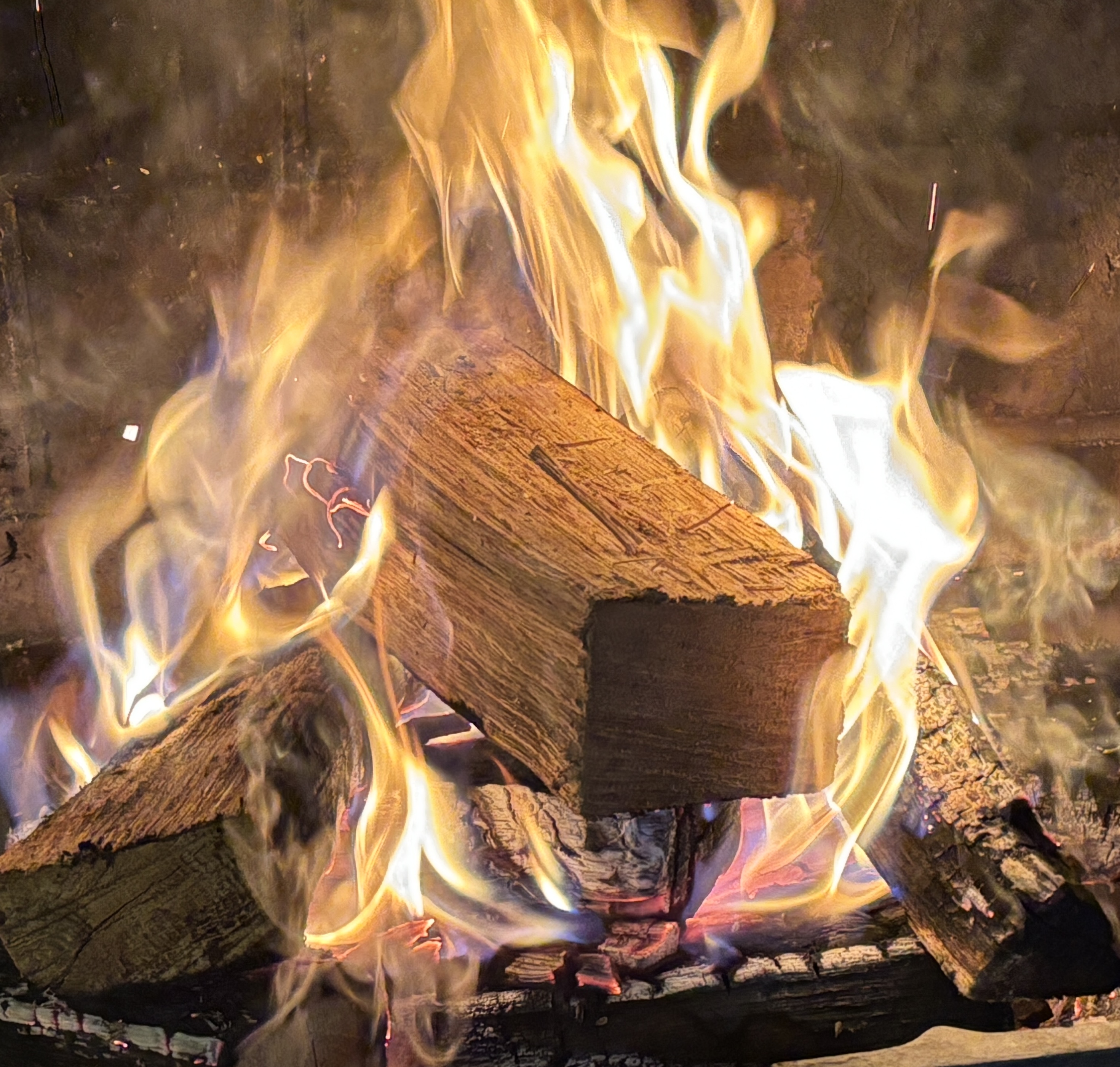
Listening to the fire wondering what exactly makes the sounds. Do flames make noise? Is it the reaction of the wood? Would it sound different if something else were burning? Trying and failing not to think about the devastation of Los Angeles. Wondering why it can be hard to get a fire you’ve built to catch while houses not intended to be burned seem to ignite so easily.
I didn’t know until yesterday what caused the sudden smoke. Every year when I build this fire it will burn respectfully for hours until without warning the room fills with smoke and the alarm blares and I have to open the windows and the door. I’ve just learned that this happened because of a particular piece of wood I’d added, which was not completely dry inside. What I still don’t know is why the dampness leads to smoke, or why one piece of wood stacked on top of another would be harboring remnants of water and not the piece below it or next to it. Is there a way to look at the wood and know what’s inside? Maybe someone who has spent more time with wood could discern it.
There is so much more I don’t know about the fire. How does the configuration of the logs determine the shape of the conflagration? What role does the oxygen play? Why are the ashes white and gray instead of the color of the wood? Why do the remains of a log look black and then collapse into dust when you poke it? How is the grate unaffected? Or does it eventually break down? This one is broken in part, but still solid enough to hold up the firewood. What makes some things burn and not others–like the grate, the screen, the fireplace tools. If a house burns down, do those pieces made of iron survive? If that is true, why don’t we make more of our existences out of iron? Or would it all eventually melt if left too long alone with the flames?
I think of a friend I used to have who always built the fires when we all went together to a cabin in the mountains. He was proud of his Boy Scout roots and seemed to relish the responsibility. I never asked him how he did it and he never stopped to explain and I thought it was some mysterious formula shared among scouts and certain dads and servants from novels about English aristocrats. There’s such an appeal to reading those books although I can never read them without imagining how awkward it would be to have a cadre of people catering to your whims and doing things for you that the rest of us do for ourselves, like getting dressed, and making dinner, and answering the front door. I think of a young woman wearing an unnecessarily frilly uniform making the rounds of every fireplace in the unnecessarily massive mansion every cold, damp morning, and laying out the kindling and the firewood just so, in case a member of the unnecessarily wealthy family decided to entertain themselves or others in that particular room on that particular day. I think about the classes of people whose money and power were passed down from one generation to the next while so many more others worked to make a living, or struggled to find work, or struggled to make a living.
And this is not unlike today, although many of the details have changed and the props and costumes and sets have changed. We still have the absurdly affluent doing whatever it takes to become more affluent and keep the serving class in poverty and with no choice but to serve or starve, or to serve and starve anyway. For centuries the divide and disgust was undisguised. Then in recent decades, discrimination became more discreet. And now, the curtains have been pulled back, but not to reveal sunshine–instead only darkness. The self-appointed wizards shout without shame that they will not tolerate anyone who is different from them–anyone who is not a straight, white, rich, egotistical man with anachronistic ideas. They will not allow anyone else to flourish, to thrive, to own their worth, to revel in their uniqueness, because if the rest of us claim our power and feel free to share our ideas, their power over us will diminish. Their ideas will be challenged. Their selfishness and greed will no longer be unhindered. They are damning the principles that many of us hold up as the ideals of humanity–the importance of including all because everyone deserves to be included and everyone’s contributions are needed, the theoretically democratic notion that all of us are created equal–possessing inherent worth and dignity–and entitled to treatment as such, and the seemingly simple but historically abused concept that our differences–the endless variations in how we look and act and think and communicate and love and live and move in the world–are extraordinary and awe-inspiring and cause for celebration, not condemnation.
The four cardinals perched in the tree outside this window have gone now. Where, I have no idea. What signals the birds to stop their feeding and flitting is unknown to me. I saw those cardinals as my ancestors, keeping watch or imparting a message I couldn’t quite understand today. But they’ve flown, leaving me to turn my focus back to the fire, gratefully absorbing its warmth while I wonder what happens now.

 You Ask a Lot of Questions