Survivors' Lap, featuring my dad and my friend Benji.

Friday night I walked laps around a high school track with my family. My dad (a prostate cancer survivor), my husband, my sister, and my brother-in-law were part of Team Capital H in the Springfield-Burke Relay for Life. Among the five of us, we raised several hundred dollars for cancer research and treatment. Our team raised nearly $16,000. And the 75 teams participating on Friday raised a total of $140,000. That blows me away.

That is money that goes to help people whose health insurance maxes out while they’re in the middle of chemotherapy to save their lives. It goes toward free cancer screenings. It goes toward research into cancers both common and rare, which completely changes the odds for people who are diagnosed every day.
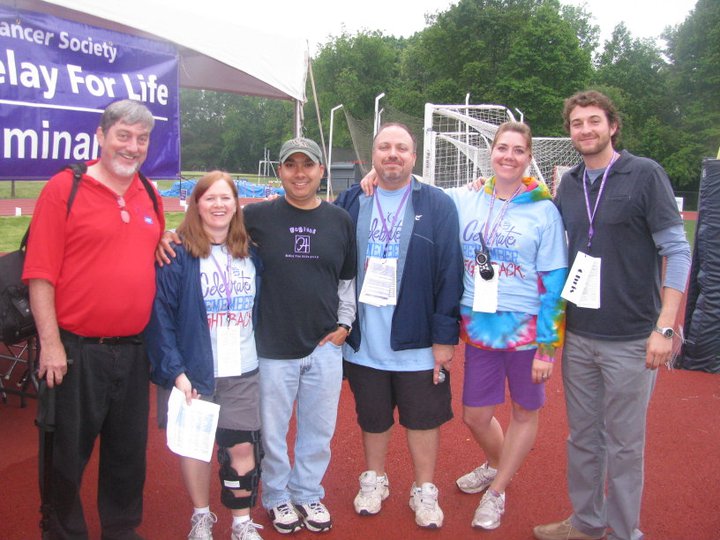
Amy Hanlein-Falcon, David Falcon, John Ariale (chair of the event), Kristy Keyer (co-captain of Capital H), and two other people

Thank you to everyone who contributed to this effort. Friday night I was in awe of my friend from high school, Amy Hanlein, who led Capital H in honor of her sister SaraH, who died several years ago. Amy clearly put in thousands of hours into planning, recruiting, and raising money. She’s going to chair the Springfield-Burke Relay next year and I know she’s up to the task. She was there Friday night walking around and taking care of business despite having recently sustained a serious knee injury.

Thank you to all of our donors. Your names were on a paper tree that Capital H displayed in front of our tents. Special thanks to those who gave at my invitation: Larry and Susan Rosen, Sabrina and Jason Kemp, J and Erin McCray, Barbara Beatty, Kristen and Jason Southern, Cyndy Rosso and Bill Word, the Swank Family, Lee and Jenny Rizzo, the Crews family, Cathy and Jeff Benjamin, Larry and Ann Hatcher, George and Phyllis Setzer, and Angela Meyers. Your generosity is appreciated. And the inspiring total dollar amount that the event raised demonstrates that every donation counts, and every person who helps makes a meaningful difference together.

Mostly what we did was walk around the track (along with hundreds of other folks) and catch up with old friends. We also listened to the story of a cancer survivor whose daughter is now facing a brain tumor. The work of the American Cancer Society helped save that mom’s life, and may save her daughter’s as well. We listened to a bagpiper play Amazing Grace and reflected on those we know who have struggled with cancer. Luminaria (bags with candles inside) lined the inside of the track, representing survivors and people we’ve lost. More luminaria dotted the stands on one side of the track, spelling out the word CURE.
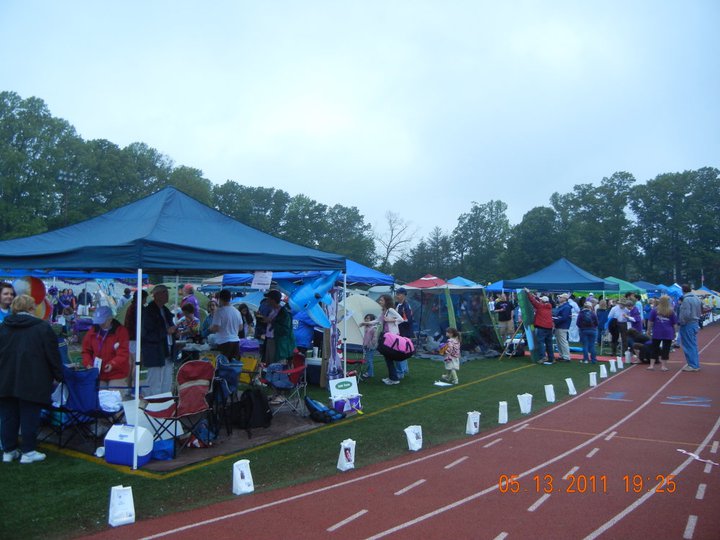
Each team has several tents where participants can gather. Some teams do onsite fundraisers out of their tents.

I know I’m not really doing this all justice, and I wish I’d been able to stay the whole 12 hours instead of just a few. But arriving there Friday night after a long day and a long week I told my husband to remind me not to sign up for charity events anymore. He gave me a look. As we left, slightly damp but inspired, I had a feeling I’d be back again next year.

Thanks for your support, and for helping us make more birthdays possible.

“Let’s have a sword fight with the golf club and the baseball bat!” I look up.

“Silly both of us, we don’t want to hit each other!”

“Let’s just play calm now, ok?”

“OK.”

Zoe has a friend over for a playdate. This is a friend from school, but who is not in her class. They were classmates in the one-year-old and two-year-old classes and have had playdates before, but not in a long time. But they still consider each other good buddies, which is great. It is hard for me to remember how much little kids live in the moment. They are much less likely than I am to think about the status of their friendships or whether time apart has affected their relationships. Proximity is often the best indicator of affection.

What really amazes me, though, is how seemingly hurt feelings are so fleeting. Zoe was at another friend’s house recently for a playdate without me. On the way home she said her friend had cried a few times and had declared after various perceived slights that Zoe was not her friend anymore. Zoe seemed disturbed by this (at least after the fact) and we talked in the car about how you can be mad at someone and still be friends, or still love them, even when you’re mad. The next day Zoe excitedly asked when she could go back to that friend’s house again. No big deal.

Zoe is just at the age where it’s easy to have playdates that don’t require participation from both parents. Especially when there’s good chemistry, the girls will go off on their own, flitting from the play kitchen to the doll house to the dress-up clothes to throwing and kicking balls outside to collecting bugs. Rather than having to intervene in the interest of sharing or address tantrums, the only thing required of me is snacks. I like to sit back and listen to their conversation, observe them taking turns, eavesdrop on negotiations, and smile at their genuine wonderment that they each have one of the same toys, or that they both like raisins.

Right now they are marching around with playground balls tucked under their tank tops. Zoe’s friend says “I think now we need to marry each other.” Zoe says “No, I think I need to have my baby first.” I am curious to hear what happens next.

Since my husband has been in Detroit for a conference I have made our bed and Zoe’s bed every day, done all the dishes and emptied the dish drainer, and generally kept everything as tidy as if we’re about to have company. (Having guests is usually the main motivation for cleaning our house). I don’t know why I tend to be neater when he’s away. You’d think the combined mess of our whole family when he’s home would provide more incentive to clean, but instead it’s the opposite. Somehow when it’s just me (and Zoe) I feel compelled to keep things nicer. Perhaps I know no one else will be arriving later who might be inclined to help out. Maybe it’s something I can control and feed good about when I can’t control Randy’s absence.

This week’s neatness was also prompted by the work of our cleaning lady on Monday. After she leaves the house looks so lovely that I don’t want anyone to eat, play, or move any objects from their homes. Of course it doesn’t last. But the initial burst of clean definitely gives me an incentive to keep things clean. I always think of the broken windows theory that Malcolm Gladwell wrote about years ago. If an environment is neglected and falling apart (an abandoned building with broken windows) it invites people to contribute to the decay. They tag buildings with graffiti. They dump their trash. So I believe the reverse is true as well. If an environment is clean and welcoming, people want to respect and take care of it. This theory is applied in urban school settings where kids feel little sense of pride or ownership in their broke down schools. It amazes me how much neglect can decay can build on itself.

Randy reported to me last night of his total astonishment during a walking tour of some of Detroit’s destroyed neighborhoods as part of his conference, on using data to improve conditions in communities across the country. He saw entire blocks filled with abandoned, ruined houses, save one where lonely residents sat on the porch in the midst of destruction. He said he saw a site that used to house a factory, now defunct, where people and companies come from surrounding areas to dump their waste. Lovely. I heard recently that not too long ago Detroit had 2 million residents, and it’s now down to 700,000. The jobs left, foreclosures hit, and gone was the capacity to care for the community. More significant manifestation of broken windows theory than just me keeping the kitchen sink clean.

On the way home from school recently Zoe told me that her teacher had discovered a trove of ants on the playground. Zoe took it upon herself to warn her classmates to stay away from the ants because they might bite. While those ants were probably harmless, it’s completely understandable that Zoe was concerned about the ants. Last week when we were visiting family in South Carolina, my aunt warned Zoe to stay away from a massive anthill containing somewhat angrier Southern ants than the ones at Zoe’s school’s playground. Regardless, I imagine Zoe’s classmates ignored her advice. Zoe said “my friends in my class are always getting into danger and I’m always trying to save them from danger.” Uh oh.

Fortunately or not, depending on your worldview, Zoe comes from a long line of rule followers. We try to teach her the right way to behave and how to take care of herself in the world, and she more or less does what she’s supposed to do. Of course she’s four and there’s plenty of running away and hiding and jumping on the bed, but generally she is pretty obedient.

So when other kids are not following the rules (at least our family’s rules, which likely have no bearing at all on what those kids think about how they should behave), Zoe gets upset. They are not doing what she knows she (and presumably all kids) are supposed to do. So she tries to set them straight. You can guess how well that works out. Recently at a friend’s wedding where she was running around with a pack of kids, she came back to me with a pouty expression, complaining that the boys were all running around poking each other with sticks. I suggested she play with the girls instead. She said the girls were doing the same thing. She explained that she had told all the kids they shouldn’t be poking each other with sticks (not an unreasonable request, really) but they didn’t listen. I told her that she couldn’t really make kids listen to her if they were playing and she should just try to find something else to do.

How do you explain the fine line between doing the right thing, trying to be a good person in the world and help others, and minding your own business when no one is going to listen to you anyway? I admire Zoe’s instinct to help and protect her friends (or strangers) and keep them safe from harm. I applaud the concern and empathy she demonstrates. I want her to keep following our rules to keep herself safe as well. But I don’t want her to feel like she’s responsible for everyone else (a characteristic that has plagued me for most of my life and been the subject of many hours with a therapist). If she sees someone really and truly in danger, I would want her to intervene, by telling an adult or doing what she could to help. But most of the time, if someone is climbing up the slide, or touching a bug, or poking his friend with a stick, she really doesn’t need to say anything. There’s a nuance there that even adults struggle with–when do we step in and when do we go about our business? When do we say something at the risk of embarrassing ourselves or annoying someone else because we think someone might need help? It’s something I’m still trying to figure out, and I just turned 37. I’m wondering how to teach it to someone who just turned four.

It’s good to know your offspring has a healthy mix of your and your spouse’s genes. While she’s only four and there’s plenty of time to develop, it is surprisingly clear how much Zoe has in common with each of us that is clearly derived from nature rather than nurture.

Yesterday Zoe got two vaccinations at her four-year-old checkup. To motivate her to be brave before the shots, I promised ice cream at the end of the day. We procured our chocolate cone and cup and headed outside to enjoy the warm weather. We found a table and Zoe sat facing the building. She started to eat but she kept squirming around to look behind her to see the various children and dogs and other passersby. I asked if she wanted to find a new place to sit where she could see who was walking by on the sidewalk. “YES!” she exclaimed, and we happily relocated to a low wall we could sit on and people watch. Like me, Zoe loves to know what is going on everywhere, all the time. She likes to observe and check things out. She even watches me and my facial expressions. In the car she’ll see me in the rear view mirror and ask what’s wrong if I make a strange face. “Are you ok? Or just tired?” she asks. I can’t hide from this girl. The upside of this trait is that she pays careful attention and she is acutely aware of the people around her and her environment. The downside is a compulsion to always know what’s going on that can sometimes distract you from what you should be focusing on.

Meanwhile, one project we have this week is sending thank you notes for all of the birthday gifts Zoe received. I created and ordered thank you notes online using a photo from her party. I wrote all the notes on the cards and addressed the envelopes. Then I asked Zoe if she would draw or write or put stickers on the notes to make them a little more personally from her. She started on this project and spent about 20 minutes drawing a thunderstorm on one envelope. She drew a scene with a bear on another card. Then she wanted to quit. She tends to spend a long time on any item she creates, working on it meticulously. This is a good thing. She is thorough and not careless. This way of working also takes a long time. Especially with a relatively short attention span. There were 25 cards. I asked her to pick up the pace. She didn’t understand why. This characteristic of careful and diligent work on a project is shared by Randy. He wants to make sure whatever he does is exactly right and done the best possible way. This is admirable. It also takes a long time. I am more likely to rush through something in the name of efficiency.

So it’s interesting to notice these tendencies emerging in Zoe. I am pretty sure we didn’t teach them to her, although perhaps unconsciously anything is possible. My hunch is they are hard-wired. I hope we can see ourselves in her when she’s demonstrating these behaviors and be patient, since they’re really our fault.

So Zoe’s swimming lessons finished yesterday. After being terrified last week by the substitute instructor, she was much clingier than usual to the regular instructor and would let go of him under no circumstances. After class he gave everyone’s parent a certificate detailing their accomplishments. There are about 25 skills listed on the sheet. He checked off that Zoe can enter the water using the ladder and exit the water using the ladder. Well, we have plenty of opportunity for growth.

Next month I’m participating in the American Cancer Society’s Relay for Life to raise money to fight cancer and help people with the disease. I am doing it to honor my dad, who was treated last year for prostate cancer and is doing great. I am doing it to honor my aunt, who died of breast cancer. And I’m doing it in honor and support of many other friends and family members who have confronted cancer in their lives. If you want to help, and if you have someone who has had cancer who you want to honor or remember, or if that person is you, now is your chance to contribute.

My team’s fundraising goal is $6,000 and we’ve raised just shy of half that. To give, please visit my Relay for Life page.

Thank you.

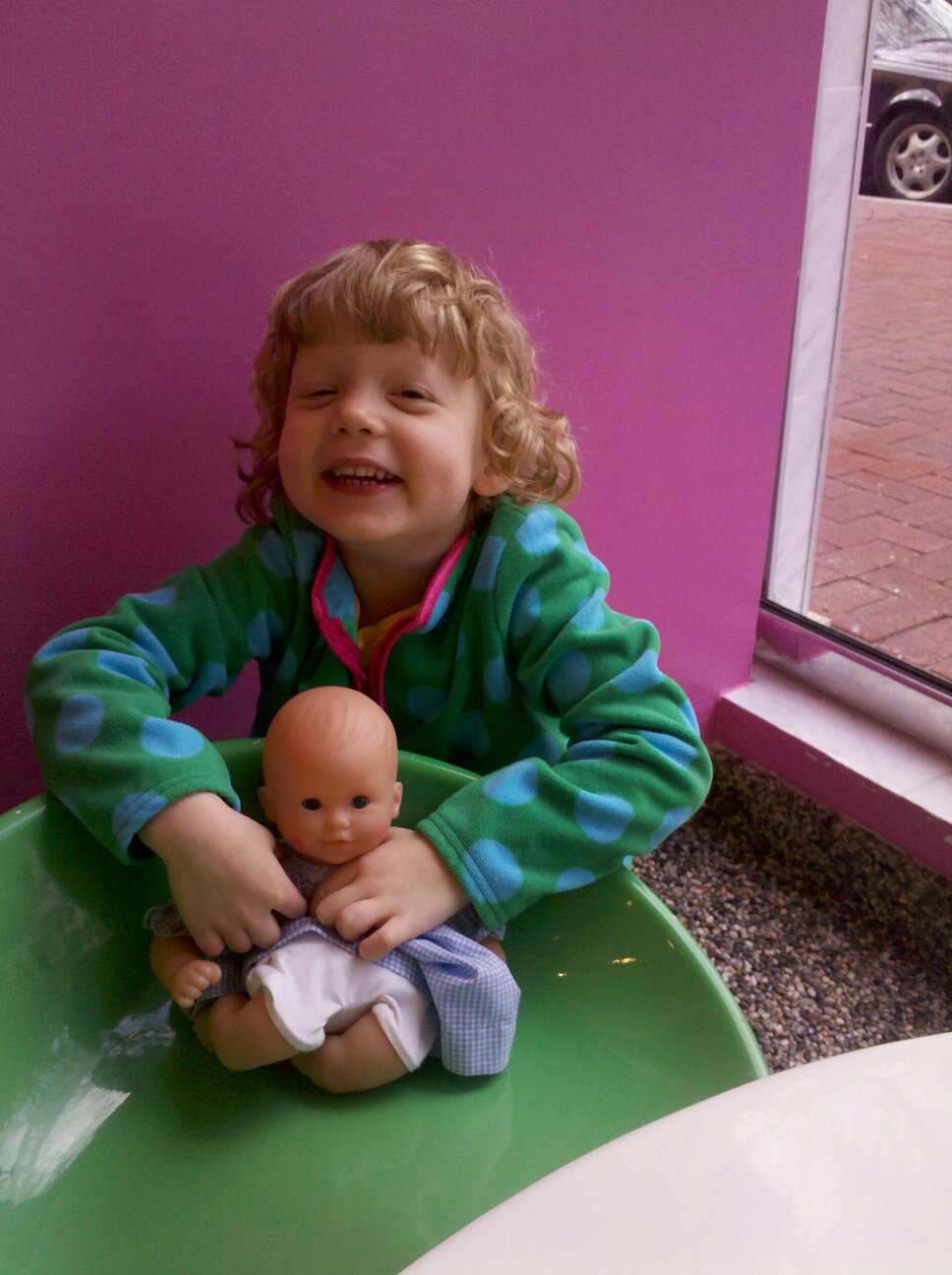
Zoe with Eve (fully recovered from the flu)

Tonight after Zoe’s requested birthday dinner of pasta with meatballs (she says it “meatbawls” with a New York accent and laughs) topped off with chocolate chip fudge cake, we played Kids on Stage, a charades board game she received for her birthday from a friend. It is a perfectly designed game and exactly on target for a 4-year-old. She could easily follow the directions and act out what was on the cards and guess what Randy and I were doing when it was our turns. And unlike with Candyland or Chutes and Ladders (which I hope to discreetly remove from the house in the coming weeks), Randy and I did not get bored or go insane. After Zoe won she wanted to play again and while getting ready for bed kept improvising actions and objects she could imitate and we could guess.

The science experiment kit we gave her today was popular too. We used eye droppers and test tubes to mix water and oil and detergent and little colored tablets and observed the results. I felt like the explanations in the instruction manual were somewhat lacking, but Randy and I are also somewhat lacking in our scientific knowledge, so it is what it is.

Today Zoe received her own library card. This is a relief because I won’t have to worry about maxing out my card checking out items for both of us. We’ve recently expanded our literary horizons from exclusively little kid books to include chapter books that we read to her and she pays attention to even though the pictures are fewer and farther between, and I’m sure there’s a lot of words she doesn’t know. We’ve been reading Charlotte’s Web at bedtime, which all three of us have enjoyed. Zoe can read some words, and I am probably unnecessarily impatient for her to be reading fluently so she can entertain herself more easily. But she’s getting there. We’ve also listened to some chapter books on cd, as well as picture books on cd where you can read along. I like the variety that is available to us now, although there are certainly favorites we return to frequently. Most trips to the library Zoe whispers to me, “Let’s find books about a mommy having a baby.” And the book can’t just be about a mommy or a baby. It has to actually be about a mom who is about to give birth and then does, and then what happens. Often she can spot such a book from 20 paces, but if there aren’t any on display, I now know enough of the better titles and authors in this genre that I can find them for her on the shelves. We are also huge fans of Mo Willems and everything he has written.

In recent months I have had more frequent migraines, and Zoe has eagerly stepped up to the role of nurse and comforter. I do not want her to think she has a sick mommy or that I cannot take care of her, but at the same time sometimes I have to lie down and invite one of our friends from PBS Kids http://pbskids.org/ or Nick Jr. to keep us company. Surprisingly, she isn’t rattled if I’m not feeling well. She immediately comes over, unsolicited, to hug me or rub my back. She brings me snuggly animals and covers me with a blanket. She says “Don’t worry, Mommy, I like taking care of people.” And while most of her caretaking focuses on her baby dolls, she is extraordinarily conscientious. Randy went into her room the other day and found her sitting on a stool next to her bed, looking completely discouraged. He asked what was wrong. “Eve [one of her favorite dolls] has the flu. She’s been sick for days and no matter what I do, she won’t get better.” And it was true that for days she’d been telling us that Eve had the flu, putting her to bed when it was time to leave for school each morning, and instructing us to be quiet so Eve could rest.

We have not escaped the princess years entirely, as I had once naively hoped was the case. But we are still not fully immersed. Zoe is drawn to princess things and knows most of the Disney princesses by name but we haven’t seen any of the movies. Way too scary. She likes to dress up and be glamorous, but royal beauty often morphs into ballerina chic as well. At preschool she will often arrive and head to the dress-up corner, slip on a princess gown or a tutu, and then go about her business of the day–pounding nails while wearing safety goggles, dictating stories in her journal, doing puzzles, or making non-Newtonian substances out of household products. Don’t ask me what this means–it’s what her teacher told me. The class made something called gak. They had fun, whatever it was.

In ballet class last Saturday we were invited to observe the last few minutes of class to see what the girls have been learning. This proves challenging every time the teacher attempts it because the girls all seem completely thrown by the presence of their parents (and always some younger siblings who feel compelled to careen around the studio). During the 10-minute demonstration Zoe was sometimes beautifully attentive and sometimes completely focused on the little kid running around and totally tuning out the teacher. But when she was dancing, she was joyful and possessed a grace that does not come from my side of the family. She is also a little yogi in training, and her birthday party on Sunday included a mini-yoga class taught by my own yoga teacher. Her friends were wonderfully engaged for most of the 30 minutes and then escaped to eat cake and explode across the playground. Zoe loves to move, whether it’s creeping like a turtle or hopping like a bunny. Except when she goes drama queen and says she’s tired and needs to lie down. After a long day she says quietly, “I’m feeling a little fragile.” And then suddenly she is jumping onto, across, and off the couch. Thank goodness for quick recoveries.

I gather that most preschoolers don’t care too much about whether they know their teacher’s name, or the name of a new buddy at the playground, or anyone else. I know when I co-op at Zoe’s school most of the kids call me “Zoe’s mom” and that’s sufficient.

For Zoe, she feels a great sense of comfort and connection knowing someone’s name. If she makes a friend at the playground she will ask his or her name first thing, and usually ask it again when she leaves because she forgot it while they were playing. Then she can say “goodbye Jasmine!” as we’re heading out, and talk for the rest of the day about her new friend Jasmine.

So today, for the second time this week, there was a substitute teacher at swim class. Tuesday’s substitute was friendly enough and I asked her name and told Zoe what it was. I was surprised as I watched from the observation deck that she had a completely different style of teaching from the regular instructor, and at first I wondered whether they would actually learn anything, but then I saw that the kids were all practicing various skills on their own while the teacher worked with each kid individually. I could see they were having a lot of fun not sitting on the wall as usual. I was actually hoping that teacher would be there again today. Instead it was a different substitute, and it was just all wrong.

I made the mistake of not asking her name at the beginning. I guess I just forgot. There were only three kids (instead of usually six or seven) so I thought it might be good for Zoe to get some extra individual attention. But it wasn’t.

As you may have read in my previous post, Zoe has loved her swimming lessons and been very brave. I’m not sure how much she’s actually learned about swimming, but she’s gotten way more comfortable playing and using the various floatation devices and toys they provide. Today she was terrified. The teacher either didn’t understand that this was a class for beginners or didn’t care, and she pushed them to do more on their own than they’d ever done. Instead of working with each kid individually, she would hand them the floating barbells or strap them into the floating belts, and expect them to motor down the length of the pool themselves. She had them working most of the time in depths Zoe couldn’t stand up in. Zoe had no idea what to do. I watched from above with growing unease. I saw the two other kids (one of whom is six years old) doing what he was supposed to do with ease. The other little girl flailed a little more but still went for it. Zoe was panicking. The instructor would try to give her a little push and she would grab onto the instructor with a look of desperation. I knew what was happening but I didn’t know how to stop it.

About two-thirds of the way into the lesson, the lifeguard turned and looked up at me and pantomimed that Zoe was crying, so I went downstairs. The instructor told me Zoe was panicking, as if the instructor had never dealt with a scared child before. I talked to Zoe for a minute and calmed her down and convinced her to get back into the pool for the last five minutes of class, to practice blowing bubbles. Then the instructor asked the kids to go under. The other two did it and Zoe wouldn’t. She has allowed the other instructors to help her go under every class. But by this time she was totally shaken up. Finally, thankfully, it was over.

On the way home Zoe mentioned at least a dozen times that she couldn’t stop thinking about how scared she was in the pool, and how she was afraid the instructor was going to let her sink. I can totally understand how she didn’t feel like she could trust the instructor who she had never seen before and whose name she didn’t know, and who was asking her to do things in a way she’d never done them before. I would have been scared too. I asked her why she was so upset. She said she was afraid the teacher was going to let her sink.

I told her that no instructor would ever let her sink, and no grown-up who’s taking care of her would make her do something dangerous. I told her the floaties hold you up, even if your face gets a little wet. I told her that Randy or I would take her to the pool soon to practice some of what she was doing in class. Nothing she hadn’t heard before, but clearly she wanted a reminder. She said she didn’t want to go back. I asked the front desk person if her regular instructor would be back next week and he said yes. So we’ll go back next week. Hopefully the memory of today’s class will fade. But I still remember being in a pool when I was probably close to her age, and being sure I was drowning because I was under water for more than a couple seconds after losing track of the wall or my floatie or whatever it was that I had been holding onto. This is why I want her to learn to swim sooner rather than later. But she has to be able to trust her teachers to relax. I am often torn between the urge to advocate for my kid and give her the chance to advocate for herself. But in a pool when you’re terrified is not a time when you can easily speak up about what you need. Next time I’ll be sure to make a formal introduction.

I overheard two moms talking during Zoe’s swimming lesson the other day.

“Is your son in the advanced class?”

“Oh yes, he’s a swimming prodigy. He only took the beginner class four or five times before he made it to the advanced class.”

“Oh it took my son at least four or five times before he got out of the beginner class.”

They dissolved into laughter.

I thought, “oh no, we’re going to have to do this three or four more times?”

But I looked down and saw Zoe smiling from the edge of the pool, looking up at me and waving excitedly every five minutes. Every time we go to the pool for a lesson she is ecstatic. When I come down to the pool at the end and wrap her in a towel, she is cold but thrilled. “Did you see me? I jumped into the pool and got my whole body and my whole head wet! I wasn’t scared and I didn’t even cry!” I am so proud of her for being brave. I am so happy she is having fun. My husband and I both were very late bloomers when it came to swimming. At three (almost four, really) Zoe is, if not the youngest in her class, one of the youngest. There are two sisters who are four and five years old whose mom told me had taken the class once before and a parent and child class before that. They are just that much more confident in the water. And Zoe is getting there day by day. Today when it was her turn she held on to the floaty things exclusively instead of always trying to use the instructor’s arm for support. So that’s something.

When we got to class today we saw kids from an earlier class, who looked like they were seven or eight or nine years old, swimming totally independently. I got tears in my eyes. At that age I was still standing fearfully at the edge of the pool. So what if it takes Zoe four more sessions of beginner before she gets to that point. She is having so much fun and she’s not scared and that is half the battle.

Enter your email address to subscribe to this blog and receive notifications of new posts by email.

Join 817 other subscribers

Archives

Follow You Ask a Lot of Questions on WordPress.com

Listen to my podcast: Five Questions with Betsy Rosenblatt Rosso

http://betsyrosso.podbean.com