
You are currently browsing the category archive for the ‘music’ category.

© Christopher Mueller
Here’s a short story of love and liberation for your Sunday enjoyment.
Chapter 1) For Christmas, my sister and her family gave us tickets to Hedwig and the Angry Inch at Signature Theatre (Arlington’s answer to Broadway). Hedwig is about gender identity and exploration, and liberation, and relationships, and figuring out how to love who you are and encourage that freedom in others. It’s funny and aggressive and profane and tender. It blew us all away.
Chapter 2) Hedwig is a two-person show with the energy of a rock concert (the kickass band is on stage and integrated into the production) combined with the pathos of a tragedy. The stars have to be on and radiant 100%. Hedwig, played by Sawyer Smith (they/she), in particular, does most of the talking, teasing the audience, singing (think diva with spectacular range), and dancing, all while wearing fabulously creative costumes and gravity-defying wigs. Yitzhak, played by V Sterling (they/she/he), is Hedwig’s partner/assistant/foil depending on the moment, and also sings like an angel or a demon, depending on the scene.
Chapter 3) Anyway, this is not actually a theater review. The important bit about this show is that it affected Niki in a way that I have never before seen them react to or connect with a piece of theater. They were profoundly moved by seeing Hedwig. It meant a lot to them. That night after the show we waited around for a while to see if we could meet Sawyer and V, but eventually we had to go home before they appeared.
Chapter 4) I knew the Hedwig was closing tonight and I had hoped to take Niki to see it again, but tickets were almost all sold out and quite expensive, as the show was extremely popular. Apparently it was a record-breaking run, but I’m not sure what record it broke. Last week I stopped by the theater, sat in the lobby, and wrote a letter to Sawyer and V. I told the actors about Niki and our experience at the show and how we hoped to come again, or, if we couldn’t get tickets, to at least meet Sawyer and V. I gave them my email address and phone number. I asked the people at the box office for an envelope and to please deliver the letter. They promised to leave it in the dressing room.
Chapter 5) Last night I got a text from Sawyer, saying they thought the show was sold out but they’d definitely be happy to meet us after today’s matinee. I looked on Signature’s website and discovered two seats left for the matinee. They were pretty pricy, however, so I figured I would buy them in person so I could try to get the student price ($25) for one of the tickets. When I got the message, Niki and Randy and I were in the middle of watching an especially intense episode of Andor, so I waited until it ended and I ran out of the house, yelling behind me that I had to run an errand immediately (and unintentionally freaking Niki out). I sped to the theater only to discover the box office was already closed. I explained the situation to another employee, who suggested I email the box office right away with my request and call them as soon as they opened this morning. I had wanted to keep my errand a secret so that if it didn’t work out to see the show, Niki wouldn’t be disappointed. But after I got home we went out for ice cream and I had to explain to them what I had been doing because they were alarmed at my sudden, unexplained departure. They promised that even if we couldn’t get tickets, they appreciated me making the effort.

© Christopher Mueller
Chapter 6) I called the box office this morning at 10 (from church, as I was helping lead today’s service) and left a message. I called again at 11, when my part of the service was over, and left a message. Shortly thereafter I got an email from the box office saying that unfortunately those tickets had been sold, but that we could come for the rush period before the show in case someone turned in their tickets or didn’t come. The matinee was at 2, and the rush period starts at 12:30, so the email suggested we bring things to do.
Chapter 7) With water bottles, books, playing cards, my laptop, and a phone charger all in my backpack, we arrived at Signature at 12:30, identified ourselves, and settled into a pair of purple armchairs to wait. Niki read a novel. I wrote an article. We watched people walk through the lobby doors. At 1:45, one of the box office staff came over to where we were sitting. I felt certain she was going to say that everyone had shown up with their tickets and we would have to go home. Instead she said, you’re in luck, there are two tickets in the front row center that opened up. Niki and I leapt out of our seats, our hearts racing. We followed her to the counter to pay, and even more fortunately, the tickets cost only $30 each because that’s the rush price. I hadn’t even known that was a thing at Signature. Everyone at the box office seemed genuinely happy for us.
Chapter 8) We took our seats. If you’ve never been to Signature Theatre, you should know that there’s no bad seat in the house—actually there are two theaters there and they’re both pretty intimate and the way the stage and seats are arranged, you can always see what’s happening. But when you’re in the front row (which we’ve been privileged to be for Into the Woods and In the Heights), you can see everything, like every expression and teardrop and bead of sweat on the actors’ faces and every stitch and sequin in the costumes, and every clever detail of the set. So in the front row for Hedwig, we were approximately a foot or two away from the actors at any given time. We were close enough that Sawyer took Niki’s hat and placed it on top of their voluminous blond wig for a moment. We were close enough that Sawyer made eye contact with Niki and winked during another song. We were close enough that Sawyer reached out and clasped the hands of everyone in the front row, and for an instant held Niki’s face in their hands. The whole performance was even more phenomenal the second time, and left Niki in a puddle once again.
Chapter 9) Afterward we made our way to the lobby, still feeling the emotional aftershocks of the show. A little while later, once most of the audience had left, Sawyer and V (and Marika Countouris (she/her), the awesome keyboard player in the band and the show’s musical director) emerged through the stage doors. Sawyer and V came out with arms wide open to give us hugs. They were so kind and sweet and posed for pictures and signed Niki’s program. Sawyer told Niki to keep being themselves and called them angel. Then they gave us more hugs.
Chapter 10) Niki gave ME a lot of hugs in gratitude for making all that happen. I couldn’t have made it happen without the pro tips from the box office staff and the generosity of the actors, who were willing to connect with Niki, during and after the performance, and show them some love. Niki is 12 and I don’t know what’s going on in their head a lot of the time, but I know they take in a lot of what’s going on in the world. Right now, there’s a lot of hate and cruelty swirling around in the atmosphere. As much as we tell Niki we love them and we have their back and we’ll do whatever it takes to support and protect them, I suspect they know there may be battles ahead they will have to fight on their own. In the first song in the musical, Hedwig sings
Enemies and adversaries
they try and tear me down
You want me, baby, I dare you
Try and tear me down
Niki won’t forget seeing Hedwig sing that just for them.

Share this:

Yesterday I had the privilege of leading the service at UUCA with my friend and fellow worship associate Tommy Lo, featuring insightful reflections from Amy Dryer and Roberta Finkelstein, all on the theme of genuine invitations. Also great music from our new music director, David Mann. We heard people were moved to tears, so we did our job. 🙂 Click the video above to watch the service.
Here is my reflection from the service:
Last week my 11-year-old and I received an unexpected invitation. Our poet friend Regie Cabico called to ask if Niki and I would write poems for an event celebrating the freedom to read. We met Regie last year when he taught a poetry unit to Niki’s class, which unleashed the poet in Niki who we had previously never met. Niki actually won the inaugural poetry slam at their school, and was a finalist in the UU Congregation of Sterling’s poetry slam, where all the other poets were adults, including me.
The Celebration of Reading event was designed to clap back at the rising tide of book bannings, especially books by and about queer people, people of color, people with disabilities, and other identities that are unfathomably threatening to those who love censorship. Apparently some of these folks also feel threatened by great soccer players and cows. One of the books on the table was a little golden book about Argentinian soccer star Lionel Messi. Was it banned by soccer fans who preferred Real Madrid to Barcelona, where Messi spent most of his career? Another banned book was Click Clack Moo: Cows that Type, a long-time favorite in our family, about farm animals who find a typewriter and demand upgrades in their accommodations from the farmer. Perhaps those who want to ban this book fear an uprising from cows who might read it?
Anyway, Regie wanted Niki and me to write about how books have shaped our identities and changed our lives. In my poem I wrote about Are You There God? It’s Me, Margaret, and thanked Judy Blume for unlocking the mysteries of puberty. I wrote about The Color Purple and thanked Alice Walker for teaching me the universality of tenderness and tenacity. I wrote about The Hate You Give and thanked Angie Thomas for replacing headlines with humanity and empathy.
And I wrote about books featuring queer characters that have opened the world for my family. Here’s one short passage from my poem, about a book called Sir Callie and the Champions of Helston.
Thank you to Esme Symes-Smith
for bringing Callie into our lives.
I’ve never had a wish to be a knight of the realm
or a princess in the palace,
but I have never felt more seen than
reading about how Callie’s dad did his best
to fight for his nonbinary would-be knight
to claim their power
in the old-fashioned
heteronormative kingdom of Helston.
In Niki’s poem, they wrote about times they were criticized for disrupting gender stereotypes, long before they came out as nonbinary. And they wrote about Magnus Chase and the Gods of Asgard, a series by Rick Riordan, which includes a character named Alex Fierro who identifies as gender fluid. Niki wrote that they always knew they were different, but they didn’t have the language to describe how they felt until they read Alex Fierro’s words explaining how they weren’t just a boy or just a girl.
Niki and I read the Magnus Chase books together the summer between their second and third grade years. I had no idea when we started reading them that gender identity would be a major theme in the books, which are largely based on Norse mythology. Although I’ve since learned there is a lot of gender expansiveness in Norse mythology, so it makes sense. I am thankful to Rick Riordan for creating Alex Fierro and giving my kid the vocabulary to articulate their identity.
In the years since Niki came out, I have spent a lot of time educating myself about gender and sexuality and making sure that my kid is surrounded by people who support them and embrace their identity, and the resources they need to grow up healthy and confident as their unique awesome self. When we invite young people to be themselves, we have to actually mean it. We owe it to them to do everything in our power to ensure that their schools and teams and troops and congregations and all the environments they’re in are willing and able to show them they are perfect just as they are.
I also try to make sure other families have the information and connections they need to support their LGBTQIA+ kids. That’s why my friend Tracey and I started a covenant group a few years ago for parents of gender-expansive kids. And why we created QA2: Queer and Questioning, Awareness and Acceptance–an event for LGBTQIA+ young people and their families last year. At last year’s gathering we invited dozens of community organizations to participate so kids and their families could see what resources are available, ask questions, and make connections. We invited a fantastic panel of queer individuals and advocates to speak about their experiences and offer advice.
This year, we’re doing it again, but bigger and better. We’re going to have workshops on gender-affirming care, legal issues, and queer futures. We’re going to have vendors who offer products and services that specifically meet the needs of queer young people. This event is open to the public and we hope to have hundreds of folks from across the DMV coming through our doors, knowing they will be 100% welcomed and supported by everyone we’ve invited to be here.
Which brings me to my invitation to you. We have some fierce mama bears organizing this year’s QA2, but we still need help. If you have connections to LGBTQIA+ friendly service providers, we want to hear about them. If you are part of an LGBTQIA+ organization, we want to hear from you. And even if you don’t have any of these connections, or even know any queer youth, but you want to help, we will absolutely find a job for you. We need people to help organize, and also folks to help with logistics on the day of the event–October 5. If you have any questions or suggestions or want to volunteer, I invite you to talk with me after the service or email me. If you go to the church website and search for QA2 you can find the address to contact me directly.
Like I said before, when we invite someone to come out, we’ve got to make sure they’re coming out into a safe and welcome space. I invite all of us to create that space, and protect it fiercely and unapologetically. May it be so.
Throughout the service we talked about different kinds of invitations. And we created some actual invitations for folks to take with them when they left the service. We invited everyone to take an invitation of their choice for themselves, or for someone else, or both. Accept the invitation, we said, and see what happens. Here are the pages of cards that we cut up and offered to everyone.


Share this:


It is true that I like to plan and organize things, particularly if they are related to something I’m excited about. I will never become a corporate event planner or a travel agent, but I like planning things that matter to me. Right now, for example, I am in the midst of planning an event at my church for families with LGBTQIA+ kids. I love to plan trips for my family, complete with detailed itineraries that everyone makes fun of and we always stray from but at least we have a starting point and options. I love options. Which is why I have thoroughly enjoyed envisioning and implementing my 16-year-old’s college search process. Why am I doing this instead of her, you might ask? I’ll tell you.
- I understand what college is and how it works much better than she does, since I went through the search process and attended college and graduated, and I know many other people who have done the same. At first I thought she magically knew all the things I knew about college, but it turns out that’s not the case.
- One thing I’ve learned about parenting her over the past 16 years is that I have a pretty good sense of what she wants and what she needs even if she doesn’t realize what she wants and what she needs at the moment. I am proud of my track record of things I’ve mildly coerced her into doing (which she resisted simply because they were unfamiliar) that she ended up really loving. So I have come to understand that she often hesitates about jumping into something she hasn’t seen for herself. I think she connects with experiential learning. It turns out that our college visits have helped her learn about her interests, or at least reveal to us interests we didn’t realize she had.
- I like to plan ahead. See above comment about often-mocked but still appreciated vacation itineraries. I’ve wondered for a while why so many families and schools wait until it’s almost time to apply to colleges to start looking at colleges. By the time you’re a senior, or even well into junior year, your GPA is pretty firmly established. You may not have the opportunity to sign up for any more classes. When you’re touring colleges, they say they want to see that you’ve challenged yourself in high school. By late junior year or early senior year, you’ve already taken or at least signed up for all your high school classes. You’ve already been doing most of the activities you’re going to do. It’s certainly possible you will take up a new sport or learn to play a new instrument as a junior or senior, but probably not likely. So that’s why I started this process when my daughter was in 10th grade, so there was still time for her to absorb the information we learned from college visits and act on it. I also anticipated that she would be unavailable for the entire summer between 11th and 12th grades because she aspires to work as a camp counselor at the sleepaway camp she attended for eight summers. That would mean no college visits during that time, which is often when families have the opportunity to tour.
Many people have asked how I started the search, since the universe of universities can seem so overwhelming, given that there are approximately 4,000 of them in the US. So the first thing is to narrow the scope. This does not mean that the initial list you make will be the final list, or that your kid won’t change their minds about what they want many times. And that is totally fine. But you have to start somewhere. Here’s the path we’ve taken so far. (Disclaimer: I am not saying this is the path for your kid, and I am not inviting debate or discussion here. Just explaining our experience).
- During her freshman year, I was concerned about the lack of self-confidence she expressed when talking about people she knew who were being accepted into colleges that she felt sure she could not get into. Similarly, she seemed daunted by the prospect of taking AP classes because she had heard how hard they were. Of course this prompted me to launch into one of many “you can do hard things” speeches that parents pull out of their back pockets when needed. I attempted to explain to her that she did not have to go to any particular kind of college, or a famous or prestigious college, and that she could take a gap year if she didn’t want to go to college right after school. She could work or volunteer or take time to think if she wasn’t ready for college. We’ve emphasized this a lot. But that she does eventually have to go to college and she does have to take hard classes because she is capable and it’s important to challenge yourself. At this point it was still all theoretical.
- While we were on vacation, we toured a well-known college in that city. Not because of any particular program that school offered, but simply because it was there. As in, “hey, here’s a college! Let’s look at it just for fun!” I hadn’t really prepared her for this tour and she mentally freaked out, as demonstrated by total silence, walking 20 feet ahead or behind us at all times, refusal to discuss anything during or after the tour, and unwillingness to read the brochure. So that didn’t go super well.
- Later, when everyone was in a better mood. Perhaps this was days or weeks later, I don’t really remember, she asked me a lot of questions about how college works which I didn’t realize she didn’t know. After that, she seemed to feel reassured that she could, in fact, handle the concept of college, and was more open to thinking and talking about it.
- One of her teachers suggested to me that my daughter might be interested in one of the Seven Sisters women’s colleges. My first reaction was, “Whoa aren’t those super expensive? We are not rich!” But her teacher assured me that these schools give generous scholarships, which turns out to be true, and was one of the first lessons I learned during the search process, which is that the sticker price of a private university is basically meaningless. I am still trying to understand exactly why that is the case, but I know that it is. There is a lot of money out there, whether or not you qualify for need-based financial aid. For example, at one school we visited, they give you an automatic $25,000 scholarship if you were a member of the National Honor Society. I felt so vindicated when we learned this in an info session because I made Zoe apply to her school’s NHS even though she didn’t understand why it mattered. Another school that we’re planning to visit this fall just sent us an email saying “every admitted student receives at least $24,000 in renewable scholarship upon admission.” Like I said, the way this works does not make sense to me, but there it is. What I have told my daughter is that she can apply anywhere she wants, and we’ll see where she gets in and what aid they offer her. Anyway the point here is that we took a day trip to the nearest Seven Sisters school, which was beautiful, and my daughter was receptive to learning about the school, appreciated its intimacy and traditions and proximity to a cool city, and she was able to start seeing herself as a college student.
- At this point I was able to start asking questions, since she had some context for coming up with answers. We discussed geography, and she said she wanted to stay on the East Coast, basically within a day’s drive. A smaller school where she can get to know professors appeals to her, so we’ve concentrated on schools with populations roughly 5,000 or fewer. However, a few larger schools with smaller programs in her area of focus have recently made their way on to the list, but she definitely wants to be part of a tight community. We’ll get to that later. She also mentioned that she did not want to go to a school with a Greek system or a big focus on sports. It turns out, we’ve since learned, that this means Division III athletics. I think almost every college we’ve visited is Division III, which means they definitely have sports but sports are not the most important thing at the school. At one college we we toured, when they took us to the gym, I asked if many students attend games. The tour guide said that their women’s volleyball team had recently won the division championship, and that volleyball games in that gym were usually standing room only, better attended than basketball or football, which my daughter and I both thought was awesome. She knew that she wants to study abroad so it was important to find a school that offers plenty of opportunities for that. And I knew, even if she didn’t yet realize it, that we needed to look at schools that offer generous financial aid.
- Armed with this information, I started looking at lists. My first stop was Colleges that Change Lives. I don’t remember where I first heard of this book, which is now also a website and a whole organization, but it seemed like a good place to start. First of all, college should be a transformative experience, and second, I liked the idea that someone had already vetted these schools and decided they were special in some way. I read about many of the 44 colleges, focusing on those within roughly 600 miles north and south of us. I requested information from any of them that seemed even remotely like a good fit. At this point, my daughter didn’t really have any idea what she wanted to study. The only class she was especially interested in was psychology, so we used that as a placeholder. Most colleges have psychology programs, so we weren’t ruling anything out based on academic offerings yet.
- I created a spreadsheet with a row for each prospective colleges, and columns to fill in info like location, size, admission rate, average GPA of admitted students, percentage of students of color (we wanted a school that is diverse, like our high school and community), percentage of students who study abroad, etc. I’ve modified the spreadsheet many times and it has given birth to baby spreadsheets with subsets of information.
- Understanding that Colleges that Change Lives is just a small slice of the big pie of possibly great colleges, I opened up the Fiske Guide. This is one of the few nods to my own college search process, which was much narrower and seemingly haphazard. I love a nice big reference book, and Fiske is just that. I had bought a copy earlier when I was introducing the idea of the Seven Sisters schools, so my daughter could get a little insight into them. Each entry is only a couple pages long, and they include ratings on social life and environment and cost and things like that. She underlined and highlighted elements of the entries that interested her. This was kind of a baby step in terms of her engagement in the process, but it was an important one. One of the most useful parts of the Fiske, in my opinion, is where they say something like “people who applied to this school also applied to these other five schools.” If you liked this book, be sure to check out these other books with a similar vibe. So I looked up every school on our list in Fiske, and added relevant details to the spreadsheet. Then I looked up every school listed in the “if you liked this school” part of the entry, and read about them to see if they met our other criteria. If they did –or came close–I added them to the spreadsheet and requested information on their websites.
- A friend whose daughter had just gone through the college search process mentioned Niche.com. This is a handy website where you can look up a college and find a lot of information at a glance, including their “grades” for each school based on value, academics, campus, etc. These may be useful but should not be taken as gospel. Different things matter more or less to different people. Overall it’s a great resource, but I have two favorite features on Niche.com. 1) a more robust version of the “if you liked this college…” component of the Fiske, which suggests schools that similar to the one you’re looking at based on several different metrics, like “here’s another school with 2,000 students or fewer,” or “here’s another school with a top nursing program,” or “here’s another school in Pennsylvania.” So you can certainly go down many rabbit holes, but eventually you feel like you’ve thoroughly examined each category. 2) You can compare schools side by side, just like you would when you’re buying a refrigerator from Home Depot or a coffeemaker on Amazon. Comparing schools has been useful when looking at net costs, acceptance rates, and other numbers. I will reiterate that these are all numbers and not the only factors in decision making. Niche.com can’t tell you if the vibe at a school feels right to your kid. But it may be able to tell you if your kid is likely to get in or not, so you can make sure they’re applying to some schools they definitely will get into, as well as maybe some schools they’d like to attend but might be a reach. So I added several schools to the spreadsheet that Niche.com suggested.
- We started to schedule visits. I’ve heard from many experienced parents that it’s just as important to tour schools you don’t like so your student continues to sharpen their sense of what appeals to them, what matters to them, and what they might want to avoid. So, while I didn’t want to waste our time going places I thought my daughter would hate, I definitely included some maybes on the schedule. Here’s what I’ve learned since we started doing tours. 1) Don’t schedule more than one school in a day, even if they’re in the same town or city. It’s too much, mentally and physically, to absorb and process. 2) Do schedule an info session and a tour. You will get different information and perspectives from each. Info sessions are typically (but not always) led by admission staff, while tours are led by students. 3) Ask questions during both the info session and the tour, but also remember you can read the brochure and look things up online, so you don’t have to ask everything. 4) Bring a water bottle and wear comfortable shoes. Maybe a raincoat and umbrella. Some people I know like to eat on campus when they visit. I do not, because 1) I feel like it’s weird to eat there when you’re not a student and you have other options, like a real restaurant. 2)You can find out how the food is from other sources, and 3) a given meal might not be an accurate representation of the food overall.
- Somewhere in the middle of all this, my daughter discovered what she wants to study and do for a living, which is something in the realm of filmmaking, video production, photography, broadcast journalism, or media arts. Every school seems to call it something different, and she is still exploring what areas of the field she wants to dig into–which is great–she has so much time ahead of her to figure it out. But once she had this epiphany, that definitely changed the shape of our search. We started looking more intentionally for schools with film/video/media arts programs. This is slightly tricky because, as I mentioned, different schools label these things differently. She doesn’t want to study film, or theory, or just communications. She wants to make things. So that has added and eliminated schools to and from our list. It is important to note, however, that we have not struck a college from the list simply because it doesn’t have a media program if it is in a consortium with other schools that do offer great options in this field. It’s quite possible that she could attend a small women’s college that has amazing leadership opportunities and a progressive vibe and close-knit community while also taking film and photography courses at one of its partner institutions. We have learned that most schools, at least in big cities, are part of these consortia and you can easily cross-register for classes and basically have the resources of several schools available to you.
- And that brings us up to speed. So far we’ve visited 8 of the 14 colleges currently on our list. We have tours scheduled for three more this fall, and are planning to take on two more next spring break. We have one late-breaking entry that we haven’t schedule yet, but it’s relatively close by, so we can squeeze it in. And there are few more schools that are basically like notes in the margin of the spreadsheet right now. Maybe someone suggested we check them out, or we heard them mentioned somewhere, so I will do a little research to see if they merit a trip. I’m sure that some of the schools will be crossed off the list after we visit, and some may rise to the top. We still have 14 months until any applications are due. I imagine by then my daughter will have forgotten her impressions from some of our trips. Between now and then she will probably meet with some admissions officers when they visit her school, or at college fairs. Her school counselor encouraged her to contact the admissions office or professors in the departments she’s interested in to ask questions, as colleges look favorable upon applicants who have demonstrated a deeper than average curiosity and interest in the school. The list of schools where she actually applies will probably look pretty different from our current list. We have time to sort it all out. Once she knows where she’s been accepted, she can always visit again for admitted students day or an overnight.
- Of course I’ve already been thinking about next spreadsheet. This one I’m going to have her create, but I’ll help. This one will include the name of the admissions officer and the application requirements and deadlines, and the requirements and deadlines for the scholarships each school offers. And of course there will be another spreadsheet for other scholarships. Thank goodness for the internet. When I was in high school I had to look these things up at the library. I think I only knew about a fraction of the opportunities that were out there. Fortunately, I found one school I wanted to attend, and I applied early and got in and I loved my time there and it all worked out. But I was a different kind of student with a different personality than my daughter, and the world is different than in was in the 90s, so I want to open up the world for her as much as it’s in my power to do.
In the meantime, I will keep loving our road trips. Our next one is to upstate New York, to a city neither of us has ever seen. Every time we travel–for college visits or otherwise–we get excited about finding local coffee shops with resident cats, browsing through independent bookstores, and eating at funky little restaurants. We usually end up walking for miles. We listen to our favorite music and stock up on snacks for the car and notice weird and wonderful things outside as we drive. We laugh a lot. I’m soaking up every minute with her before she leaves on this grand adventure that I’m helping her imagine into being.
Share this:


It’s almost my birthday and I am thinking a lot, as one does when a birthday approaches, about everything. Asking a lot of questions.
I am thinking about why every book I read seems to contain a subtle but unmistakable link to the previous book I read, like a scene set in New Haven, Connecticut, or a young character hospitalized with a serious illness, or a political protest. Why are books about witches and witch trials so popular right now? Perhaps, or probably, because most men (and some women) have always been threatened by women who are strong and independent and powerful, and they still are. I have read a lot of books about the persecution of witches and they never fail to enrage me. Maybe I just want to be a witch. I also want to have to a Scottish accent. Or listen to Scottish accents. All day.
Books consume me these days. Reading always has, but lately novels are my means to escape from our ceaselessly corrosive culture. I can hardly stomach our society and the way it treats people–people of color, women, LGBTQIA+ individuals, people with disabilities. Basically anyone who isn’t Mitch McConnell or similar. Even though books I read have bad guys and characters have bad days and there is trauma and suffering there is also so much joy and redemption and humor and empathy and fascinating and strange and delightful people with whom I can immerse myself. Of course that good stuff exists in my real life too, but it’s not as reliably accessible. Reading is my vice and my virtue. The novels I read also help me understand why people can be such schmucks. But it doesn’t make their cruelty any easier to take.
I am thinking about earwax, and where it comes from, and where those teeny tiny flies that emerge from the drainage holes in the back of our bathroom sink come from. And how you wouldn’t want those flies to encounter your earwax. Why do the flies only appear in that bathroom? Do they have a purpose in life? If so, I am quashing that purpose. Sorry, little guys. Apparently as my birthday approaches, I am inclined to tie together loose threads. Sometimes they come unraveled again.
I am pretty sure I believe that people can change, but how much I am not sure. At the age I’m about to be tomorrow, I feel like what’s left for me to master is infinite and what I don’t understand is vast. Certainly there is plenty for me still to learn. But what’s my capacity to learn it? I played soccer last night, the second game in my 12th (?) season of playing in the Arlington Women’s Soccer League. I am fairly confident I’m never going to get any better at soccer. I would say I’m probably better than most people who have never played the game. But I am not as good as most of the women who play on my team or in our league. Admittedly, I do not practice outside of our games and I have not put time or energy into improving except for the simple fact that I am showing up and doing my best. And after all these years, I still have to remind myself every single Monday that showing up is enough.
Yesterday I was the guest speaker for a class in the school of public affairs at American University. My co-worker and friend teaches the class and invited me to talk about nonprofit communications. I love talking with students about writing and communicating, whether it’s elementary school kids at career day or college students. The crux of the conversation was that communication is all about choices. When you interview someone, you choose what to ask and how to ask it. When you write about the interview, you choose what facts to focus on and what to leave out. Your choices have immense power to influence the reader and their perception of the subject. When you’re doing nonprofit communications, you choose your audiences, and how you’re going to reach them, and what you want them to do. You can’t control what they do, but your choices can push them in one direction or another, if you make good ones. I told the class that usually the choices aren’t right or wrong, but they always matter.
In recent weeks I’ve visited a lot of college campuses. In addition to the class visit at AU, we spent our spring break touring colleges so my high school sophomore daughter can start thinking about what’s possible for her after she graduates. More choices. Big ones. Complicated choices. Seeing these colleges is exciting and also startling. I cannot quite comprehend that it’s been more than 25 years since I was one of those kids, at a point in my life when so many choices lay ahead of me–lavish, abundant possibilities. Even though I am only middle-aged now, I feel like there are so many choices behind me, so many doors closed, that I am unsure about what’s left. I have chosen my husband and we chose to have two children and we chose how to raise them. We chose where to live, and what jobs to have, and even though some of the small details may change, it feels like we’re pretty locked in to our current circumstances, for better or for worse. This is primarily because of bad choices, most of which are around money. My brain does not like to keep track of money, or calculate things, or hold onto numbers of any kind. I can’t even remember my license plate number. I think I have dyscalculia, although I’ve never been diagnosed, and people have made fun of me when I’ve brought it up.
Some part of me has always hoped that my financial foibles would be graciously overlooked because of my decency and tendency toward kindness. That I would be excused from my mistakes by virtue of my virtue. I don’t think it actually works that way.
When I was talking to the AU students, all of whom were taking notes (I hope, and not doing something else entirely) on their laptops, I kept thinking how I had to take notes by hand in college. And I went to college before ordinary people even had the internet! Not that it’s a good thing or a bad thing. It’s just a thing. Making choices was a whole different ball of wax before the Internet. I don’t know that we make any better choices now, we just make choices while information floods our brains. What did my brain used to be full of? Song lyrics? Hormones? Possibilities? Questions, for sure. That hasn’t changed.
What do I want from the rest of my life? More chocolate cake? Bigger muscles? The chance to hold more babies. Last week I interviewed four young women for a project for work. When I asked one of them–Patrese–to sign a consent form acknowledging that our interview would be recorded and excerpts from it posted online, she asked me to hold her baby. I was glad to. I hoisted the little girl onto my hip and talked with her about what her mom was doing. She played with the laminated card on which interview questions were printed and listened to the noise it made when she moved it around. She dropped it. I picked it up and handed it back to her. Several times. I continued to hold the little girl, who was wearing a denim jumper over her diaper, while we set up the camera and the lights and got Patrese set up with her mic. I bounced the baby while I interviewed her mom about how the pandemic affected her life and what she’s had to do as a result. I held her baby while I asked her about safety, and family, and the kind of world she would like to see her baby grow up in. By the time we finished talking, that little girl was fast asleep on my chest. I wondered if Patrese was going to take her back or if she was simply too relieved to have someone else holding her baby for a little while. I would’ve kept holding her too. But I handed her back, trying not to wake her up. I was thinking about all the ways the pandemic changed my life, which were different, but not entirely, from Patrese’s. I don’t know if those feelings– isolation and uncertainty, and that sense of being in survival mode–will ever truly go away, even when we’re surrounded by people and things are theoretically ok. Maybe it’s the uncertainty that haunts me the most. The constant grinding in my brain of questions that have no answers. Choices that may not be right or wrong but simply are. Maybe all I can ask for in the rest of my life is patience and the ability to take a few deep breaths and let the questions float away.
Share this:


I realized today that when friend after friend from church hugged me this weekend and said, “I haven’t seen you for so long! I’ve missed you! I’m so glad to see you!” that not a single one of them was trying to make me feel guilty about not coming to church or accusing me of being a bad friend. Every single hug was accompanied by genuine joy. Every single person made me feel loved and valued just for being me and for appearing right in front of them at that moment. I wasn’t required to do or accomplish or prove anything. They were just happy to see me because I’m me. And I was equally happy to see them. Now why is that so hard to believe? I’ve been letting that sink in all day.
While are long past the “stay in your bubble” phase of the pandemic, collectively and individually we’ve had to retreat into new bubbles, emerge from them, retreat again, and sometimes the bubbles just pop. There’s no more universal wisdom. I assume there is new science but if there is legitimate and agreed-upon public health guidance based on the new science, I sure haven’t heard about it. And so everyone has their own extremely specific ideas about what they should and shouldn’t do, although they might change from day to day or situation to situation, and they remain emotionally fraught. As of January 2023, every time you leave your house you have to take into account your tolerance for risk, the tolerance for risk of anyone you might be interacting with, and the house rules for anywhere you’re going to go. We’ve never been so aware of the fact that our behaviors can seriously affect others, even though we may still be unsure of exactly how.
Ever since I was a teenager, being part of a faith community has mattered to me. And because of my personality, my DNA, my enneagram type (two), or whatever other measure you might use, when I am in any community, I mean to make a difference. When I do not have a specific role to fulfill, I can feel lost and useless. I am not saying this is a good thing or a bad thing. It is simply how I have felt for most of my life. I have spent some amount of energy in recent years reminding myself that I am important not just for what I can do, but for just being me. You would think it would take the pressure off.

Being in a faith community can also be hard as hell. Yesterday I participated in a workshop at church for people who want to be–or already are–leaders in the church, about how leadership in a congregation should not simply be out of duty, but should be about. sharing our gifts with others to make the community better, and should include elements of holiness, joy, and fun. As Rev. Amanda jokingly reminded us, however, the challenge of church is that it’s made up of people. And people are human. And humans make mistakes. And sometimes church (or any other faith community) breaks your heart. She asked how many people had experienced that particular kind of heartbreak when the community you revere disappoints you. Most people raised their hands. I realized that every single congregation I’ve been a part of has broken my heart. I take that back–the church I attended in college did not at any point crush my spirit, but I’m not sure I was involved enough for that to count. I was part of the college ministry of the church for a few years and I don’t recall anything bad happening there. But four other congregations rocked by some kind of scandal or rift or bad behavior is plenty. Rev. Amanda said making the effort to repair and heal from the brokenness matters, and makes the community stronger. But it also requires a lot of courage and commitment to put yourself back into the fray.
In my current congregation, the Unitarian Universalist Church of Arlington, I was asked to be a leader soon after I arrived. I had come to the church warily, certain that I could not find a community where I both agreed with the theology and would be treated like I mattered. Immediately, I felt a sense of belonging. I served as a worship associate, helping craft and lead services. When the minister had to leave (i.e. heartbreaking experience #4), I was asked to help orient the temporary minister to her role until an interim minister was found. I helped the interim minister as a worship associate. Then I was asked to serve on the ministerial search committee to find a permanent minister. This was a two-year obligation that was beyond time-consuming and also incredibly rewarding. And just as we were concluding the search, the pandemic hit. Our new minister (the aforementioned Rev. Amanda) was called to a congregation that largely existed at that point as hundreds of little boxes in a zoom meeting. And then, my job was done. I tried to do zoom church for a while, but it made me too sad, for so many reasons. I did some church classes and workshops and meetings through zoom. Some of them were good. Some were frustrating because I had to do them from my bedroom, propped up in my bed, in an effort to find any semblance of privacy. There is no privacy in my house. I just got tired of it all. I’m an extrovert. Zoom is exhausting. There are no hugs.
At some point church reopened. Then it closed again. And reopened. I hate wearing a mask. I do it, of course, when called upon. But it still makes my face sweat and my glasses fog up unless I go through various machinations to adjust and readjust it. And I realized during the pandemic that I have a hard time understanding people speaking when I can’t see their mouths. I also realized I have a hard time recognizing people who are wearing masks, especially when I haven’t seen them for a couple years. So when I went back to in-person church for the first time in a while sometime last year, I felt so lost and confused. After the service I just sat in the back and cried. I felt like I had completely forgotten who I was or how to be with other people. It was awful.

I had dipped my toe in the church waters in the fall when I volunteered to co-facilitate a covenant group for parents of gender-expansive kids. I’ve remembered how satisfying it is to choose readings and music that make people think and feel. (See quotes sprinkled throughout this post.) Yesterday at the leadership workshop I remembered how, even though I cannot sit still for very long, I love being in a room with other humans who are trying to nurture themselves and use their spiritual gifts to do something good for their community. Tikkun olam! These are my people.
Today I went back to church for the service. I sat near the front where I love to sit. I wore my mask and had to adjust it and got a little sweaty but survived. More importantly, I listened to the wisdom lesson which was one of my all-time favorite children’s stories and beautifully illustrates what Unitarian Universalism is. I geeked out on the sermon about why the history and principles of the UU tradition matter and how we are still evolving and transforming, as individuals and as a faith. I sang hymns, some of which I like and some of which are just ok. And I hugged people. And they welcomed me. It’s been a while, but no one judged. My heart was full and I was home again. AMEN.

Share this:


Even before the pandemic we were online shoppers–it’s usually easier to find exactly what you want when you want it and we have better things to do than go into stores where there are other people. Oh wait, that second one was true before but is truer still today. And you can order something online in mere seconds. I recognize the danger in this. The allure of convenience is strong. Impulse buying is no longer just about candy bars. Is it instant or delayed gratification, when you know you have found what you were seeking, but you must wait for it to arrive? Does it matter? No, it does not matter. This is simply the state we’re living in, and we have (mostly) come to terms with it.
Here are some of the items we have bought online in the past couple months. You can guess who these were for.

- Green Gobbler drain cleaner (worked great on our bathroom sinks!)
- Snacks for high school teachers (the PTA is putting together goody bags–will these delicious snacks address the extreme mental and physical stress that educators are facing? Only time will tell)
- A new recording of Mozart’s Requiem
- A sample vial of the perfume that Hailee Steinfeld wears
- Brightly colored extra large women’s underwear (they’re not granny panties if they’re not plain white, right?)
- KN95 masks for kids and adults (hopefully the legit kind and not the counterfeit kind)
- Taco Cat Goat Cheese Pizza card game (theoretically this was for Niki but I really love it. The whole family plays)
- Iron supplements (who needs anemia? We don’t!)
- Beethoven piano sonatas
- Stainless steel cups and insulated tumblers with lids and straws because all four of us seem to break a lot of glasses and spill a lot of drinks. What is wrong with us?
- Three angled plastic measuring cups (1 cup, 2 cups, and holy cow 4 cups! because see above we broke all our glass measuring cups)
- Mozart symphonies 39, 40, and 41
- A set of new Pyrex dishes with lids primarily because I was trying to make cornbread recently and realized our 8×8 pyrex was missing and remembered that we had broken it (seriously, why can’t we hold onto a piece of glassware?) and it turns out if you’re ordering a new 8×8 Pyrex it’s only slightly more expensive to order a set of 20. And this way we can phase out the plastic containers that you can never find the lids to and that crack and get stained and sometimes warp. The lids to the glass containers always stick around. They seem to be more loyal.
- Subscriptions to Jenny Lawson’s Nowhere Bookshop Fantastic Strangelings and Happy Endings book clubs where you receive a new book each month (Fantastic Strangelings=a variety of weird stuff, Happy Endings=romance) because you know, I definitely don’t own enough books. But I do read them. And I love them. And they sustain me during dark times, which are currently all the times.
- Tarot cards–I have a deck that a friend gave me when I said I wanted to learn to read them, but I realized that I don’t love the images on the deck and that has kept me from studying, so I started reading some books–still using that deck as a reference–but I found a couple decks online that look absolutely amazing and feel right to me. And Zoe ordered a deck because she wants to learn as well. I gave my first ever reading to her the other night (only using six cards from the Major Arcana, and completely relying on my notes) but she said it was amazingly accurate and made her think about her question in a new way. I’m excited for the new decks to arrive.
- Venetian music from 700-1797 which comes with a very pretty book of paintings of Venice
- Of course groceries.
- And dinners.
- And COVID tests.

So what does this say about our family? We are hungry and thirsty and clumsy. We love music and books and games. We are trying not to succumb to Omicron, but who knows if we will succeed. In the meantime, we will shop.
Share this:

Tonight Randy, Zeke, and I watched Dar Williams perform one of the free, live-streamed living room concerts that have become a highlight of the past three months of quasi-quarantine for our family. When you watch one of these concerts on Facebook Live–the platform through which most of them are delivered–you can also read a steady stream of gratitude, requests, and memories, from other folks who are watching from all over the world. The comments can be a little distracting, but they also serve as a small reminder of the sense of community you feel when you see an artist perform live.
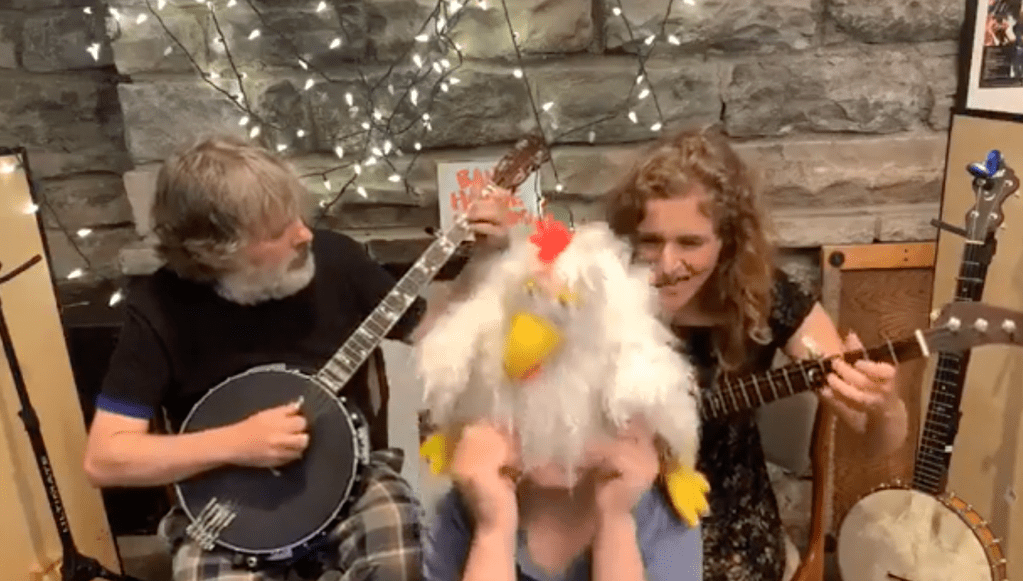
Dar said her set list tonight was put together by her manager Patty, who was celebrating her birthday. So I don’t know if it was Patty or Dar or both of them who were in a particularly contemplative mood when they decided on the songs. With one exception, what Dar played were among her most somber songs. I get it. We’re living in a serious moment. But it was a little surprising because the other live-from-home concerts we’ve seen have been a bit more buoyant and reminiscent of a regular live show in terms of the variety of music. Béla Fleck and Abigail Washburn‘s Friday night Banjo House Lockdown tends to be particularly joyful and lighthearted as their sons–seven-year-old Juno and two-year-old Theo are often participants. Last week Juno jumped in front of the camera and began to dance, wearing a chicken hat, during one of the songs. Some of the Indigo Girls‘ shows from home were performances of entire albums. Similarly, Brandi Carlile is doing a series with her band where they perform each of her albums (tune in June 14 @ 9pm for Firewatcher’s Daughter).
During one of their livestreams, the Indigo Girls raised more than $200,000 for Honor the Earth, a nonprofit dedicated to Indigenous environmental issues. Brandi raised $100,000 for racial justice organizations in her first concert. She and her band have always been activists, and have their own foundation that supports people and communities. And Béla and Abigail have invited viewers to donate to a few different causes during their shows. So I was surprised when during Dar’s show tonight, a banner came across the screen that said something like, “Enjoying the show? Tips are appreciated,” and included a PayPal link. Dar also mentioned that a portion of the proceeds from the show would be given to vote.org. Dar is a good activist too. But it made me think that she must be struggling. She’s certainly a successful singer-songwriter, but not a household name. I don’t know much about what it takes for musicians to earn their livings. I definitely support them with ticket sales, buying merchandise, and buying and downloading albums, but my dollars aren’t going to pay anyone’s mortgage.
Going to hear live music has always been one of Randy’s and my favorite things to do, and we’ve missed the experience since the pandemic canceled everything. I’ve read how singing is a particularly effective way to spread Covid-19, so I have no idea what has to happen before we will be able to go to concerts again. But we have loved the intimate feeling of seeing musicians we love perform from their houses–seeing their dogs walk by and their kids dart through and just hearing what they have to say, knowing that they’re experiencing some of the same things we are. And hearing more of Dar’s sad and serious songs and knowing that she appreciates tips made me think the uncertainty of this time may be hitting her hard too.

 You Ask a Lot of Questions